
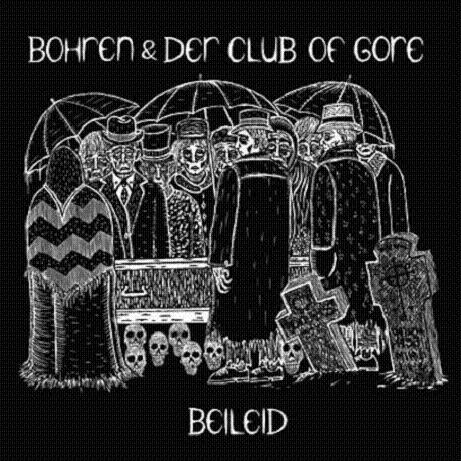
Bohren & Der Club Of Gore – Beileid (Ipecac Records)
It is undoubtedly a cliché to invoke James Riley’s quotable bit of inductive reasoning that suggests that those things that look and act like ducks necessarily belong to that selfsame category of waterfowl, but it can be difficult to resist the temptation when dealing with a band like Bohren & Der Club Of Gore. They are a group that has spent the past two decades using the instrumentation of a jazz ensemble to make music that bears unquestionable resemblances to jazz, yet is fundamentally separate from jazz itself. Theirs is music that exists in the interstices between the expectations attendant to any particular genre, a defiance of semiotic familiarity so single-minded in its aesthetic that it is difficult to think of any tidy comparisons that could be affixed.
Bohren & Der Club Of Gore – Beileid (Ipecac Records)
It is undoubtedly a cliché to invoke James Riley’s quotable bit of inductive reasoning that suggests that those things that look and act like ducks necessarily belong to that selfsame category of waterfowl, but it can be difficult to resist the temptation when dealing with a band like Bohren & Der Club Of Gore. They are a group that has spent the past two decades using the instrumentation of a jazz ensemble to make music that bears unquestionable resemblances to jazz, yet is fundamentally separate from jazz itself. Theirs is music that exists in the interstices between the expectations attendant to any particular genre, a defiance of semiotic familiarity so single-minded in its aesthetic that it is difficult to think of any tidy comparisons that could be affixed.
The band’s lineup wouldn’t be out of place on any Blue Note recording from the mid-60s or so – upright bass, Fender Rhodes piano, vibraphone, tenor sax, brushed drums – but the similarities don’t really extend much further. Jazz’s emphasis on improvisation is largely absent, the band instead favoring a grim minimalism, with tempos plodding along at a pace just slightly quicker than glacial, eschewing any sense of the swing or syncopation inherent to the genre. There are references to a variety of sources, though none offer a thorough blueprint for the band’s sound. Angelo Badalamenti’s work on the Twin Peaks soundtrack comes quickly to mind, though Bohren’s music favors a dolorous bleakness over Badalamenti’s hallucinatory noir references. The faux-jazz of early Lounge Lizards albums serves as a more general stylistic template – that of a band paying overt tribute to a genre while remaining largely outside its parameters – though Bohren’s music lacks the kitschiness of the Lounge Lizards. The band themselves readily compare their approach to that of metal’s more fringe strains, though their music, for all its sinister atmosphere, prefers a whisper to a scream. And their somewhat surprising cover of 80s hair-metal band Warlock’s histrionic power ballad “Catch My Heart,” complete with an uncharacteristically restrained vocal cameo from Mike Patton, sounds like a Chet Baker LP played at half-speed.

But unlike so many bands, Bohren are more than the sum of their similarities. Their music is atmospheric, but not in the sense that the term is normally used – that is, a music writer’s slapdash shorthand for anything spacier than, say, Radiohead. It’s redolent of the Vienna back-alleys in The Third Man or De Chirico’s empty cityscapes: a sustained meditation on foreboding and desolation with no catharsis or resolution, a monolithic evocation of long gazes into the void and sharp detours into the psyche’s darker corners. Even the album’s title, the German word for “condolence,” implies loss and bereavement – though not without the sort of sympathetic overtones that prevent its somber implications from seeming too exaggerated. It should be little surprise that something so wholly shrouded by peril and unease wouldn’t be an easy subject for summation, and while a plethora of explanations exist detailing what Bohren’s music is not, what their music is exactly cannot be captured by heavy-handed genre specificity. Rather, it is captured by the band’s ability to unsettle, and to sound like nobody else in the process.