
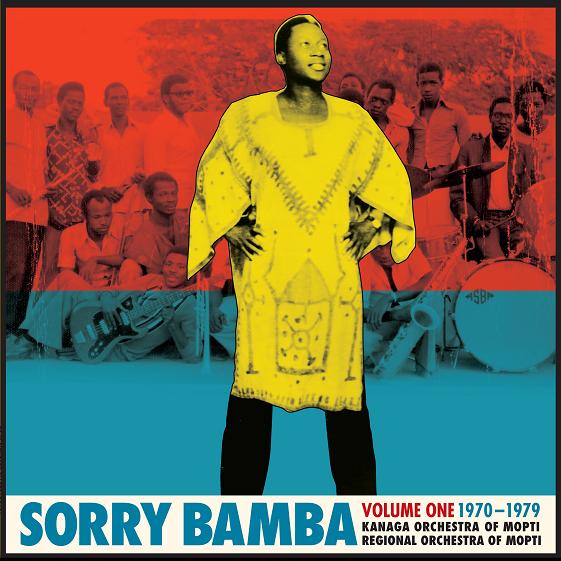
Sorry Bamba – Volume One: 1970-1979 (Thrill Jockey Records)
The past three decades or so have witnessed a wider appreciation for African music, in all of its widely-varied forms, than had ever been present outside that continent. Artists as disparate as Nigeria’s Fela Kuti and the Congo’s Konono No. 1 have all been embraced by audiences worldwide. They have helped to dispel much of the condescending Western attitudes towards non-Western music, and to garner recognition of African artists’ artistic merit based on criteria other than how well their sound can be grafted onto a Paul Simon song. There is a common tendency to view the continent’s music as some monolithic foreign entity, when in reality there are a wide variety of aesthetics that are consistently characterized by a give-and-take relationship with other cultures, African and otherwise. The amount of hip-hop, reggae, metal, psychedelia, punk rock, and electronic music coming from Africa might surprise listeners less familiar with the continent’s recent artistic history. But what the artists do with the music is often even more surprising, as the styles undergo drastic permutations that constantly evolve to fit the tempestuous and ever-shifting social, cultural, and political landscapes surrounding their creation.
Sorry Bamba – Volume One: 1970-1979 (Thrill Jockey Records)
The past three decades or so have witnessed a wider appreciation for African music, in all of its widely-varied forms, than had ever been present outside that continent. Artists as disparate as Nigeria’s Fela Kuti and the Congo’s Konono No. 1 have all been embraced by audiences worldwide. They have helped to dispel much of the condescending Western attitudes towards non-Western music, and to garner recognition of African artists’ artistic merit based on criteria other than how well their sound can be grafted onto a Paul Simon song. There is a common tendency to view the continent’s music as some monolithic foreign entity, when in reality there are a wide variety of aesthetics that are consistently characterized by a give-and-take relationship with other cultures, African and otherwise. The amount of hip-hop, reggae, metal, psychedelia, punk rock, and electronic music coming from Africa might surprise listeners less familiar with the continent’s recent artistic history. But what the artists do with the music is often even more surprising, as the styles undergo drastic permutations that constantly evolve to fit the tempestuous and ever-shifting social, cultural, and political landscapes surrounding their creation.
The music of Mali provides no exception. After achieving independence from France in 1960, the country strove to fit itself into post-colonial African culture through a variety of means, not least of which was a higher regard for the role of the artist and musician in society. One could easily contrast Malian guitarist Ali Farka Toure’s role as a touring musician and his subsequent election as mayor of Niafunké with, for instance, the Nigerian government’s long-standing persecution of a musician as widely visible as Fela Kuti or the Ethiopian government’s censorship of the arts during Mengitsu Meriem’s regime. This contrast acts as evidence that Mali placed a considerable amount of stock in its creative sector in terms of the cultural aspect of constructing a national identity. Granted, there are exceptions – that same nation-building process that aspires to incorporate cultural elements into a singular entity is exclusionary by nature. The ossified borders of the nascent country led to Mali’s systematic campaign of persecution towards the nomadic Tuareg groups, a process that has not only initiated violent uprisings that occur to this day, but has marginalized their cultural achievements. It remains to be seen whether the international success of Tuareg musicians like Tinariwen or the Nigerian Tuaregs in Group Inerane will help forge inroads to wider cultural acceptance.

One of the means that the Malian government used to promote this new-found sense of cultural identity was through officially-sponsored concerts and competitions featuring orchestras comprised of each region’s most promising young musicians. One of the most successful, the Regional Orchestra of Mopti, was formed by band leader Sorry Bamba, and between 1968 and 1981 earned the grand prize in these biennial competitions on multiple occasions. Some incarnation of the group had existed since 1957, when the young Bamba assembled Group Goumbe. Group Goumbe were little more than some percussionists and a trumpeter, but the group would thrive after Malian independence, through the integration of traditional Malian music with elements of jazz, afro-Cuban elements, and eventually funk and hints of psychedelia. It was an ideal aesthetic for a fledgling nation attempting its first wobbly footsteps on the world stage, but unlike many of his contemporaries, whose work can appear dated when viewed through the unforgiving lens of hindsight, the music Bamba recorded during this era stands the test of time exceedingly well, due in no small part to its experimental spirit.
Like the majority of bands from the early Afrobeat era, the emphasis isn’t squarely placed on any instrument or single facet of the sound, instead favoring interlocked polyrhythms that occasionally let slip some distinctive embellishment. It is often these individual elements that help distinguish the material, though – individual flutes and horns will take solos, keyboards occasionally make their presence known, Bamba’s nasal voice rings over top of it all – but the element most consistently utilized for this purpose is the guitar. This is hardly surprising; much of Mali’s musical history has been characterized by the instrument or its antecedents, from the ngoni that survives from antiquity (the migration of which, via the Middle Passage, led to its subsequent influence on the development of the modern guitar and banjo) to more recent artists like Ali Farka Touré and his progeny, or the typically guitar-based musical acrobatics of more recent Tuareg groups. The guitar work on these recordings varies in its approach, understated and interwoven with the other musicians in some songs – “Boro” and “Poory” (an excerpt of which had previously appeared on the excellent West African compilation Love Is A Real Thing some years ago) being good examples – but can just as easily let loose, as shown by the flamboyant distorted solos in “Bayadjourou.” The majority of these songs walk a middle course, however, with airy, lightly psychedelic guitar leads underpinning and accentuating the work of the larger ensemble.
There are some non-Malian influences at work in the songs – some jazz in the horn solos, the aforementioned psychedelia in the guitars, hints of the Cuban influence that was popular in West African popular music before nationalism pushed an agenda focused more on a localized cultural identity – but the material tends to draw less directly from Western influences than many of Bamba’s peers, despite the presence of such disparate elements. As a result, the material is more distinctive – a product of its influences without seeming derivative, mellow without seeming slow-paced, a distinct reflection of a place and time that doesn’t seem dated. It maintains a mood, not remotely somber but not quite jubilant either, more of a stately reserve that prevents the songs from falling into any sort of predictable pattern. While the aesthetic of artists like Bamba might seem far-removed from present-day Western listeners, recordings like these can go a long way towards encouraging the understanding that – despite the geographical, cultural, and temporal divide – music like this is as relevant and compelling here and now as it was in Mali four decades ago.