
When I was still a teenager, my grandfather (who was suffering from advanced dementia) moved in with my mother, my siblings and I.
When I was still a teenager, my grandfather (who was suffering from advanced dementia) moved in with my mother, my siblings and I. He had spent the last year or so in a home for the elderly where he was neglected and severely injured. Based on the arbitrary date that the doctors had set for the remainder of his life, my mother felt that we could all sacrifice and pitch in to make him just a little more comfortable during his last days. Those days turned to weeks, then months and before I knew it he had been with us for nearly three years. I learned a lot about a lot of things in that time. I learned that my grandfather was a decorated veteran of three wars. I learned about compassion and that sometimes it’s okay for men to cry. Most of all, I learned that a person suffers from dementia but it’s the people who love that person who end up suffering the most.
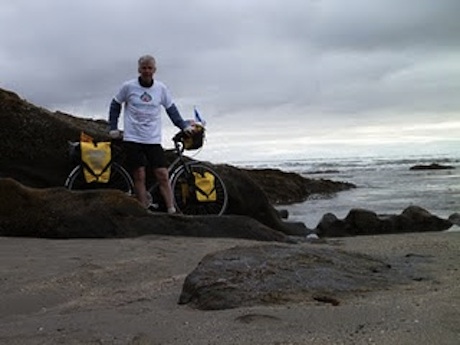
When Iain Duffus (of Grape Cloth) contacted me to interview Andrew Dickson about his efforts to raise awareness for Alzheimer’s, I agreed. I sat down with Andrew at Third Street Diner to learn more about his bike ride across America.

You’ve been biking across country to raise awareness for dementia. Most people only think that dementia effects old people. Why should our readers care?
Whilst dementia, in one form or another, generally affects older members of the population, it is not exclusively connected to this age group. In fact dementia can be diagnosed in young children. It is the case however, dementia affects a proportionally higher percentage of the population in the older the age groups.

The non-profit you represent is Alzheimer’s Scotland, whats the difference between Dementia and Alzheimer’s?
Dementia is the all encompassing word use to described a loss of brain function, ie memory, problem solving and cognitive ability, above what is generally associated with the aging process. Alzheimer’s is a specific disease which causes such loss of brain function. Alzheimer disease is probably the most common dementia and is certainly the best known. Dementia can also result from other illnesses, such as Multiple Sclerosis and Parkinson’s disease where the individual also suffers a loss of brain function. Other factors such as excess alcohol/drug use and brain trauma can sometimes result in a dementia diagnosis in later years.

Is there a link between riding a bike and preventing dementia?
There is no specific link between cycling and dementia. I simply enjoy riding my bike. It is generally accepted however that a healthy lifestyle helps in reducing the chances of suffering from a dementia related condition. As such, a nutritious and health diet, regular physical exercise, mental stimulation and social contacts should all provide positive benefits to overall health as well as dementia prevention.

Where did you start, how many miles have you traveled so far and where does your journey end?
My trip commenced on the 3rd May when I arrived in Seattle. I then cycled out to Cape Flattery on the Pacific Coast near the Olympic mountains which I consider to be the official ‘start’. I have since traveled through Washington, Idaho, Montana, Wyoming, Colorado, Nebraska, Kansas, Missouri, Illinois, Kentucky and will shortly reach my ‘end’ location on the Atlantic coast here in Virginia. I will then cycle north to Washington DC for my homeward flight to Scotland at the end of July. My trip from the Pacific to the Atlantic will be very close to 4000 miles but my overall mileage between Seattle and Washington DC will be 4,500 miles.

That’s a long trip, you must have been touched pretty deeply by dementia. Would you be willing to share you experience?
I have two connections with dementia. Firstly, my wife Aileen, at the age of 48, was diagnosed with dementia in 1999 along with another condition. I cared for Aileen at home and as a result became aware of Alzheimer Scotland and in particular their Early Onset Support Service which provides one-to-one home support for younger people who have dementia. Very sadly Aileen’s decline was rapid and she lost the struggle in 2005. As a consequence of my experiences, I currently work part-time for the Early onset Support Service. Secondly, my mother was diagnosed with dementia over ten years ago. Despite the condition, she was able to retain a degree of independence within supported accommodation, with additional regular visits from myself to deal with shopping, bill payments and banking etc. In 2010 at the age of 91 she move to a nursing home allowing me the opportunity to undertake this trip.

Your Scottish and your blog says that you are doing this to increase awareness of Dementia and hopefully raise money for Alzheimer’s Scotland. Why did you choose to bike across the US and not the British Isle?
I’ve visited the United States on vacation some 6 or 7 times over 30 years and have enjoyed every experience. Aileen and I actually cycled from New York to Virginia some 20 years ago and in 1999, just after her diagnosis, we drove from California to Virginia. The distance involved in my current trip also created a true, long distance challenge, taking in 10 States I’ve not previously visited. It also allowed me to see the Olympic, Cascade, Rocky and Appalachian mountains, Yellowstone and Grand Teton national parks and cross the Mississippi, Missouri and Ohio rivers. As a consequence, a trip from the Pacific to Atlantic oceans seemed a very obvious choice.

What type of hospitality have you enjoyed on your journey here in the states?
Whilst some of the sights I’ve seem can only be described as spectacular, the most memorable feature without doubt, has been the warmth, kindness and generosity of all the folks I’ve met. I cannot recall anything which might be described as a bad or negative experience. I’ve been invited into people’s homes to stay overnight, provided with meals, given donations for Alzheimer Scotland and went to see the Seattle Mariners vs the Chicago White Socks. I have also felt perfectly safe, despite traveling alone in environments ranging from very remote to inner city.

How do you feel that would be different if you where in Scotland?
I’d hope someone traveling to Scotland would encounter equal hospitality and in fact, I’ve spoken to several people who have undertaken a visit to the United Kingdom, who experienced similar hospitality to my own over here in the United States.
Statistically, are Americans more likely to suffer from Dementia, if so, why do you think that is?
I’m not in a position to provide statistical comparisons but I’d imagine the situation between the United States and United Kingdom are comparable due our respective lifestyles being similar. As previously mentioned, lifestyle can influence the incidence of dementia and as a consequence good diet, physical and mental exercises and social contacts seem to have positive effects. Sadly however, it is the case that dementia affects proportionally more people in the older age ranges and with our increasing life expectancy, it is probable greater numbers of people will receive a diagnosis of dementia in future years. As a consequence, the proportion per head of population will inevitably increase. Whilst there is considerable research currently being undertaken worldwide, I think it’s fair to say a cure for any of the dementia conditions is not yet on the horizon.
You’ve covered a lot of ground and I bet you’ve met some interesting people along the way. Any cool stories you’d like to share?
As previously mentioned I went to my first baseball game during the first week of the trip. I also had the pleasure of linking in for a few days with the Biking Across Kansas event which involved some 800 cyclists crossing the State. I’ve been interviewed by one local cable TV news outlet and two local newspapers. The Church of Ascension in Mount Sterling, Kentucky invited me to give a couple of talks to the congregation and I also had the opportunity of speaking the children/young people at Cathedral Domain, a summer camp also located in Kentucky.

Your trip is almost over, do you plan on continuing your efforts to raise awareness of Dementia?
On returning to Scotland I hope to give talks about my trip to various groups, with contacts also being made to businesses and other organizations. And I’ve no doubt another long distance bicycle trip will feature in the years to come. I would also urge anyone reading this article to consider carrying out a fundraising event of their own, to raise much needed financial support for U.S. based dementia charities.
Where can people go to learn more about dementia, your journey and donate to your cause?
The internet is probably the most accessible source of information. For those who do not have a computer at home, their local library will almost certainly have internet access. All libraries should also have relevant books on the subject. There are also several foundations and societies based here in the United States who can provide information. I believe the majority have easily accessed websites and some can be contacted by telephone toll free. Local health centers will also hold leaflets on dementia.
In my own case, I am raising funds for Alzheimer Scotland (www.alzscot.org) and my adventure can be followed on-line at BIKING ACROSS AMERICA. Donations to my cause can be made to HERE

