
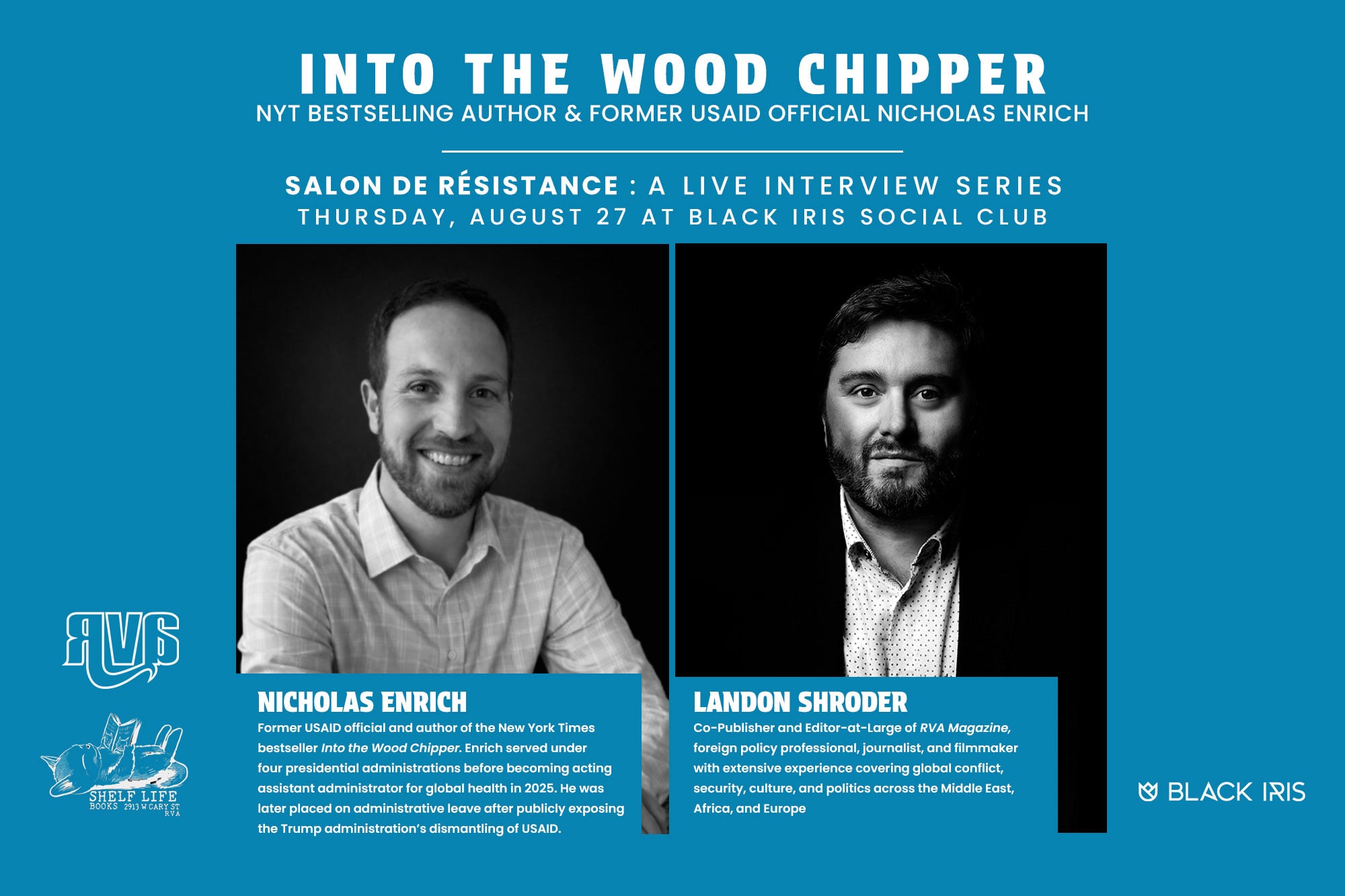
Join us for a special edition of Salon de Résistance on Thursday, August 27 at Black Iris with former senior USAID official and whistleblower Nicholas Enrich, author of the New York Times bestseller Into the Wood Chipper: A Whistleblower’s Account of How the Trump Administration Shredded USAID. Presented in collaboration with Shelf Life Books, this salon is free and open to the public.
Doors at 6pm. Conversation at 7pm. Event page here.
Not all acts of government are final. Budgets can be restored. Policies reinstated. Laws reversed. Wars ended. Institutions can be reorganized.
But the dead can’t be brought back.
When Trump and Elon Musk began dismantling USAID under DOGE in early 2025, the argument was framed around efficiency, waste, and cost-savings. But those claims were nebulous at best and outright nefarious at worst. They were part of an ideologically driven campaign that tapped into decades of resentment toward foreign aid, wrapped in the language of America First.
For more than 60 years, USAID was the frontline. The work was pragmatic and necessary: vaccines reached clinics, food found communities before famine, public health systems were strengthened before local diseases became global ones, while democracy and peace building initiatives secured our national security interests abroad.
But then overnight it was summarily dismantled. Programs were frozen. Contracts canceled. Foreign Service Officers and administrators were fired and publicly vilified. Organizations that spent decades building global networks to combat humanitarian crises couldn’t find funding. By the end of 2025, 90 percent of USAID’s global grants had been terminated.
As a result, hundreds of thousands of people have died globally. A moral choice made for the American people without consultation or conversation.
Those consequences were not theoretical. They were real. Nicholas Enrich understood that better than most having spent years inside USAID, eventually becoming the agency’s Acting Assistant Administrator for Global Health. But as the agency’s dismantling accelerated, Enrich chose to stand on principle, becoming one of the first senior officials inside the government to publicly document what was happening—he became a whistleblower.
Through memos and internal records shared with major media outlets, his disclosures helped expose the consequences of DOGE’s assault on USAID and directly contributed to hundreds of lifesaving aid projects being restored. A principled stand that ultimately led to his administrative leave and eventual termination.
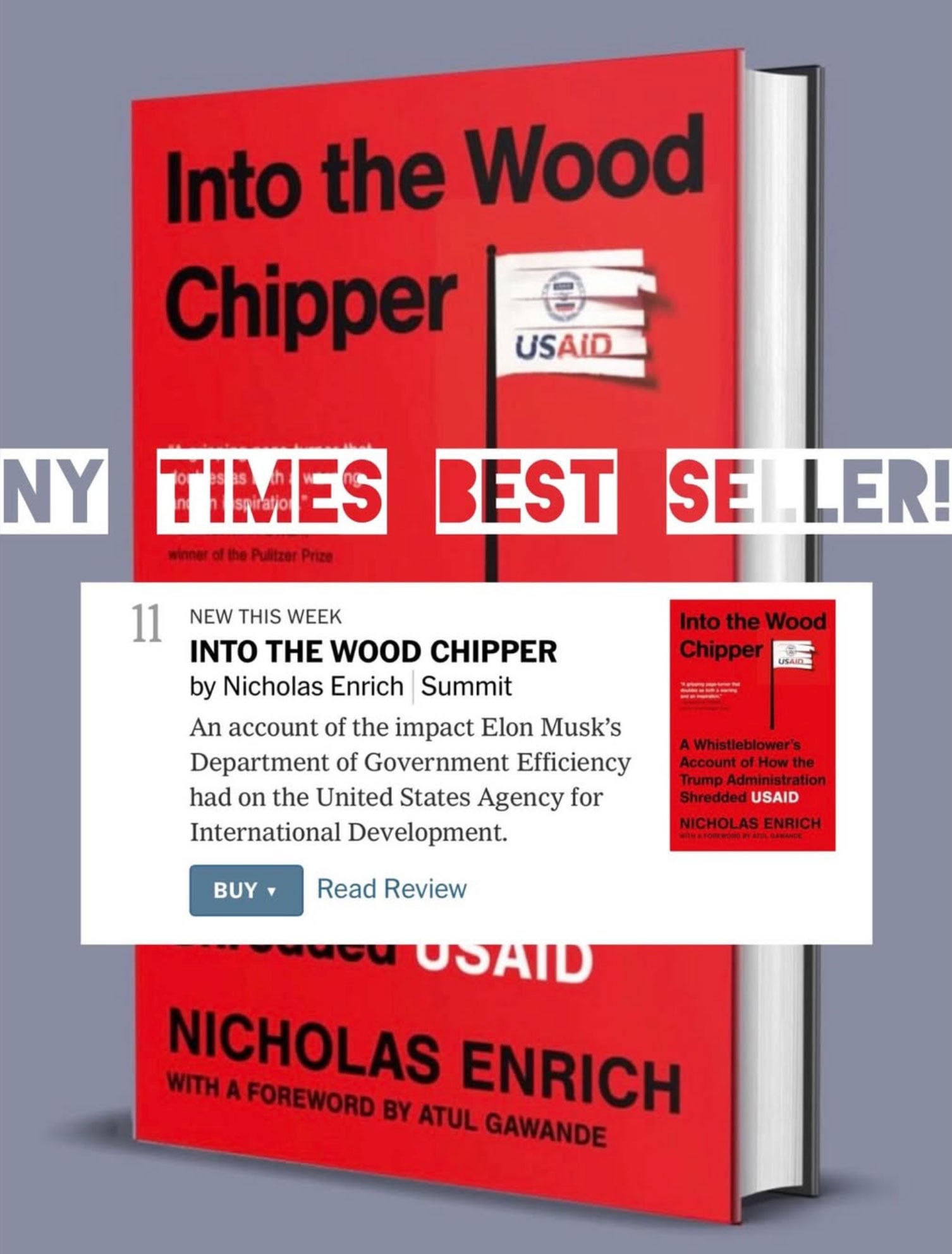
The result of this experience is Into the Wood Chipper, his NYT best selling account of USAID’s destruction from inside the agency. This salon, however, is not just about what happened to USAID. It’s also about what happens when government leverages an ideological position in a political war on itself.
We need to talk about it
For this edition of Salon de Résistance, we’ll sit down with Nicholas Enrich for a rare one-on-one conversation about the dismantling of USAID and what it looked like from inside the agency as it happened. We’ll talk about how humanitarian aid and development actually worked and why those programs were directly linked to American prosperity.
We’ll also confront the human and moral cost of abandoning the world’s most vulnerable and what it says about us — as Americans — when the most prosperous and powerful country in the world decides that responsibility no longer matters. And then we’ll ask the larger question hanging over Enrich’s story: if government can destroy its own capacity to serve the vulnerable in the name of “efficiency” what’s the actual role of government in 2026?
your guest
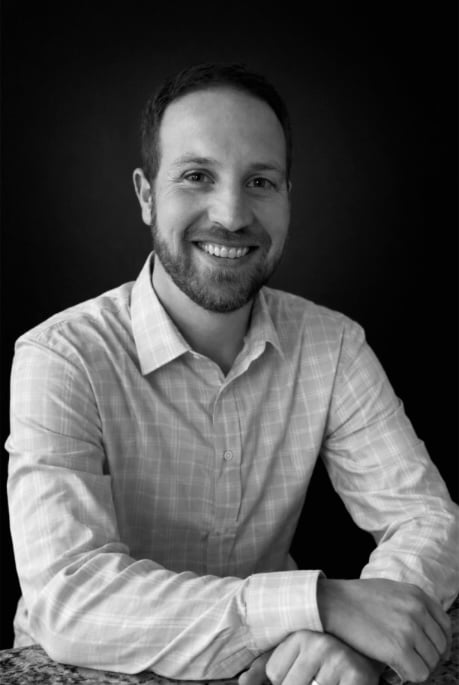
Nicholas Enrich is the author of the New York Times best selling book, Into the Wood Chipper: A Whistleblower’s Account of How the Trump Administration Shredded USAID. He is a former civil servant who worked at USAID under four administrations. He served as the Bureau of Global Health’s director of policy, programs, and planning until January 2025, when he was designated as USAID’s acting assistant administrator for global health. On March 2, 2025, he was placed on administrative leave for exposing the Trump administration’s illegitimate and dangerous dismantling of USAID, and was removed from federal service later that year.
Enrich’s prior roles at USAID included leading the Critical Coordination Structure in the Bureau for Management, and the Tuberculosis Program Team Lead in the Office of Infectious Diseases in the Bureau for Global Health. Prior to joining USAID, Nicholas served as a Presidential Management Fellow in the U.S. Department of Housing and Urban Development. He holds a J.D. from Brooklyn Law School and a B.A. from Tulane University.
Your host
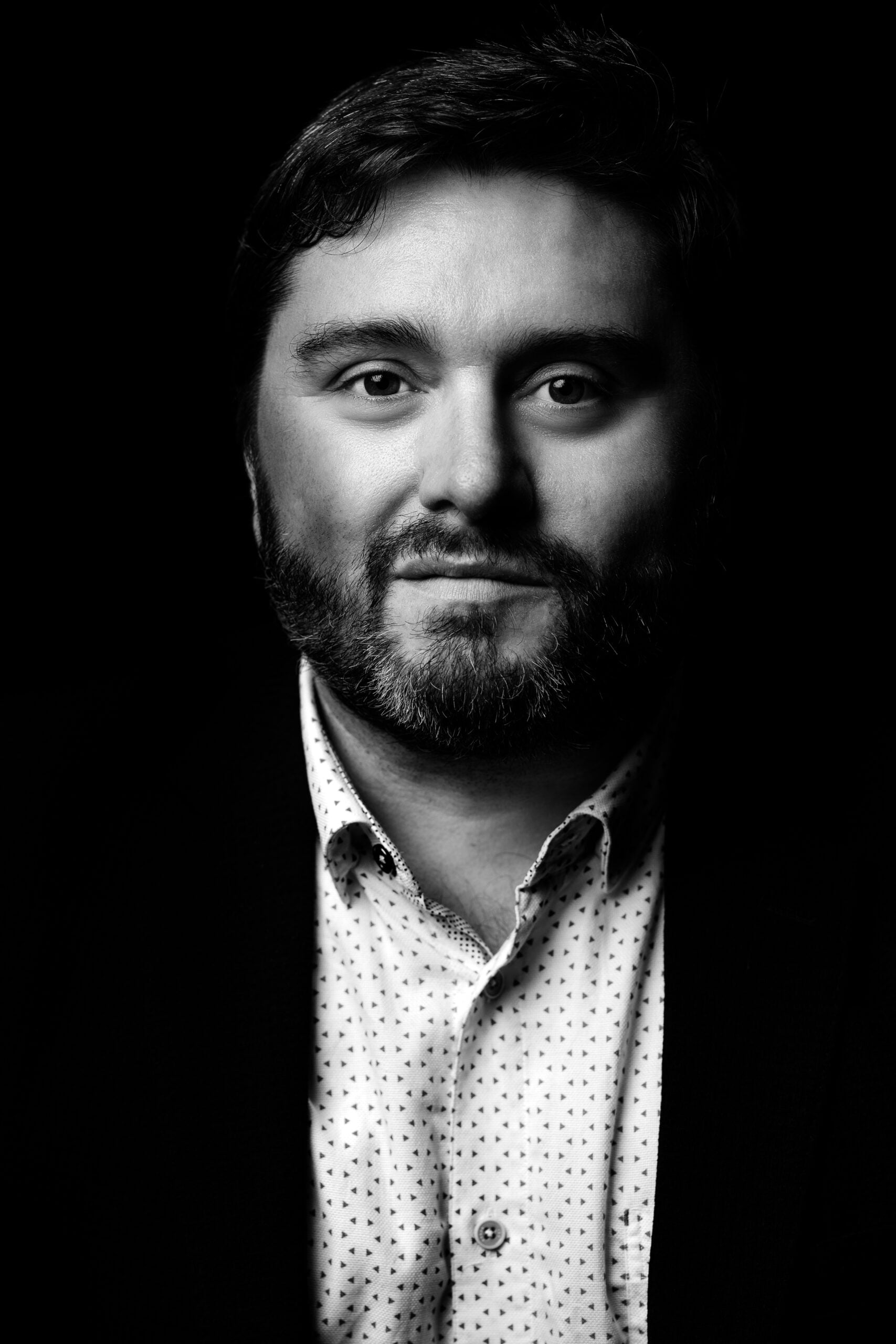
Landon Shroder, is the co-publisher and editor-at-large of RVA Magazine. He is also a foreign policy professional, communications strategist, and filmmaker whose career has spanned over twenty years across the Middle East, Africa, and Europe in the humanitarian, energy, defense, and security sectors.
His documentary feature The Soft Revolution, on the federal firings under DOGE, is set to premiere in late 2026, and his upcoming film Cosmic Echo, about the life and legacy of revolutionary jazz icon Lonnie Liston Smith is currently in production. A former producer and journalist for VICE, he has written extensively on conflict, culture, and politics for outlets including Fair Observer, War on the Rocks, World Policy Journal, Chatham House, and, of course, RVA Magazine. He has also been quoted extensively in The New York Times on conflict in the Middle East.
Salon de Résistance unfolds in three movements: a convergence to begin, a conversation to spark, and a reflection to carry the ideas forward.
6:00pm: Convergence
Drinks and shared conversation, set to vinyl flips.
7:00–8:30pm: Conversation
A live interview then opening into questions and exchange with the room.
8:30pm: Reflection
Space to connect with our guests, develop perspectives, and imagine what comes next.
Support RVA Magazine. Support Independent Media in Richmond.
RVA Magazine has remained one of Richmond’s few independent voices. Since 2005, we have provided grassroots coverage of our artists, musicians, and communities, marginalized or otherwise, documenting the city’s culture that lies right under the surface and beyond the headlines.
But we can’t do this without you. A small donation, even as little as $2, one-time or recurring, helps us continue to produce honest, local coverage free from outside interference. Every dollar makes a difference. Your support helps keep us going and keeps the local creative spirit alive. Thank you for standing with independent media, and thank you for reading.
Show your SUPPORT HERE
Also, subscribe to the newsletter HERE
We’ve got merch HERE
Subscribe to the Substack HERE
And Reddit HERE
And YouTube HERE