
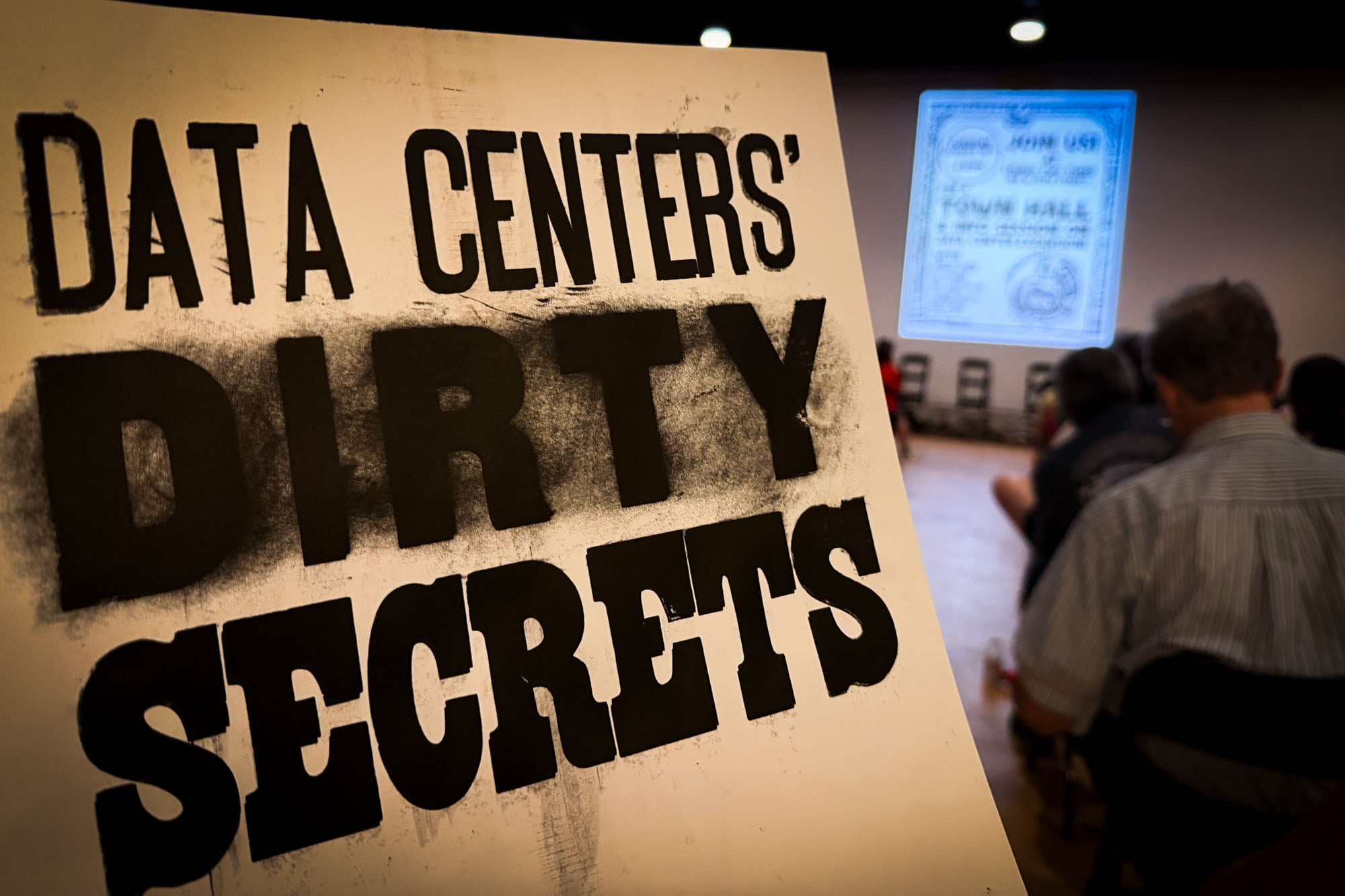
On Monday night, close to 300 to people packed into Studio Two Three in Richmond for a town hall about data centers, moderated by Gray Montrose and co-hosted by Henrico Civic Action and Data Center Defiance.
I went to get a better sense of where Richmonders are from the activist side, and to better understand the issue myself. Virginia has spent years building the largest concentration of data centers in the world and the decisions being made now will affect all of us for decades to come.
Speakers came from the Sierra Club Virginia Chapter, Friends of Hanover and Stop Hanover Data Centers, Data Center Defiance, The Brockovich Report and The Balm in Gilead.
This wasn’t a room full of people complaining about data centers as almost everyone there seemed aware of the issue at this point. This was more of a community conversation about how to get organized and, ultimately, how to stop these projects, or at least force more public input.
“We keep hearing we’re not mad enough,” moderator Gray Montrose told the crowd near the beginning of the night. “I think everybody in this room is pretty mad, but we’re learning a lot more details about why.”
You Can’t Fight What You Can’t See
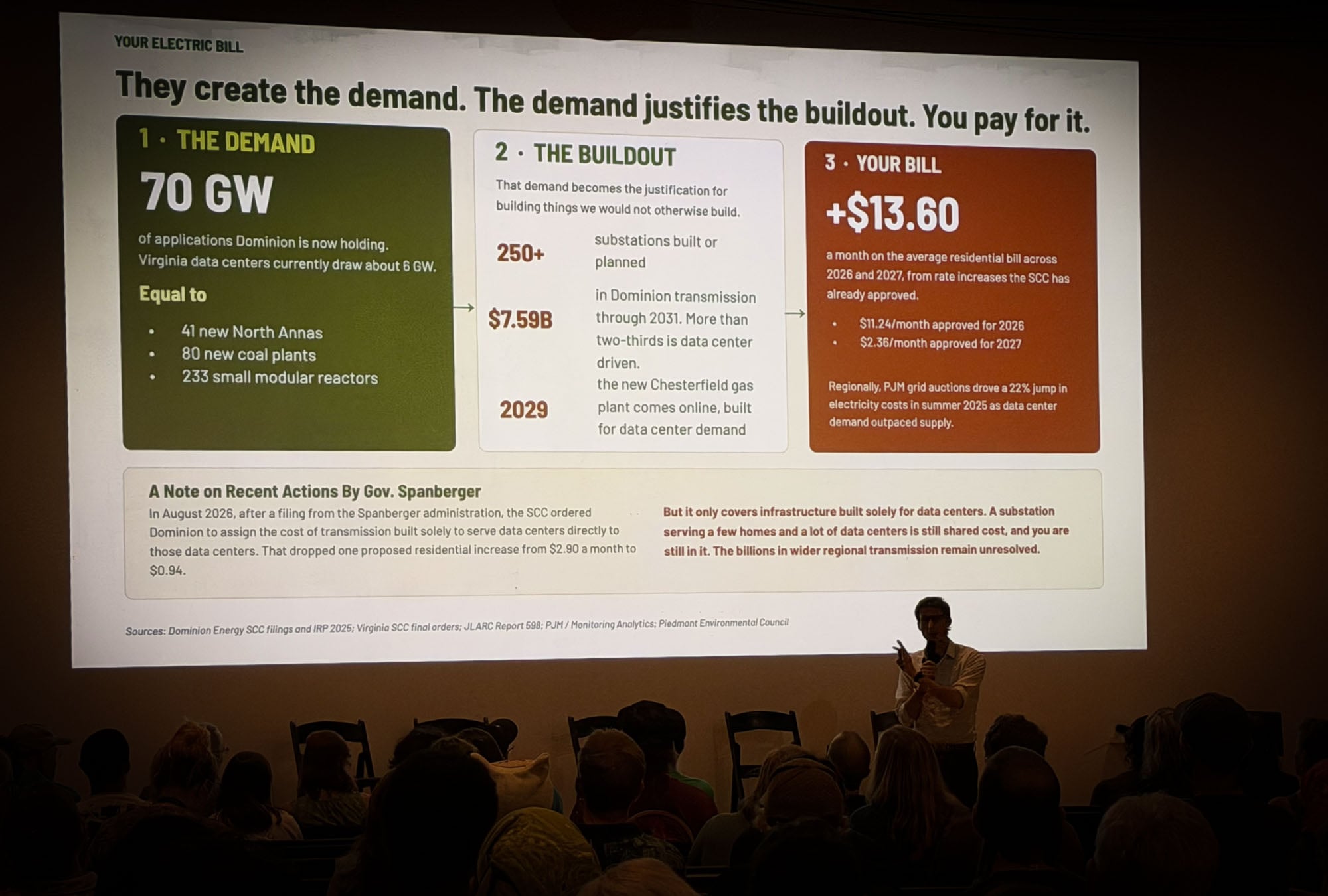
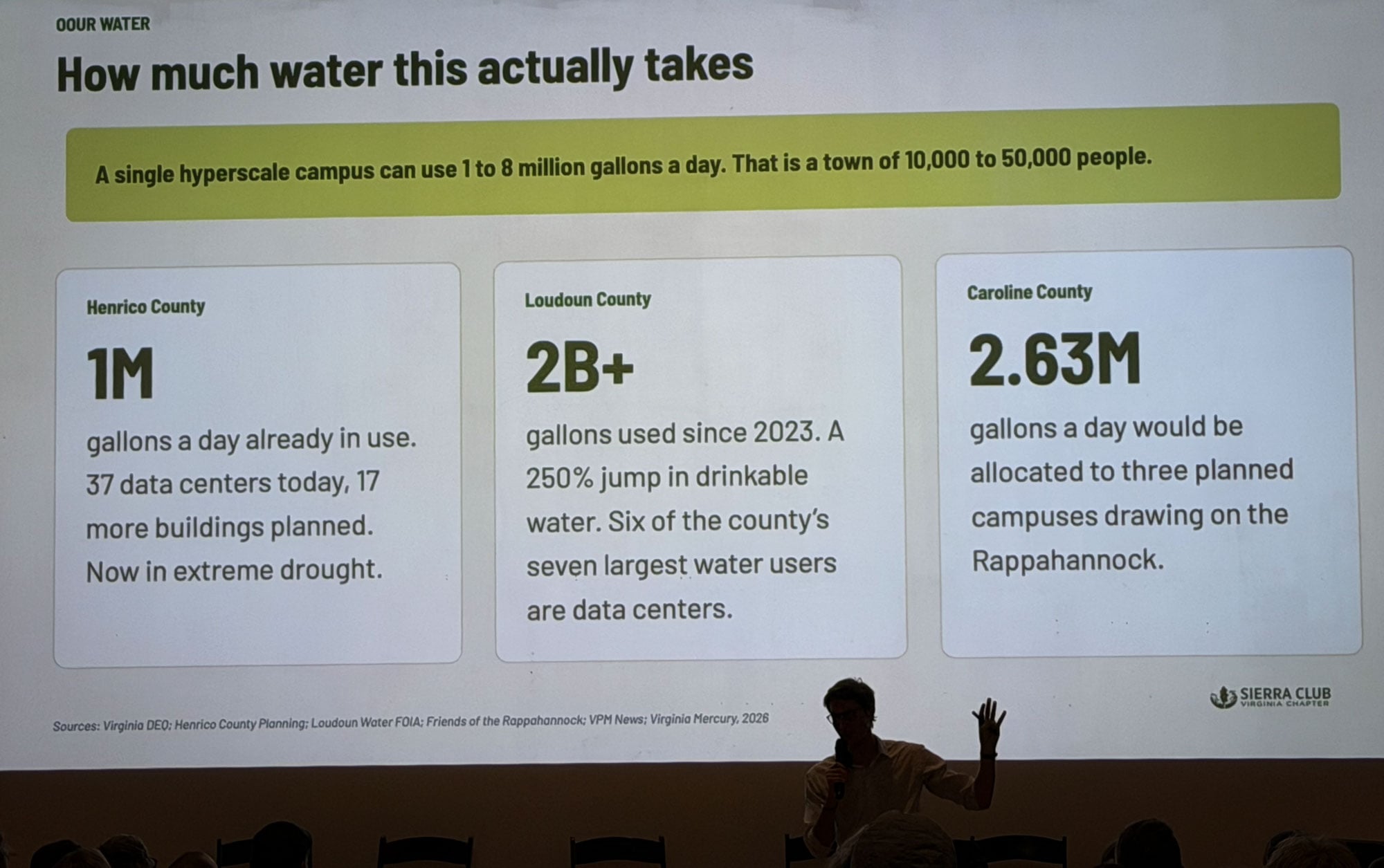
Tim Cywinski, who works on data center resistance efforts with the Sierra Club Virginia Chapter, started with where we are now and has been working on the issue for about five years. During that time the conversation around data centers has changed as more people became aware of the industry’s impact statewide.
“Five years ago, it was these things make the internet work. How could this be hurting us?” Cywinski said. “So let’s move from the conspiratorial back then to sounding the alarm to the holding point that we’re at right now.”
Cywinski admitted he never expected to become an expert on the subject. “I did not go to college to be a data center expert, and here I am,” he said. “Because once we looked under the hood of it, it was kind of like, this is actually really bad.”
“We know it’s at least 500-plus,” he said, but even getting an accurate count is difficult. His presentation was put together a few months ago and, he admitted, were probably already outdated. This gave everyone in the room a sense of just how quickly the industry is moving.
That fed into his larger point that Virginia has made itself attractive to the industry, helping fuel a massive boom without establishing adequate statewide rules governing where these facilities can go or what resources they can consume.
“They come to Virginia because we make it easy for them,” Cywinski said.
And part of the problem, he argued, is that data center development often arrives in what he called a “black box” created by non-disclosure agreements. “It’s not just your local leaders that sign the NDA,” Cywinski said. “Sometimes it’s just one person at the Economic Development Authority, and then the rest of the county has to adhere to it, so they say.”
For Cywinski, that lack of information puts residents at a disadvantage before a fight over a project even begins. “We’re already on our back leg. You can’t fight what you can’t see.”
“There’s no universal safeguards. Not at the federal level, not at the state level, and most of the time, more times than not, at the local level,” he said. “How much water can be used? No standard. How close can it be built to people’s homes? No standard.”
Cywinski argued that the enormous demand on both water and electricity from the largest hyperscale data centers was driving the need for new substations, transmission lines and power generation, with some of those costs ultimately being paid by us.
He did acknowledge recent moves by Gov. Abigail Spanberger to require data centers to shoulder more of the infrastructure costs directly tied to their facilities.
“Step in the right direction,” Cywinski said. “We need more.”
Then the conversation moved to what has been learned in fighting them.
Grow Tomatoes, Not Data Centers
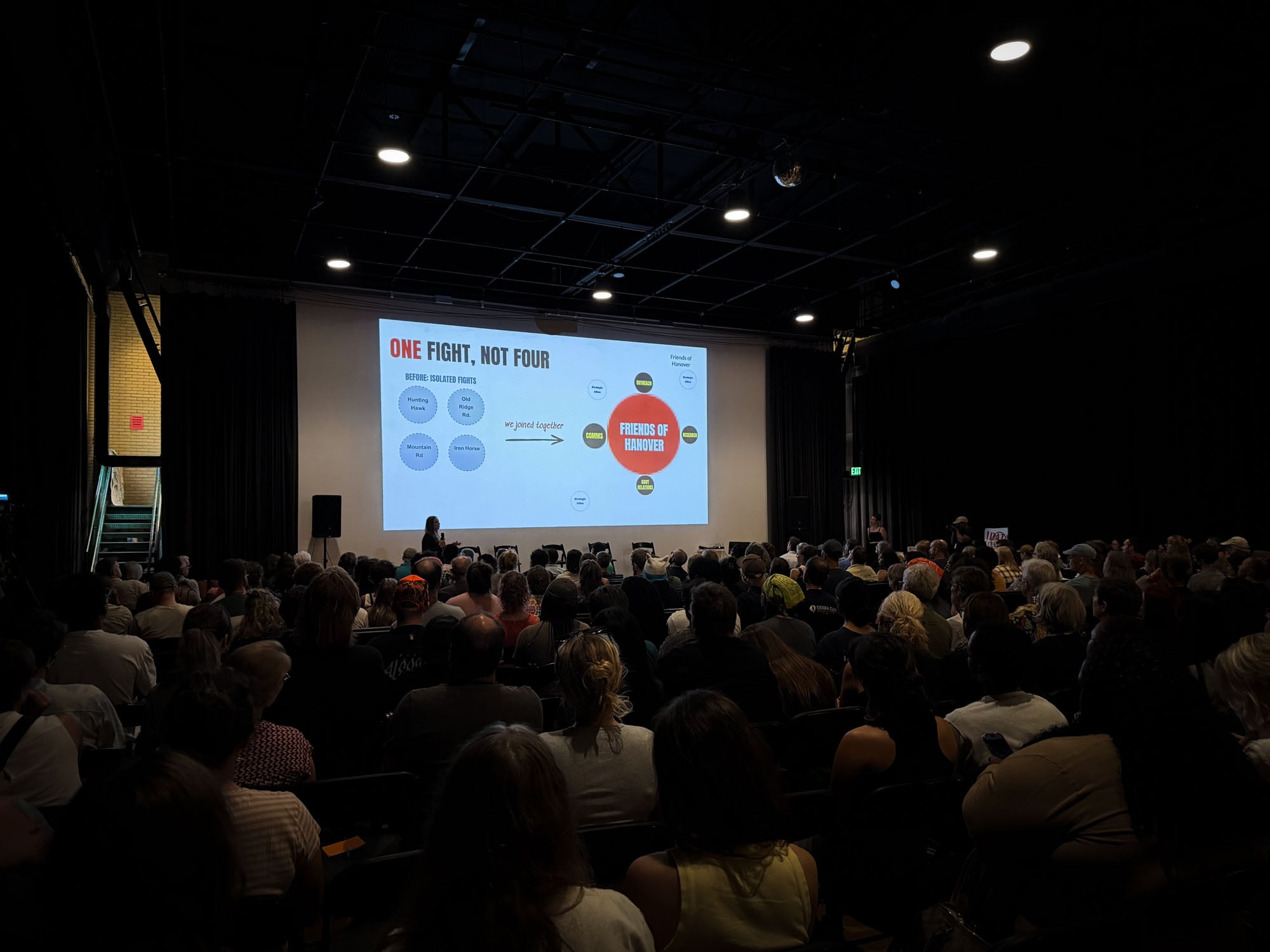
Then Jennifer Corpus, a founding member of Friends of Hanover and Stop Hanover Data Centers, told the story of what has happened in Hanover over the last nine months and how it started, as many good things do, with a couple of people talking in a library.
Corpus had been talking with another organizer involved in fighting a proposed quarry when the subject of data centers came up.
“Maybe when we’re done fighting the quarry, maybe then we could fight data centers,” she recalled.
Then came a community meeting over the proposed Hunting Hawk data center, and the Hanover Facebook groups exploded.
“Everyone is just so worried about the water, about the impacts it’s going to have, and just the fact that it’s a precedent,” she said. “We’re like, if we let this one in, how many more will follow?”
“I don’t think we can wait,” she remembered telling another organizer after the Hunting Hawk community meeting. “Everyone is mad. This is the time. We got to organize people. Like, the time is now.”
At that point, she said, nearly 4,000 acres in Hanover were either already approved or proposed for industrial development, including several data center projects. The group started small and without much time to figure out exactly what they were doing.
“When you’re thrust into something as crisis mode, you’re fighting something actively in crisis. You just jump in headfirst,” she said. “We didn’t necessarily have time to train a whole bunch of people and form teams or build anything else. We were just like, okay, we need to be able to make quick, nimble decisions on the ground. We’re fighting this now.”
From the beginning, Friends of Hanover also made a conscious decision not to let the fight become partisan.
“We knew that this was not a partisan issue,” she said. “From the get-go, we were like, okay, this is not political. We can’t let it get political. We just are all in this because we love the land, we love the water. I mean, we need to survive. We love wildlife, and these are all common things that humans love and benefit from protecting.”
After residents organized against Hunting Hawk, the developer withdrew the proposal. It was a win, but organizing was taking its toll. She described their small group as “eating, breathing and drinking data centers.”
They quickly realized they needed to organize better if they were going to keep fighting these projects, and began turning a small group responding to one proposal at a time into something that could grow and continue.
This Is How We Win
Friends of Hanover stopped operating as a handful of angry residents and started dividing the work.
They created a government relations team to meet individually with supervisors.
“These are your diplomats,” Corpus explained. “They’re not going to the meetings and yelling at people. They’re not angry. They’re going in and they’re doing what the developers do, which is, you know, you sit down, you grab a coffee with your board member, and you take a fact sheet and you explain to them. You talk to them rationally and calmly, and, you know, like they’re a human, which sometimes we forget that they are.”
Then there were researchers.
“Then we had our researchers. These are our technical folks,” she said. “They were going in, they were looking at the site plans, they were analyzing the traffic impact analysis, and then they were translating it into, like, normal people speak for the people who don’t have technical minds.”
Then there were the communications people, who took what the researchers found and turned it into something the broader community could understand.
“Those comms people were using social media to get the message out to the public,” she said. “They’re making it in a digestible format, so that people can say, ‘Oh, I understand what’s going on. I understand why it should be stopped. I know where things are at in the process, and I’m going to show up to these meetings.’”
The outreach team took that information directly into the community.
“They table at events and they went canvassing so that, like, suburban neighborhoods near these projects actually know that there’s a data center going up across the street,” she said. “They did flyering, and they just put a lot of work into getting the message out there.”
Finally, the group relied on what Jennifer called its “strategic allies,” including organizations such as the Sierra Club and other groups whose work aligned with theirs.
“So many of these folks whose groups align with ours have been able to show up and support us when we need extra support,” she said.
And she acknowledged that the structure is still a work in progress but every time the organization joined another local fight, Jennifer said, some of the residents they helped stayed around.
“People were like, ‘Wow, you saved our home. Now we’re going to help you save someone else’s.'”
Then came Mountain Road.
“The cards were stacked against us, honestly,” Jennifer said. “It was written into the small area plan. It was written into the county’s comprehensive plan. It said data centers are a permissible use for this area, and there were a lot of people who said, ‘This is a done deal.’”
“Honestly, it really felt like it was a done deal,” she continued. “The Planning Commission approved it six to one. They recommended it for approval. That was a huge blow to the group’s morale because we’d been working on this for months and months and months.”
By the night of the final vote, even Jennifer was preparing for the possibility that they had lost.
“We were like, ‘Well, at least we did the best we could,’” she said. “We did a darn good job making this a less bad project. Obviously, we don’t want it, but realistically, if it’s going to go in, we want it to be less bad.”
After hours of public comment, she stood in the back of the room listening to supervisors discuss the project.
“We’re standing in the back, listening to the Board of Supervisors all say why the project was great,” she said. A neighbor who lived near the proposed project finally told her he couldn’t watch anymore and left.
Then the final supervisor began speaking.
“He was talking about all the positives, the data center work in the county, and then he paused and started talking about the negatives,” she said. “And we were like, ‘Is he gonna vote?’ And we all just kind of paused, and the whole room paused.”
The vote was 4-3 against the project.
“This was really a testament to what happens when neighbors band together and they stop fighting each other and they start fighting for each other,” Jennifer said. “This really was a countywide effort.”
“It’s hard to point to any one thing and say this is the thing that worked, but we tried everything, and because of that, that data center got voted down,” she said.
“This is not really a story about us. This is a story about how we can win, and Hanover shows that even the most powerful companies in the world aren’t all powerful. They are still susceptible to the power of the people.”
And that, she said, is something that can be learned.
“I really believe that it’s something that all Virginians can learn from, and that people can take home some information to their counties,” Corpus said. “Hopefully we can also use some of these lessons in a statewide play against data centers.”
“There are a lot of organizers in the crowd right now who just don’t know that they’re organizers yet,” Jennifer said. “It is going to take all of us. This is going to need to come from the grassroots up. It’s going to be a statewide push against these data centers.
From Hanover to Richmond
That local organizing model is now beginning to connect with something larger.
University of Richmond professor Mary Finley-Brook introduced the audience to Data Center Defiance, a regional coalition formed only about four months ago.
“Our mission is straightforward: to protect from harms of data center development,” Finley-Brook said. “Some of the most important words in our mission statement are collaboration and communities.”
The coalition has four working groups and an advisory council, but Finley-Brook emphasized that it is still very much a new organization.
“Data Center Defiance is only four months old, so our story should be short. Yet our roots run deep,” she said. “For some, this is their first environmental activism, but for many, DCD is an offshoot of the many vibrant social and environmental movements that have fought extractivist mega-projects and systems of inequality across our Commonwealth for more than a century.”
Finley-Brook pointed to previous fights over coal pollution, coal ash, the Mountain Valley Pipeline and other energy projects, arguing that many of the same communities are now confronting data centers, power plants and transmission lines.
“My most important point tonight is that we need to stand together and not let this industry divide us, either by geography or other differences,” she said.
Data Center Defiance is organized into four working groups: one supports community gatherings, another focuses on education and outreach, a third works to influence government and the private sector, and a fourth focuses on research.
“We are learning to work together, building climate resiliency, weaving together our social fabric, becoming stronger and more flexible,” Finley-Brook said. “Data Center Defiance is about collective and transformative organizing.”
The coalition was formed out of a shared concern about the scale of what is now being proposed around Richmond.
“We are motivated by understanding that the cumulative impacts of more than 100 hyperscale data centers proposed in the Greater Richmond area, if they were to be built, would be devastating,” she said. “Our whole region would become a sacrifice zone.”
For Finley-Brook, the scale of what is being proposed is why the response needs to extend beyond individual neighborhoods or projects.
“The key point is that this is our shared water, our shared air, so we need to work collectively,” she said. “We are stronger together.”
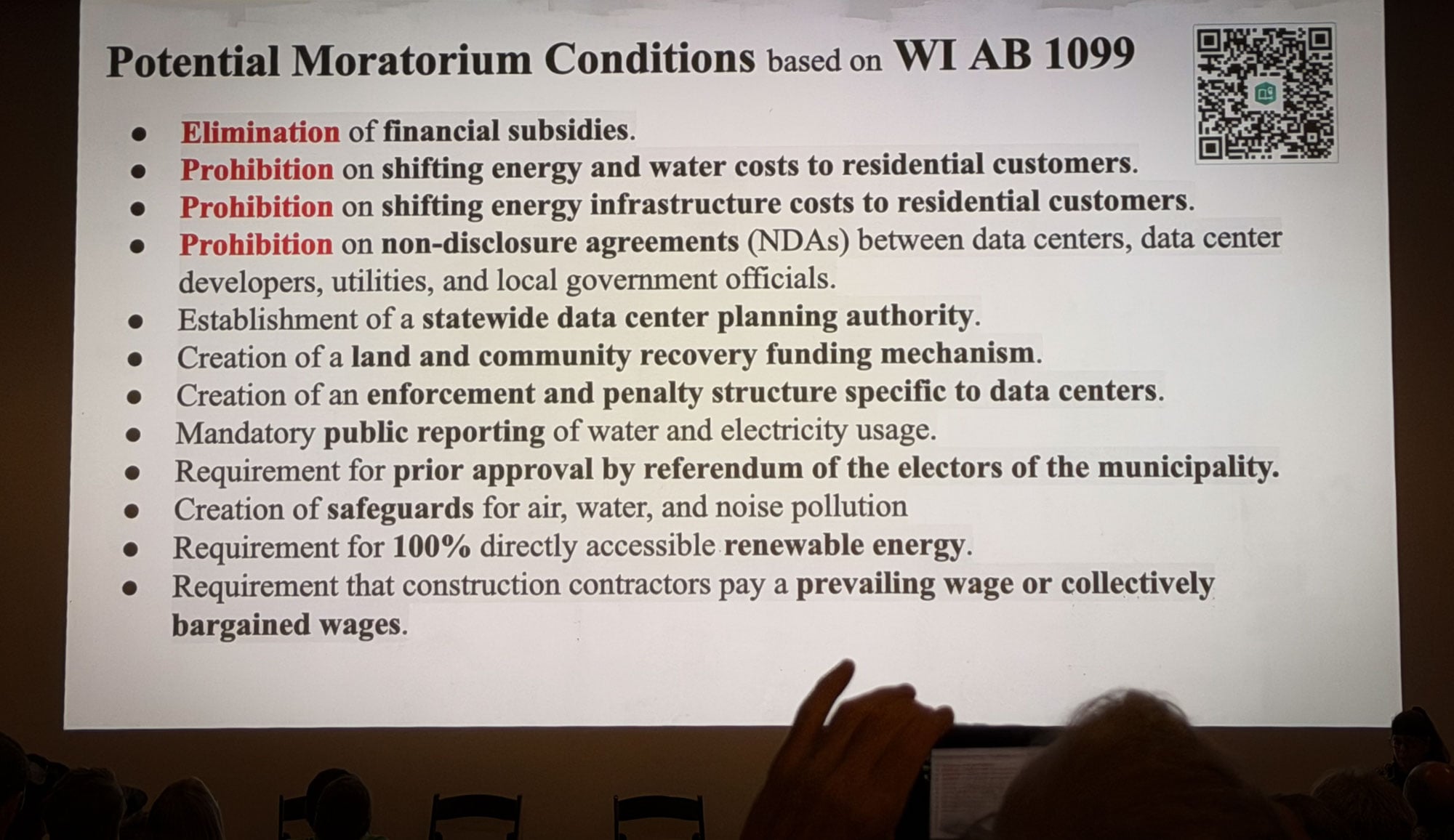
Her presentation then moved into a moratorium on additional data center development.
“A moratorium is a temporary pause,” Finley-Brook said. “It gives us the time to come up with conditions that would need to be met in order to lift the moratorium.”
The list she put on the screen was extensive. It included eliminating financial subsidies for data centers; prohibiting energy, water and infrastructure costs from being shifted onto residential customers; prohibiting non-disclosure agreements between data centers, developers, utilities and local government officials; establishing a statewide data center planning authority; creating a land and community recovery fund; and establishing enforcement mechanisms and penalties specific to the industry.
Finley-Brook also called for mandatory public reporting of water and electricity use and safeguards addressing air, water and noise pollution.
“We need mandatory public reporting of water and electricity usage. There needs to be transparency,” she said.
Other potential conditions went further, including requiring data centers to have access to 100 percent renewable energy and requiring construction contractors to pay prevailing or collectively bargained wages.
Then Finley-Brook raised the issue of requiring a local referendum before a data center could be approved.
“Should voters in municipalities where a data center is proposed to be sited vote before any approval?” she asked.
For Finley-Brook, the larger point was that the current pace of development doesn’t have to simply be accepted.
“Data centers are not inevitable,” she told the room.
Then she asked everyone to say it with her.
“Data centers are not inevitable,” the crowd repeated.
“One more time,” Finley-Brook said. “Say it like you mean it.”
“Data centers are not inevitable!”
“Why so much seems to happen before people have a chance to weigh in”
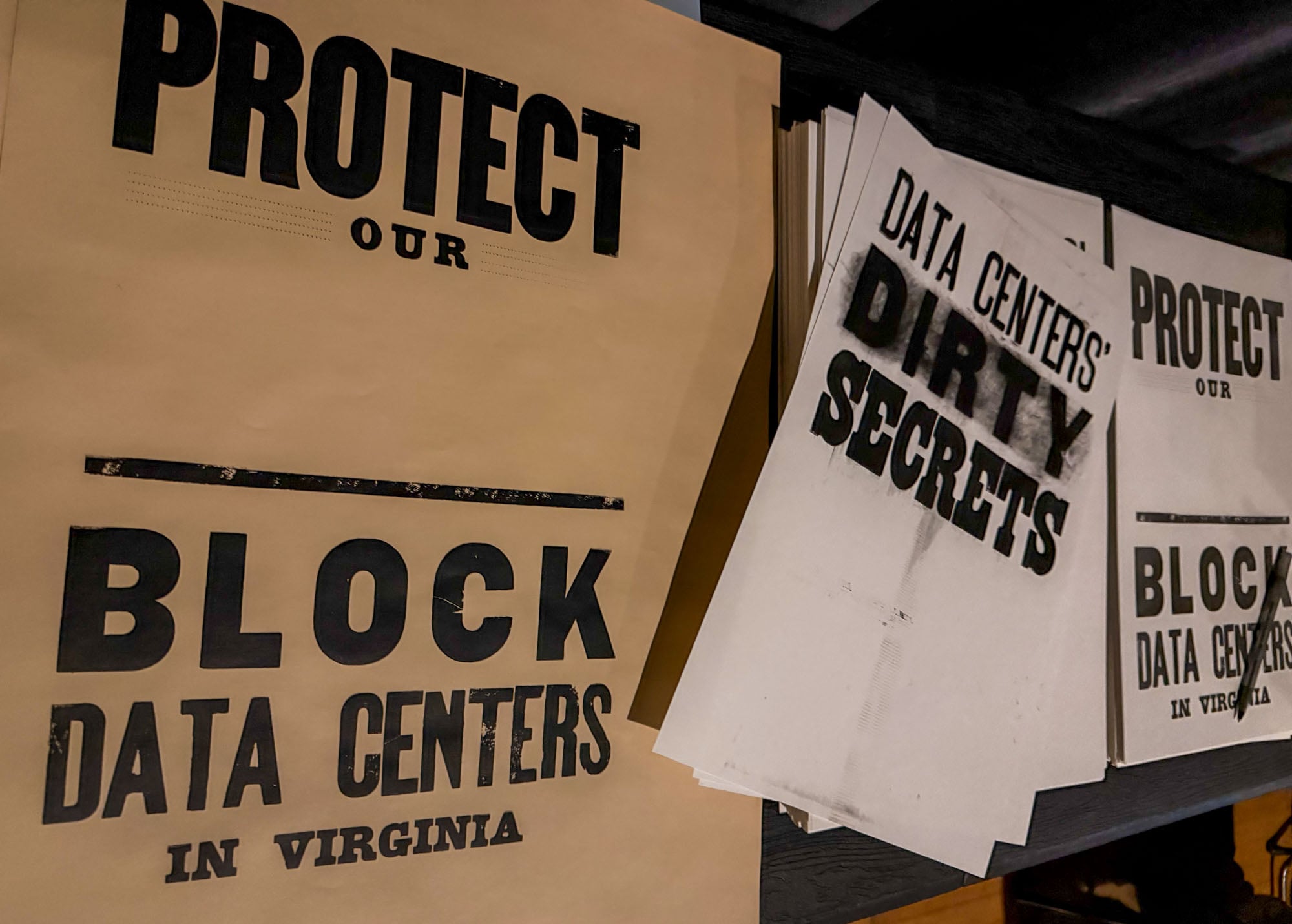
Suzanne Boothby, an author and journalist who works with environmental advocate Erin Brockovich on The Brockovich Report, brought the discussion back to what residents actually know about the projects being built around them.
“Communities are trying to figure out what’s being built around them, what it means for their water, power, health, bills and land,” Boothby said.
“They want to know who knew what, who signed what, and why so much seems to happen before people in the community have a chance to weigh in.”
Boothby focused much of her presentation on water and the scale of development already coming to Henrico.
“In July, the DEQ released a report on the aquifer under the eastern half of the state, the one right under us,” Boothby said. “It came out six months late, well after our legislative session ended, and after we could have made meaningful changes to our laws. Here’s what it found: groundwater east of I-95 is constrained and is declining, not stabilizing.”
According to Boothby, the report found that there is nowhere left within the aquifer system where a new large groundwater withdrawal could pass the technical evaluation required for a permit.
“Nowhere,” she said. “But switching to surface water instead of groundwater doesn’t mean switching problems. It means competing for a different one.”
That brought her to the James River and Henrico’s existing water system.
“Henrico’s water plant, along with the water that Henrico buys from Richmond, delivers 38 million gallons a day, sourced from the James River,” Boothby said. “That’s for our faucets, our schools, our hospitals.”
She said Henrico’s plant can produce up to 80 million gallons per day, citing the county’s 2025 water quality report.
“That’s the cushion left in the county for everyone, for decades of growth,” she said. “So where does the water to cool these data centers come from?”
For Boothby, that is the larger concern as Henrico considers more data center development.
“The aquifer is tapped out, and every gallon of surface water a data center takes from that 80 million gallon ceiling is a gallon that isn’t going to go to the next school, the next neighborhood, the next family that moves to Henrico,” she said. “We’re being asked to grow this industry on the same finite river we’re going to use to grow everything else.”
“You would never get any of this from the press releases that the data centers like to put out,” she said. “I take my calling as a storyteller very seriously. I believe stories can educate us, inspire us. I love fact-finding and sharing what I find through my writing, but stories can be tall tales, propaganda, a way to push an agenda through.”
Having covered data center fights elsewhere in the country and closer to home in Henrico, Boothby said she keeps encountering a similar sales pitch.
“Everywhere I see people pushing back against the same pitch that a data center can only be good for a community,” she said. “It’s great for tax revenue, jobs, economic benefit.”
She also played a promotional video from QTS Data Centers emphasizing its relationship with the communities where it operates.
“We see communities as partners, people as neighbors, and connecting our world not as our job but a privilege,” the QTS video said. “That’s the way we’ve always done it, and that isn’t changing.”
When it ended, Boothby turned back to the audience and contrasted QTS’s message with the scale of its White Oak Technology Park proposed expansion in Henrico.
“So we see a lot of happy people in that video, but here’s what it doesn’t show you the two campuses, 17 buildings, 1,100 acres, nearly 8 million more square feet of servers on top of the 3 million already built coming to Henrico,” she said. “That’s larger than Central Park and, closer to home, it’s roughly the size of the entire Richmond Raceway complex: the track, the fairgrounds, the amphitheater, all of it.”
“And we haven’t built the enormous part yet,” she said. “The 8 million square feet, the 1,100 acres. So we actually don’t know the full impact. The unanswered questions are still out there.”
She pointed to more than 300 proposed backup generators, 11 cooling towers and questions about the power grid, then recalled what a resident said at a community meeting she attended back in May.
“‘Those decisions impact our water. They impact our health. They impact my child. We want you to stop it. So what are you doing to stop it?’” Boothby recalled the resident saying.
“And that question, ‘What are you doing to stop it?’ is the one that I keep coming back to,” she said. “That video that we just watched did not address any of those concerns.”
Boothby then widened the lens beyond Henrico. She and environmental advocate Erin Brockovich write about these issues in The Brockovich Report, and Brockovich launched a self-reported map in April tracking major hyperscale data centers alongside concerns submitted by residents around the country.
“We’ve received more than 16,000 submissions,” Boothby said.
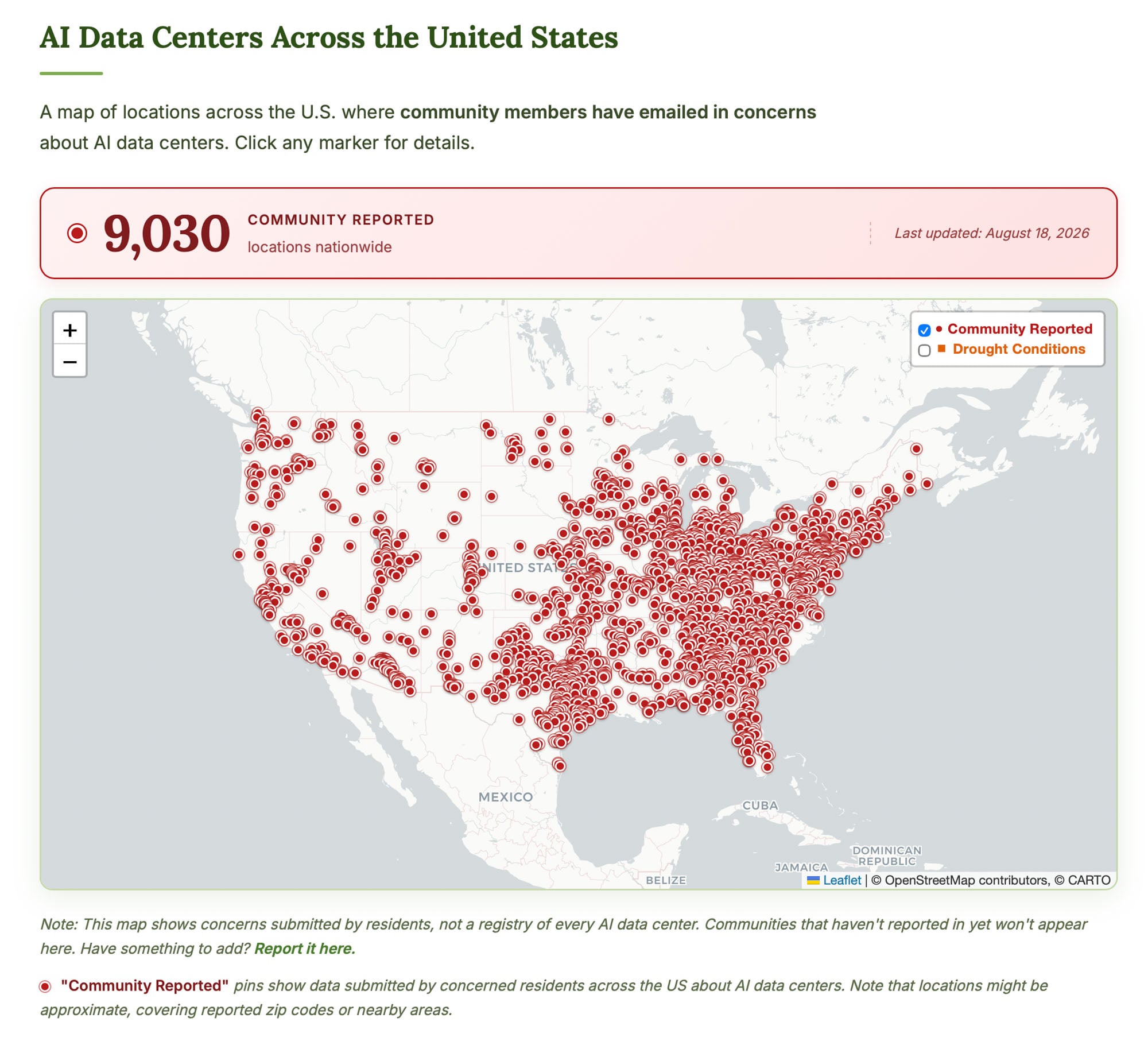
She said the same language keeps appearing in those submissions.
“Community members use words like silenced, ignored, secretive, and not heard,” she said. “They write about backdoor deals and NDAs. They describe showing up to planning meetings only to find out decisions have already been made.”
“When you hear about these issues in one community here or there, it looks bad,” Boothby continued. “But when you line these communities up side by side, you see the larger picture.”
Then she put the question directly to the room:
“If AI data centers are so great for communities, why are so many of them being built without meaningful community input?”
Fill the Rooms
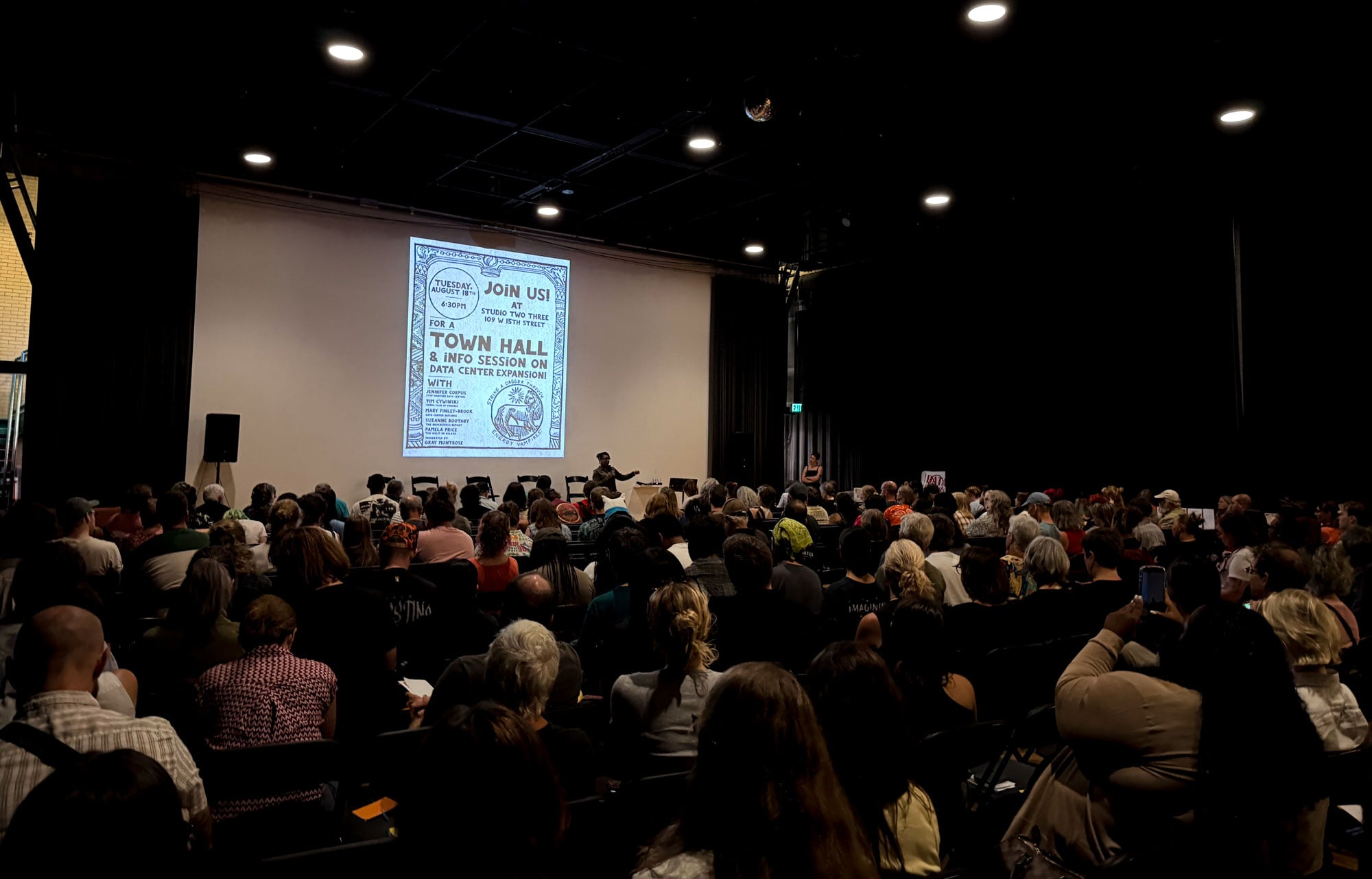
By the end of the night, the message was pretty clear: show up.
Boothby encouraged people to participate in public comment, attend upcoming hearings, contact Gov. Spanberger and their state legislators, get onto organizers’ mailing lists and pay attention to the next permit, meeting and comment deadline.
“We got to keep the rooms full,” she said.
Pamela Price, deputy director of Richmond-based nonprofit The Balm In Gilead, brought a public health perspective to the conversation by asking what the rapid growth of data centers could mean for public health, then she pushed the room toward action.
“Email your legislators and email Governor Spanberger,” Price said. “I take it one step further. Go see them.”
Price said much of her work involves bringing stories from communities directly to elected officials so they understand what their decisions look like on the ground.
“I want to challenge each of us to think about who you’re connected to,” she said. “Who is not here in this room with you today that should know they should be here? They should be hearing this information.”
Also, reminding our public officials who they answer to.
“It really does matter when we let them know it is our vote that often keeps any of them in office,” Price said. “I think sometimes we forget that, to say, ‘Look, you’re here because we put you here because we really wanted you to do some really positive, great things for us. But this is not it.’”
For Price, that means demanding a place at the table before a project is already moving forward.
“How do you work with us to make sure that we’re at the table before a data center goes up?” she asked. “That you listen and present us with factual information, and if you don’t have it, then we can bring that factual information to them.”
Price also argued that communities need to look beyond the immediate tax revenue promised by data center development and calculate what she called their own “community return on investment.”
“This may be a tax incentive for you, but here’s where this is going to cost in the long run to our communities,” she said.
She ended with a challenge: take what people had learned that night and tell five more people.
“I want you to think about your why,” Price said. “Why is this important to you, to your family, to your community, to maybe the organization that you work with or work for?”
For Price, that “why” comes back to public health and household finances.
“I do this work because I grew up with grandparents who couldn’t afford their medication,” she said. “I’m imagining people now sitting around the table saying, ‘Do I pay Dominion this extra $100, $200, $1,100 this month, or can I actually go and afford my diabetes medication?’”
“All of these things are connected,” Price continued. “I think that’s how we make sure that we don’t feel like this is not our fight, like this is not my problem. They don’t put it in my backyard. It is. It’s all of us.”
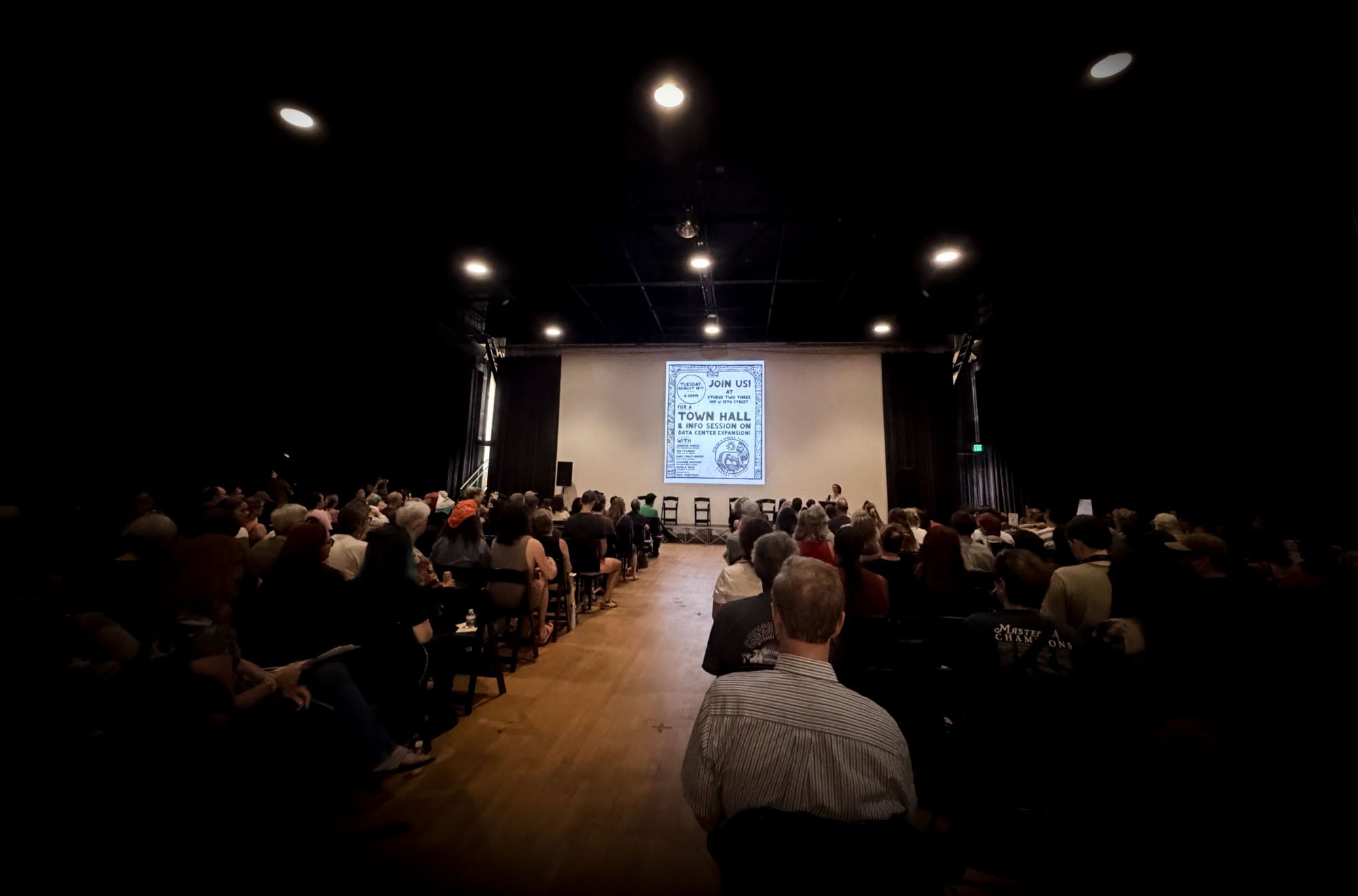
People are organizing and comparing notes across counties. They’re learning how planning commissions work, reading site plans and permits, meeting with supervisors and tracking votes. They are pushing for moratoriums to give themselves space to understand the long-term effects in their neighborhoods and showing other communities how to stop projects.
For an industry that grew without friction for a decade while much of the public wasn’t paying close attention, nights like Monday are happening across Virginia, cutting across partisan politics and industry propaganda.
People are paying attention now.
And that should put the industry on notice.
Support RVA Magazine. Support Independent Media in Richmond.
RVA Magazine has remained one of Richmond’s few independent voices. Since 2005, we have provided grassroots coverage of our artists, musicians, and communities, marginalized or otherwise, documenting the city’s culture that lies right under the surface and beyond the headlines.
But we can’t do this without you. A small donation, even as little as $2, one-time or recurring, helps us continue to produce honest, local coverage free from outside interference. Every dollar makes a difference. Your support helps keep us going and keeps the local creative spirit alive. Thank you for standing with independent media, and thank you for reading.
Show your SUPPORT HERE
Also, subscribe to the newsletter HERE
We’ve got merch HERE
Subscribe to the Substack HERE
And Reddit HERE
And YouTube HERE