“Richmond has always had this DIY, collaborative spirit, and I think projects like this are a great expression of that. There’s a lot of talent here, and when those different creative communities start crossing paths, I think the city gets more interesting.”
— Justin Paciocco, VILLAGES
As the major music industry seemingly ignores and neglects midsized city music scenes across the country, choosing reality TV contests and checking follower counts on streaming apps rather than building new catalogs with and uplifting organically formed music acts that make music as an honest and expressive outlet of human emotions, Richmond creatives are doing the collaborative work, what we now call content.
It is ever more than that reduction, regarding cultural dialogue, storytelling and songwriting traditions to the shared human experience of listening to a band, seeing and hearing them live and in person with each other.
Midtown Tilt Creative Studios and Downtown In Your Ear Studios have made great use of their facilities in Richmond, using their respective production sound stages and recording studios to make space for Virginia-based acts to record and broadcast their audio magic visually outward into this new chapter era of internet and social media landscapes.
I had the wonderful invitation this past summer to attend the VILLAGES taping at Tilt Creative Studios. I left that event thinking about the importance of cameras recording musicians and the resonance between the communities of commercial and film production and the live music scenes.
These bridges strengthen the lines between overlapping creative circles in a production studio setting for the larger world to enjoy the results of those collaborations.
This is a compilation of thoughts across the camera side and band side of the June 25, 2026, taping, with a look to the sessions that led there. Included are Tilt Studio Sessions co-founders, producer Lindsay Hess and director of photography Bobby Bruderle, as well as director Ross Gerhold, production designer Joe McCorkle and VILLAGES guitarist and vocalist Justin Paciocco.
T-Rav: When was Tilt Creative Studio created? Has it always been at the Boulevard location?
Lindsay Hess: Tilt Creative Studio was created in 2018 when Park Group merged with Studio Squared, a division of The Martin Agency. The original stage location was off 18th & Main Street and moved over to the Boulevard in 2016.
T-Rav: Outside of music videos, MTV, VH1, MuchMusic, PBS and even late-night television had/has amazing live performance captures. What are some of the inspirations for y’all behind the Tilt Studio Sessions?
Lindsay: MTV Unplugged, ’90s era, has always been one of my favorite videos to stream in the background. NPR’s Tiny Desk also has been a huge inspiration. We really wanted to take that idea of an intimate set with a small audience but also lean into the equipment and production design we have so readily available.
Bobby Bruderle: The first studio session was a shoot with Valentin Prince. He’s a really close friend of mine. For many years now, I have been working on ways to control camera movement and lighting. The work I’ve done is in the interest of being able to work with an artist one-on-one and to do things to make it easier for artists to get footage and to make everything a musical experience.
He and I did that inside of Tilt Studios. He set up his amp, and I set up a bunch of lights, and we called it Tilt Studio Sessions. Lindsay is a connector, and she’s so brilliant at bringing people together. She saw that, and her thought was that it should be an event, something where people see how it gets made.
That first video with Val is like proof of concept. That’s how we sold it to Tilt on doing the first fully produced, event-style studio sessions for MacKenzie Roark and the Hot Pants. I was the director. Joe, the production designer, put together that set we used. We collaborated with everyone in the band to come up with the theatrics for the performance.
In the beginning of that one, you can see the potential, almost like a game show or variety show format, where there’s creative flexibility even moments before the performance. They’re amazing to work with.
T-Rav: I recently rewatched Teenage Mutant Ninja Turtles, the motion picture from the early 1990s. I was amazed that, while it is a perfectly structured and composed comic book hero film, it was savvy with classic movie and art film references and was more thoughtful than I picked up on when I was a kid seeing it. I then saw the director was Steve Barron, who had been the director of the “Billie Jean” music video for Michael Jackson and other iconic work like “Money for Nothing” with Dire Straits and “Take On Me” for A-ha. Certainly, that work factored into his storytelling and cinema success. What is the importance or excitement for a production team to tackle visualizing a music group or artist?
Joe McCorkle: Music is a really fun medium to build visual elements and worlds for. It’s a more abstract storytelling than the narratives we find ourselves usually creating with commercials, films and web content. It leaves more room for creative approaches that you normally wouldn’t be able to put on the table.
Most people have their own visual worlds formed in their minds when listening to a song or album. It’s really satisfying to work with the team to build an environment or sort of nest for the music that allows the band and audience to get on the same frequency.
Whether it’s a live performance or video, if you can convince your audience that the band belongs there visually, it becomes even more of a shared experience as you are invited to live in their world for a while. You are never exactly sure what will be successful until the moment the music starts and the energy in the room vibes with the presentation of the show. I find this type of collaboration very exciting and feel honored to work with such talented artists.
Bobby: I came into this whole world as a still photographer. Everything that I do evolved from working one-on-one with somebody. Over the years, musicians have been the people that I’ve been around, and my work has moved in that direction.
But in terms of how I sort of moved more into motion, late in high school, early in college, is when the RED ONE camera came out and the Canon 5D Mark II. And in my naive mind, my first thought was that stills and motion are going to end up being a single medium. I thought that because these cameras could do both. You would shoot a magazine cover with a RED. Some people were doing that at the time.
That’s what melded these worlds together for me at a very impressionable age. That technology came out and, in my mind, everything changed. I started becoming a part of the film scene here, and music and just any kind of visual art, it’s like everything that you could possibly want or need is in Richmond. It’s just not necessarily all in the same place at the same time.
The amount of talent that’s just casually living here in Richmond is astonishing.
T-Rav: Shockoe Sessions Live! in the Bottom, with In Your Ear Recording Studio, has carried on its weekly live music streaming broadcast, providing fantastic exposure for the Richmond music scene. It was born out of the pandemic era. What was the impetus for using the studio soundstage space for this purpose?
Lindsay: Love this event. It’s so wonderful to see Richmond thrive in the creative space the way it is. This came from the idea of taking advantage of what we have at our fingertips. Since we are a full creative and production studio, we own quite a bit of camera and supporting production equipment. That, along with the incredible talent we have who knows how to capture this type of content, brought us to the question: Why don’t we utilize what we have sitting at our fingertips to elevate an evening for the Richmond community?
T-Rav: What is unique to the form in what you are doing here at Tilt?
Lindsay: We lean into what we already have access to on the Boulevard: a fully equipped 16,000-square-foot stage with camera and lighting gear to make million-dollar commercials. Combining that with a high level of production design and a local live band allows us to create a container to make deep connections with the community along the way.
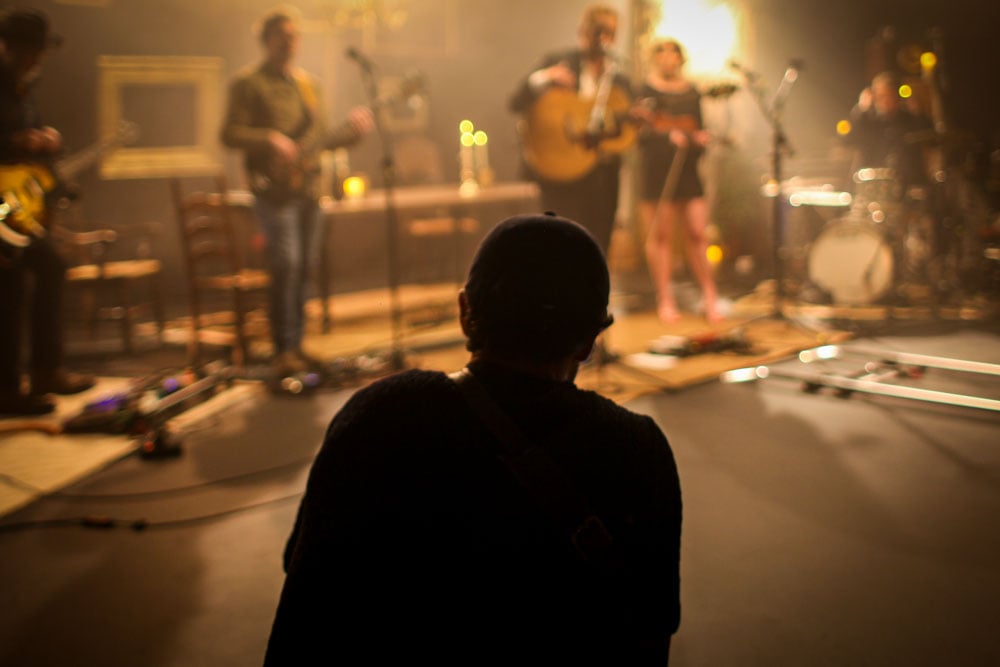
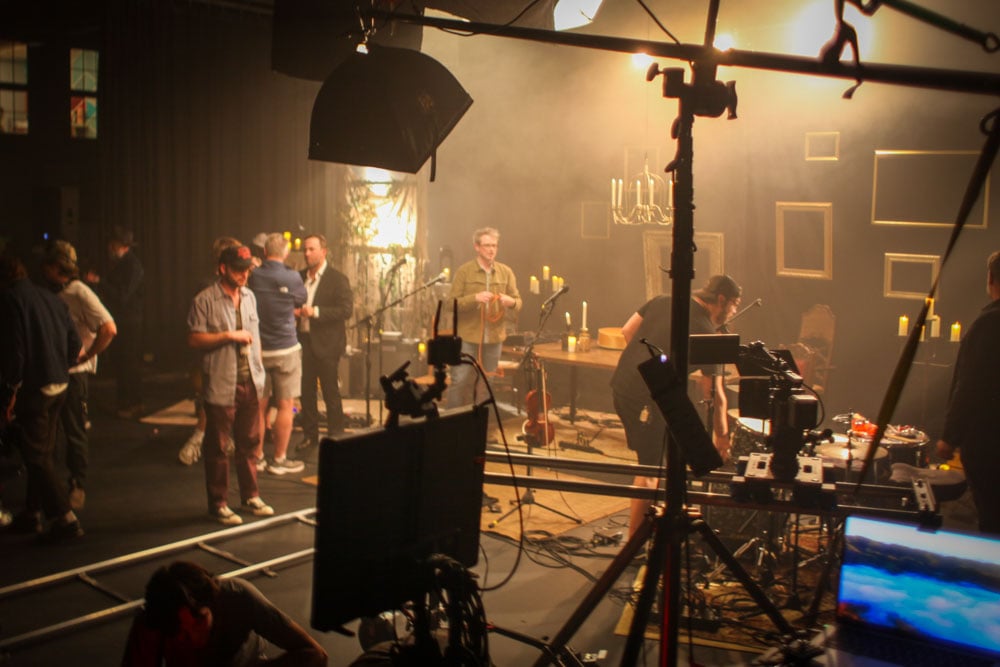
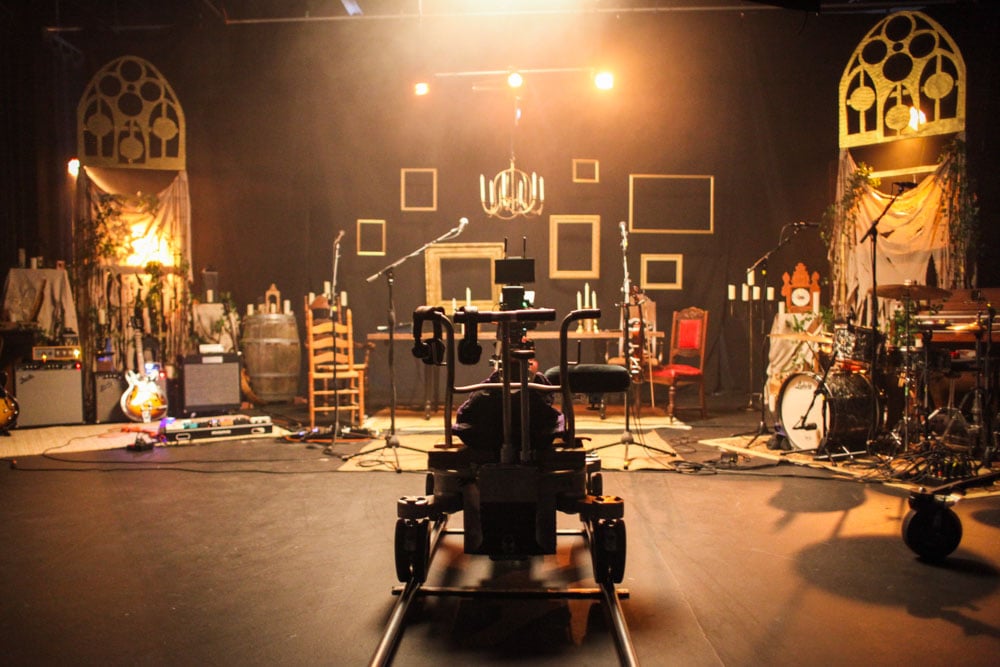
We want each band or artist we work with to feel heard and like their vision is being incorporated with the gear and props we already own. As for the audience experience: We want them to see the C-stands, the dolly tracking back and forth, and the cords scattered on the ground. It’s real, raw and gives the attendee an experience that they truly can’t get unless they’re in the industry.
How the juice is squeezed is kind of a deal. Being vulnerable and real with performance. And the best part is, we have something incredible to share with the world after the night is over: a full-length, multi-camera performance video that will hold for years to come.
Joe: Lindsay has always talked about the importance of bringing a sense of community to Tilt Studio Sessions. I think over the past few events it’s grown into a melting pot that brings a lot of creatives together from music, film and photo, while also giving the greater community a peek behind the curtain to see the mechanics of how a production like this comes together.
As a freelancer, it’s also a special event since it brings folks that I love to work with but don’t see as often because of the nature of our industry. We get to catch up and talk about our creative projects in a low-pressure environment. I think it helps cultivate new ideas and opportunities that may not have arisen otherwise.
Bobby: If there’s any intent with the whole thing, it’s to erode some of the formality. Film production and live music both have a certain degree of formality and process, and a lot of it is very helpful. It’s good to have roles and sequencing things in certain ways.
But ultimately, everyone in that room is super creative. If you’re a working musician or a film worker, most of the time creativity has to be put to the side. So, in the experimental sense, seeing how much of that formality and hierarchy can be done away with, making something that we’re all proud of and that is fun to make, I think is the bigger-picture goal.
T-Rav: For the Shera Shi session, were some of the vintage effects captured in camera, or were some of those put through in post, or were some of those live-mixed during the performance?
Bobby: As far as the transitions went, that was done in post. It’s interesting that you mentioned live mixing because I think, from a technical standpoint, that’s the thing that I most want to accomplish next time around. I want there to be a live edit. It’s a multi-cam shoot. The audience is there seeing all these cameras work. I want there to be a live mix.
I’m hesitant to say that would be the final cut. I think for people to see the entirety of film production in that one little space and time.
In terms of the look, the camera was a RED Raptor with a 20-100mm Cooke Varotal, which is one of my favorite lenses. It’s a really sick lens that was working most commonly in the mid-to-late ’80s. It has a little bit of murkiness to it, but it’s still really sharp. It feels vintage, especially with the use of tungsten lights and the way the lens was impacted by all of the different point sources.
T-Rav: What has been a smooth confirmation that this synergy of scenes is doing something really special?
Lindsay: Chills from the second I’ve heard the first strum of a chord at sound check. I’ll be running around getting last-minute things sorted in the kitchen. I’ll hear it, and every time it tells me, “This is going to be a badass night.”
Also, the notes and comments I’ve heard from the audience. Folks have the kindest things to say, from “OMG, I’ve never seen anything like this before.” For me, that’s HUGE. And the other question is always, “When’s the next one?!” It feels really special and unique to be on the front edge of something that people haven’t experienced before.
Joe: I’ve been taken aback by every performance, even though I was involved in the process of the production and present for rehearsals. Seeing the bands perform in the spaces we created with a live crowd that arrives curious and supportive really brings a magical atmosphere, and we get to capture that on video.
Also, having great eyes to capture that through a lens and editing that footage to retain the feeling is an art unto itself.
T-Rav: Take us through the timeline of development for one of these sessions, from musical act selection conversations to the release of the media?
Lindsay: This part is so fun. We work internally and closely with our directors in the community to determine who is the next artist we want to work with. From there, we kick the project off at the stage. We get an idea of each other, what look and feel is important, and nail down the set list.
Next, the internal team will work on a mockup for the direction we want to go in. We’ll share that out, get everyone aligned, and then start moving into invitation design, sending those out, dialing in production design. That takes us up until the eve before the event, where production design is dialed in, the band loads in, and we start dialing in performance, sound check and any last-minute tweaks. Next evening, doors open to invite the public!
Bobby: The main thing would just be to let artists know that they can reach out, trying to create what’s best for the community. And what could be the most fun to make, more vehicles for their music, do more of it.
Justin: The setlist was really about trying to give an honest picture of what VILLAGES can be in a live setting. We didn’t want to make five songs that all lived in the same world. We wanted there to be some intimacy and space, but also some moments where the whole thing opens up and gets loud.
The first couple songs lean into the more stripped-down, folkier side of the band, the kind of thing we might do as a duo or trio, while the back half gives the full band room to really stretch our legs. The conversation was less about, “What are our five best songs?” and more about, “What five songs tell the story of this band?”
We wanted someone watching the session who had never heard VILLAGES before to come away with a sense of the range we can cover, both musically and emotionally.
T-Rav: With the commercial and film production community coming together to make these programs with the music community, what have y’all found in the evolution of lessons learned from the first session with Hotpants to the Shera Shi session to what we were able to experience with VILLAGES?
Lindsay: I’ve learned to continue to listen closely and observe. Musicians move and create differently than the creative world I’ve been around for ten years, so I’m always learning how to accommodate and how to be proactive to anticipate their needs. I think I’m learning something new with each session and taking that knowledge with me to the next.
T-Rav: How do y’all approach prep for concepts and art direction? Is it a conversation with the band or is it a vision for the band?
Joe: Lindsay is the mastermind of production. She somehow wrangles us all via Zoom or a physical meeting at the Tilt stage to discuss the overall look of the performance and what the band’s ideas and expectations are.
I usually create a mock-up of a design or look based on those discussions with the production team and the band. I share that with Lindsay and Ross. After they give their notes, it’s sent to the band for their approval. Once they sign off on that, I begin the process of building, sourcing and collecting pieces that support that design.
Two days before the show, I start assembling and shaping out the stage as the director, producer and band are made aware of how that’s coming together to give room for the band members’ stations, lighting and any blocking that may be needed for movement around the set. As the band rehearses the day of the performance, we make any adjustments as needed and let them get comfortable with the space.
Justin: One of the things I loved most about the production design was that it wasn’t simply trying to create an interesting visual backdrop. It was trying to get at something true about the band itself.
A lot of the credit there goes to my bandmate Rich Stine, who came in with a vision that we all immediately gravitated toward: the idea of centering the set around a dinner table. And interestingly enough, when we met with Tilt on that first creative call, they had independently thought up the same idea! So we knew that was the direction we had to go.
It felt symbolic in a really honest way because VILLAGES has always existed in its purest form not only on stages, but around tables, on back porches, in living rooms and in all of those in-between spaces where friendships are built and songs are shared.
At its heart, VILLAGES has always been a communal project. The music grows out of relationships, conversation and time spent together, and the dinner table felt like a perfect visual reflection of that spirit.
I think the production team did a beautiful job taking that idea and building a world around it. In a way, the visual design became an extension of the music. It reflected the warmth, friendship and sense of community that have always been embedded in VILLAGES.
T-Rav: How does the director bridge the creative balance of crew and band?
Ross Gerhold: The band’s involvement is heavy at the beginning and then slowly transfers over to the crew closer to production to bring the vision to life. It really is a perfect balance.
My process started with hearing out what Lindsay and Tilt’s goals were for this particular session. After a good conversation about that, it’s time to have a thorough chat with the band and see what their vision is, or what may be going through their heads at this current moment in their lives and careers.
We mainly discussed what sort of theme came to mind when thinking about this VILLAGES performance. They mentioned something along the lines of “It takes a village” and said how a dinner table really brings people together, so it might be a cool prop. After that, I asked if their visual taste leaned more toward bright and vibrant or dark and moody. And they said dark and moody.
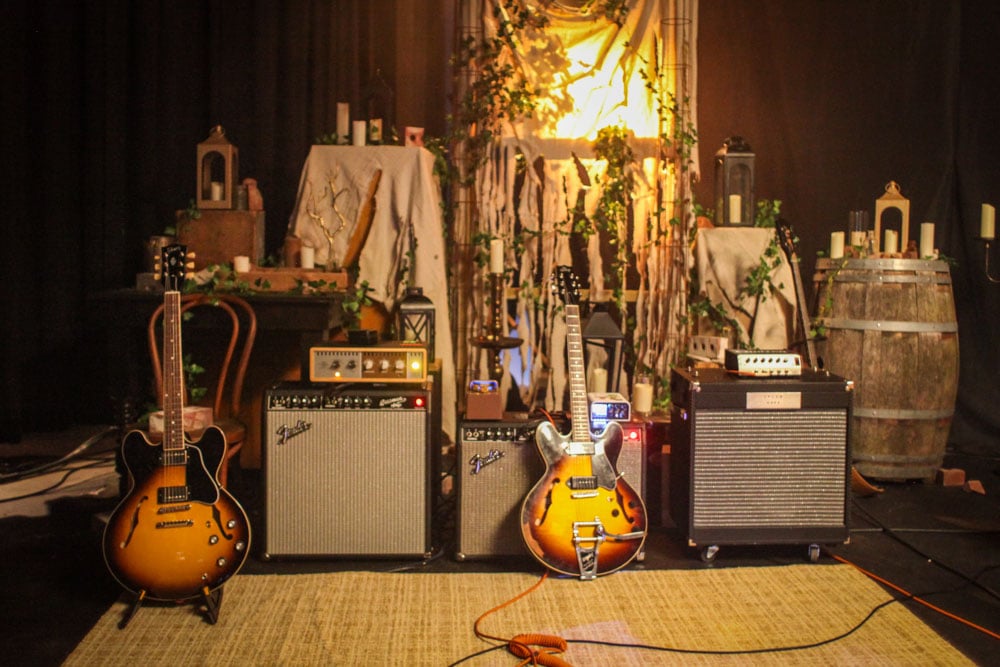
That conversation led my mind toward somewhat of a gothic dining scene lit by candlelight. To me, this was a good contrast to the previous Tilt Studio Sessions, which was kind of a 1970s retro living room set. Our environment is still somewhere found within a home, but from a different era, almost leaning into a cohesive communal universe of Tilt Studio Sessions that I have in my mind.
From there, it was a matter of putting together an example mood board/visual approach with Lindsay to show our production designer, Joe. After some conversation about that, Joe then ran with it and spent some time sourcing objects for the stage, eventually building everything that was in frame that day.
I wanted him to take that initial idea and do whatever he wanted with it, and that’s exactly what he did. I love putting a ton of trust into each crew member, knowing that everyone involved has their own admirable taste that will show in the final product.
As the director for this session, it’s my job to quite literally be that creative bridge in between the band and the crew. In a perfect world, it’s just getting everyone on the same page and letting each crew member do their thing to fulfill the overall vision.
However, everything is very determined by our timeline, so it’s a matter of knowing how long we have to collectively play with this concept, and when things need to be anchored into place so we’re incredibly prepared for a shoot that is truly a unique experience.
It truly did, and does, take a village.
T-Rav: With VILLAGES, there was a MiniDV camera that was outfitted for high-def recording?
Bobby: It was a Sony MiniDV Handycam and was actually the Bruderle family camera growing up. In the same bag that I carry it in, there are some tapes of Christmases and vacations.
I put it on a Ronin gimbal. The thing that made it the most fun rig I’ve ever used was I put a rocker VariZoom controller that allowed me to hold the gimbal and control the zoom simultaneously, so shots that would normally be impossibly shaky, those longer focal lengths, became possible.
I didn’t get everything right in that department, but it was really fun mixing that super-modern robotic Ronin technology with very dated MiniDV footage.
T-Rav: Do you like making those unique rigs, or was that an extracurricular exploration?
Bobby: The thing that was unique about it is that I was using an old camera. Most of the work that I do, I try to get “the latest and greatest,” whatever I can get my hands on. But recently, I’ve been trying to loosen my grip a little bit on sharpness and resolution.
But I would say that I very much enjoy creating camera movement rigs. I spent all of COVID designing, trying to figure out a super lightweight dolly with a jib on it that allows me to have full control over the camera, its movement, and also does not have any weight on me at all as an operator, so I can have a free hand to potentially control lights.
That was the very original spark that led to Tilt Studio Sessions. I really wanted to test this thing that I built. And I used it on the pilot and the MacKenzie Roark sessions.
And then, as things kind of grew, I couldn’t resist the temptation of using a legitimate PEEWEE Dolly. That’s the most bitchin’ way you can possibly move a camera if you have the crew and resources to do it.
T-Rav: For the VILLAGES taping, you talked about the use of the old family camera. What were the other packages that were rolling that night?
Bobby: I was on the fun MiniDV camera. The A camera was a Canon C50, and then the B camera was the RED Raptor. I can’t quite remember what the C camera was. But a lot of cameras, a lot of lenses and a lot of hands and a lot of opportunities to cut.
T-Rav: What was the nature of playing the music to both the in-room audience and the cameras?
Justin: There was something really important to us about having an audience in the room. VILLAGES has always been about connection, and that connection isn’t just in the songs themselves. It’s in the banter between songs, the stories behind them, the intimate interactions, and giving people some context for why we’re playing what we’re playing. All of that is part of the VILLAGES experience.
So while we knew the cameras were ultimately going to be telling the story of the session, we didn’t want to make something that felt like five songs simply being played perfectly into a lens. We wanted it to feel like an actual VILLAGES show, a shared experience between the band and the people in the room.
The cameras added another layer to that experience because we knew we were capturing these moments in a way that would live beyond that night. But the best thing we could do was largely forget they were there and focus on creating the same kind of genuine connection we try to create whenever we’re playing for people.
Hopefully the finished session captures not just what the songs sound like, but a little bit of what it feels like to be in a room with VILLAGES.
T-Rav: How do you look to see this program grow? What are the best-case scenario outcomes of this community bonding effort?
Lindsay: I think the idea of it staying in the same realm but also catering to a specific arts visual look and feel is a beautiful thing. There is an obsession in our culture to GROW. Sometimes, something is enough on its own. But of course, my producer brain loves the idea of a mini-documentary encapsulating our artist, crew and attendees’ experience.
Justin: I think Richmond is uniquely suited for something like this because there are so many people here doing really high-level creative work across different disciplines, but those communities don’t always overlap as much as they could. There are incredible musicians, filmmakers, photographers, designers, producers and other artists working in the city, and this session felt like a really tangible example of what happens when those worlds come together.
For me, that’s one of the most exciting things about the Tilt Sessions. It’s not just a way for a band to get a nice live recording. It’s an opportunity for musicians and filmmakers to challenge each other creatively and make something that neither group would have made on its own. I loved being able to see how the production team thought about our music visually, and hopefully we gave them something interesting to work with musically.
Richmond has always had this DIY, collaborative spirit, and I think projects like this are a great expression of that. There’s a lot of talent here, and when those different creative communities start crossing paths, I think the city gets more interesting.
T-Rav: What else might be on the release horizon for Tilt that you can share?
Lindsay: We’ll continue to host these events twice a year. Our productions range from broadcast to social, and we usually share our work out on social media.
T-Rav: Where can we get more information or follow along?
Lindsay: Check out our Instagram and YouTube pages!
Tilt Creative Studio on YouTube
Tilt Creative Studio on Instagram
VILLAGES
Justin Paciocco – guitar, vocals
Caroline Vain – violin, vocals
Rich Stine – electric guitar, synth
Chip Hale – bass, vocals
Stephen Lecky – drums
Tilt production crew for the VILLAGES production:
Ross Gerhold – Director
Lindsay Hess – Creative Director + Producer
Bobby Bruderle – Creative Director + Director of Photography
Joe McCorkle – Set Designer
Adam Clark – Videographer
Dan Wagner – Videographer
Nathan Burns – Editor
Support RVA Magazine. Support Independent Media in Richmond.
RVA Magazine has remained one of Richmond’s few independent voices. Since 2005, we have provided grassroots coverage of our artists, musicians, and communities, marginalized or otherwise, documenting the city’s culture that lies right under the surface and beyond the headlines.
But we can’t do this without you. A small amount, even as little as $2, one-time or recurring, helps us continue to produce honest, local coverage free from outside interference. Every dollar makes a difference. Your support helps keep us going and keeps the local creative spirit alive. Thank you for standing with independent media, and thank you for reading.
Show your SUPPORT HERE
Also, subscribe to the newsletter HERE
We’ve got merch HERE
Subscribe to the Substack HERE
And Reddit HERE
And YouTube HERE