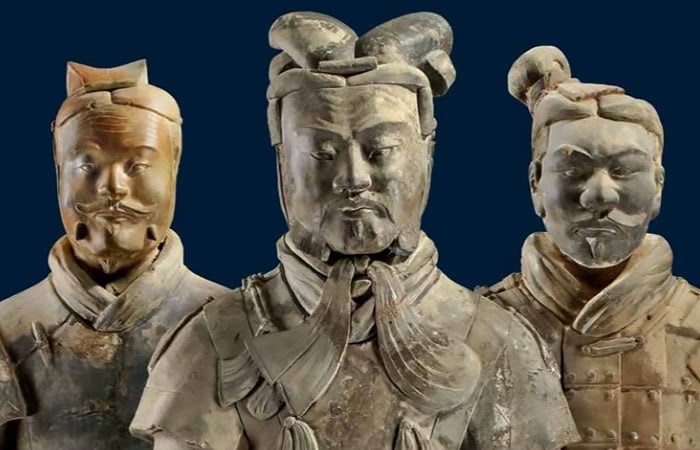
Chinese Art is making a journey to the west by coming to the VMFA next month. The exhibit, Terracotta Army: Legacy of the First Emperor of China will feature 130 pieces of art including 10 life-sized terracotta figures straight from the pits of Xi’an, the capital of the Shaanxi province in China.

Terracotta Warrior. Photo by VMFA
Riding off the overwhelmingly positive responses of the previous Asian centered exhibits, Forbidden City (2014) and Japanese Tattoo: Perseverance, Art, and Tradition (2015), curators Li Jian, the E. Rhodes and Leona B. Carpenter Curator of East Asian Art at VMFA; and Hou-Mei Sung, of the Cincinnati Art Museum; came together to make this a reality.
“The Terracotta Army is one of the most important archaeological discoveries of the 20th century, and VMFA is always looking to offer compelling exhibitions that represent different cultures and historical periods,” said Alex Nyerges, VMFA’s Director. “With Terracotta Army, we are returning to Asia to offer the first exhibition in VMFA history to focus on the art and archaeology of ancient China.”
The museum also partnered with the Chinese-based Shaanxi Provincial Cultural Relics Bureau, Shaanxi History Museum (Shaanxi Cultural Heritage Promotion Center), and Emperor Qin Shihuang’s Mausoleum Site Museum of the People’s Republic of China for the exhibit to become a reality.
The terracotta army — which features warriors, a cavalry horse and an armored general — is a representation of the strength of the Qin Dynasty and the First emperor of the Unified China, Ying Zhen, better known as Qin Shihuang.
“[Qin Shihuang] remains a prominent figure in Chinese history for unifying the country, and [for] his political, economic and cultural reforms. He also ordered construction of his mausoleum complex, which took 38 years to complete,” said Li Jian.
Qin Shihuang’s mausoleum complex is where the brunt of the the art was excavated from, and it was built to reflect his vision of what a unified China should be.
“Like other ancient cultures, such as the Egyptians, ancient Chinese believed in an afterlife. The First Emperor’s mausoleum was constructed after the Qin capital of Xianyang. It contains palaces and is surrounded by city walls,” said Jian.
Each period of the Qin dynasty will be represented by the exhibit, which is divided into three different sections: the rise of the emperor, the history of the Qin, and the emperor’s quest for immortality.

Armor from Qin Shihuang Grave Site. Photo by VMFA
Qin was obsessed with attaining immortality, and it’s hard not to say he achieved it with a legacy that includes ascending to the throne at age 13; establishing administration, law, language, art, architecture, interstate roadways; and the unmissable Great Wall. Qin deservedly remains undisturbed in the afterlife.
“Ancient tombs are part of cultural relics, and often tombs are discovered accidentally as results of road and building constructions, and illegal activities,” said Jian. “To better protect the contents, there is no plan to excavate the First Emperor’s tomb.”
Aside from ceramic forged terracotta figures, there will be works of jade, gold and silver, and divine jewelry on display. All were excavated from various tombs from not only the Qin Dynasty, but the previous dynasty of Zhou (1046-256).
“The objects from the Eastern Zhou represent the growth of the Qin from a small state to a powerful empire. The objects in the gallery — including a ritual bell and chime, ceramics, jade figures and nomadic objects — tell us how the Qin assimilated elements not only from the Zhou, but also different cultures during the course of over 500 years,” said Jian.
Every one of the pieces of art in the exhibit is authentic, except for one figure.
“The exhibition only includes one replica, which is the bronze chariot. The original work is a very rare Chinese national treasure, and it has never traveled outside the country,” said Jian.
VMFA will host numerous public programs to accompany the exhibit, such as lectures, gallery talks, and films. The full list of events can be found on the museum’s website.
The VMFA will also host two different events complementing Terracotta Army. The first is Dig It!, the special interactive exhibit for all ages that incorporates augmented reality with the exhibit of Qin Dynasty artifacts. Dig It! will continue until July 4, 2018, long after the Terracotta Army exhibit has ended. There will also be an Archaeology forum for scholars and archaeologists to talk about new research and innovations in their field on February 2, 2018.
“There is nothing else in the world like these extraordinary Terracotta figures. Many people who traveled thousands of miles to see them in China have remarked on how impressive it is to see them in person. With this exhibition, we offer that opportunity to people who may not be able to travel overseas, to see them right here in Richmond,” said VMFA Director Alex Nyerges.
The exhibit opens November 18, 2017 and will be on display through March 11, 2018.

Art Sponsored by Virginia Museum of Contemporary Art