Editor’s Note: RVA Magazine is proud to partner with Virginia PrideFest, happening this Saturday, September 12, and to produce the annual Pride Guide celebrating Richmond and Virginia’s LGBTQ+ community. You can download the 2026 Pride Guide HERE.
We’d also like to thank the following sponsors who made the 2026 Pride Guide possible: Virginia Museum of History & Culture, Virginia MOCA, Virginia Repertory Theatre, Richmond Triangle Players, Health Brigade, Godfrey’s, Chrysler Museum of Art, and Steve Davis at River Fox Realty
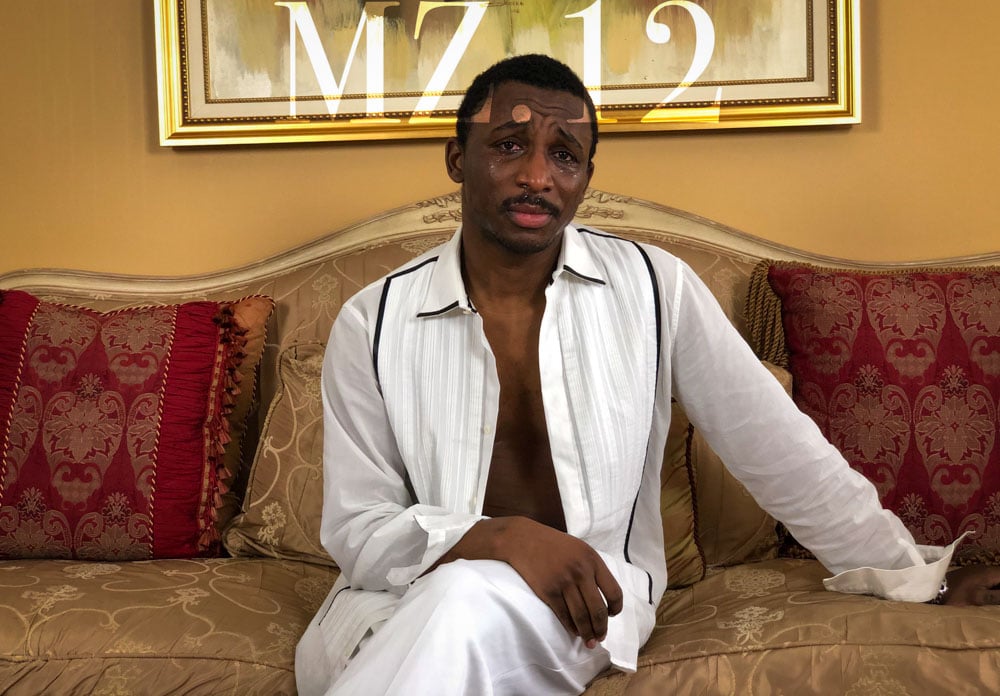
Dressing as a poodle carrying a cross, painting on paper towels, putting wigs on fans, Monsieur Zohore is a Richmond-based artist who is not afraid to offend and twist your brain using comedy in art.
Zohore was in Miami for the next few months setting up for a show, so I chatted with him on Zoom about his upcoming shows and why he will always call Richmond his home base.
Callie Watts: Hey, nice to finally meet you. So, you are in Miami?
Monsieur Zohore: I’m working on a project right now. The show opens October 17, so I am here producing it all. You know, it’s really funny, since the Ukrainian war, shipping got really crazy. And so, every project since then, it’s been cheaper for the galleries to ship me than it is to just ship the work.
C: You work in paper towels. Has the price of paper towels gone up?
M: Oh, completely, completely. They’ve gone up. They are also made completely differently now. The material has changed, like the patterning of it, the quilting is completely different now. It’s like a bigger, wider quilt so that they can skip out on materials.
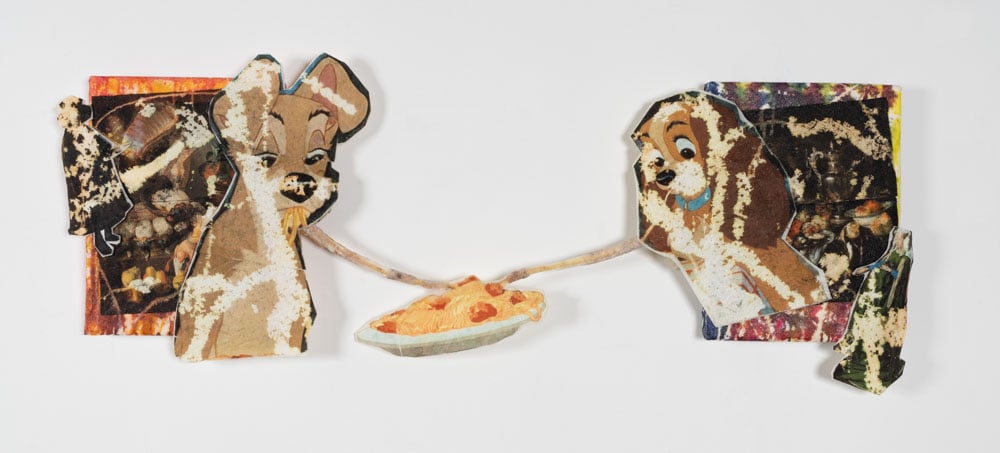
C: Since they changed the quilting, does that affect your work?
M: Completely. The old ones look different than the new ones. The design doesn’t bleed and bleach out as much as it used to. Before, you would be able to fully tell the little patterning of the paper towels, like the beautiful little diamond shape they would have.
C: They’ve taken the beauty out of your paper towel.
M: It’s funny because I remember a few years ago, I was doing a show in Athens, Greece. The shipping of the American paper, of the Bounty towels [his normal go-to brand], to Greece would have cost us $15,000 to $20,000 for enough for me to run a show, which does not cost that much normally, but because of the shipping.
And so I started doing this thing when I went overseas. I’d switch to a different paper towel. The Italian paper towels were pretty great. The German towels are fine, but the Italian ones were my favorite. The Greek ones are like one-ply nonsense. Like, you have to think about their environmental laws. So the more people care about their country, the worse the paper towels are.
C: You should really think of a side gig as just being a paper towel reviewer.
M: If I had any social media brain in me, I’d be doing unboxing videos or some shit.
C: Speaking of social media, it was really hard to research you.
M: Everything about me is something someone’s written down through some press or something.
C: You don’t even have a personal website.
M: No, no, no, no, no, no. If, you know, you know, and that’s that. And thankfully, in the last 15 years, people have found out. I feel pretty comfortable being able to, like, just appear and disappear as I feel.
I put my information out there. It exists the way that I need it to be. And then any other kind of over-hustling of it kind of kills my relationship to the practice. That’s somebody else’s job, you know? Like, somebody else can do that.
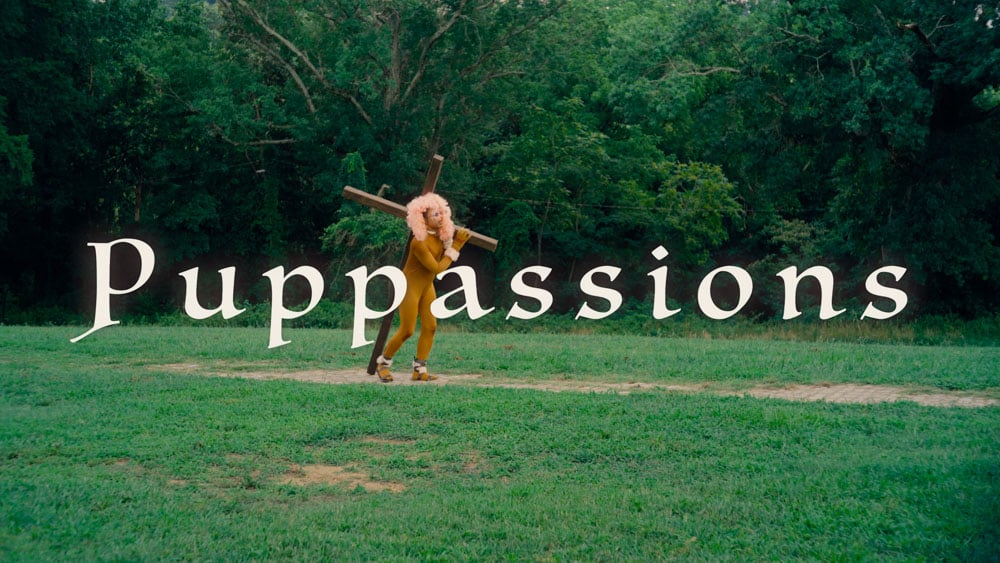
C: Christian [Detres] sent me this crazy film that he worked on with you where you dress as a dog and carry around a cross. Can you tell me a little about that project?
M: Puppassions. I mean, I’ve been really interested in the interplay of interspecies relationships, like how people relate to dogs, you know, versus how people relate to people, specifically people of color, specifically Black people. You know, it’s a complicated, messy, long history of Black relationships with dogs and dog relationships with Black people.
C: Sorry, do you think that certain kinds of dogs, or all dogs? I’ve never even thought of this.
M: If we’re talking specifically about breeds, yeah, I think there are certain kinds of dogs, but also that would depend on breeding. Like, certain dogs have been bred to fear or attack or do something, literally, inherently.
But then also, talking about, like, on a more interpersonal level, I think there are some cases where we value dogs’ lives more than people’s lives. Sometimes that becomes a weird scapegoat, like a subterfuge of other understandings, of other sociopolitical understandings of ideas, you know, of our lives.
It’s like the way that we allow the animal hierarchy can sometimes reveal other deep understandings about race and culture. It becomes a dog whistle without us actually noticing. This is kind of a longer body of work of mine that I’ve been exploring for the last few years. I used to give a real straight-up lecture, up-and-down lecture called “Why Do People Like Dogs More Than Black People?”
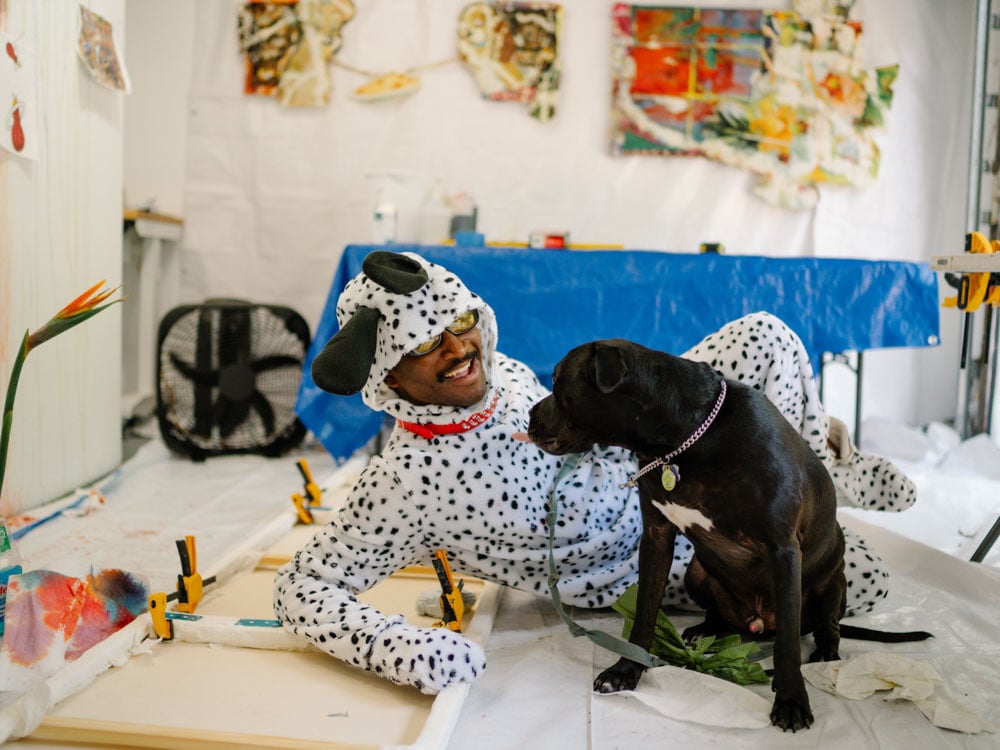
M: So, coming down to Puppassions, I was invited to be part of this “dog and pony show” at Main Projects in Richmond. At first, I was like, what am I going to do about dogs? And then I was like, oh, well, you know, I do have all this research. It was an easy thing to tap into because I’m already thinking about it.
This idea had been kind of percolating for years. I was like, oh yeah, I’m going to be a dog with a crucifix one day. That’s going to be so funny, you know? Or I’ve always wanted to be a dog in a window. Yeah, a dog in a window was something I’ve been thinking about for a while.
C: Maybe that is why they called you.
M: They’re like, who’s someone weird who’s not going to make a painting, that can really spice things up for us? Let’s call this freak, you know, which is usually how every phone call I get goes.
They’re like, “Oh, I saw you did something wild over here. Do you think you could do something like that, but not, like, hurtful or offensive?” And I’m like, I don’t know, how do I not be?
C: Because all of your art that I’ve seen so far could be offensive to people that are easily offended. So, like, what are they asking for? [laughs]
M: That is a question I ask myself quite often. What are they asking from me? Because especially when I get these calls, and then I submit proposals, and then they’re like, “Oh, my gosh.” And I’m like, well, girl, you called me. [laughs] Did you think I was going to change into somebody else?
I have a very long and proven track record of doing the most and doing it too much all the time.
C: Was there, like, a show where you were like, this is it?
M: So, like, my thesis exhibition at Cooper Union was pretty well attended, you know, but, like, my first big, big break that I remember was my graduate thesis in Baltimore, which was this lecture performance that happened right during COVID.
So I graduated in interdisciplinary art in Baltimore in 2020. Can you imagine getting a master’s degree in interdisciplinary art in the middle of a pandemic? You can’t really do that shit anymore. There’s no outside to put an installation in. There’s no other person to do a performance with. And so, you know, you have to pivot.
So I wrote a lecture on the history of mourning and lamentation in contemporary art practices while I cried for the duration of the lecture.
C: And then you had everybody else cry.
M: I taught everybody else how to cry. It’s, like, comedic, yet actually a cathartic system. I remember the Zoom was packed. So many people came. So many major art people showed up to my graduate thesis on Zoom, thankfully.
I think because it was Zoom, and also because I was able to adapt to the time so quickly, the phone calls started rolling in after that. Then the next day, I was named the best artist to watch somewhere, and I really love that crying my eyes out on Zoom was all I had to do.
C: Because I’m a wig fan, I love your work with hair and the fans. How did you end up dealing with these materials that you’re working with?
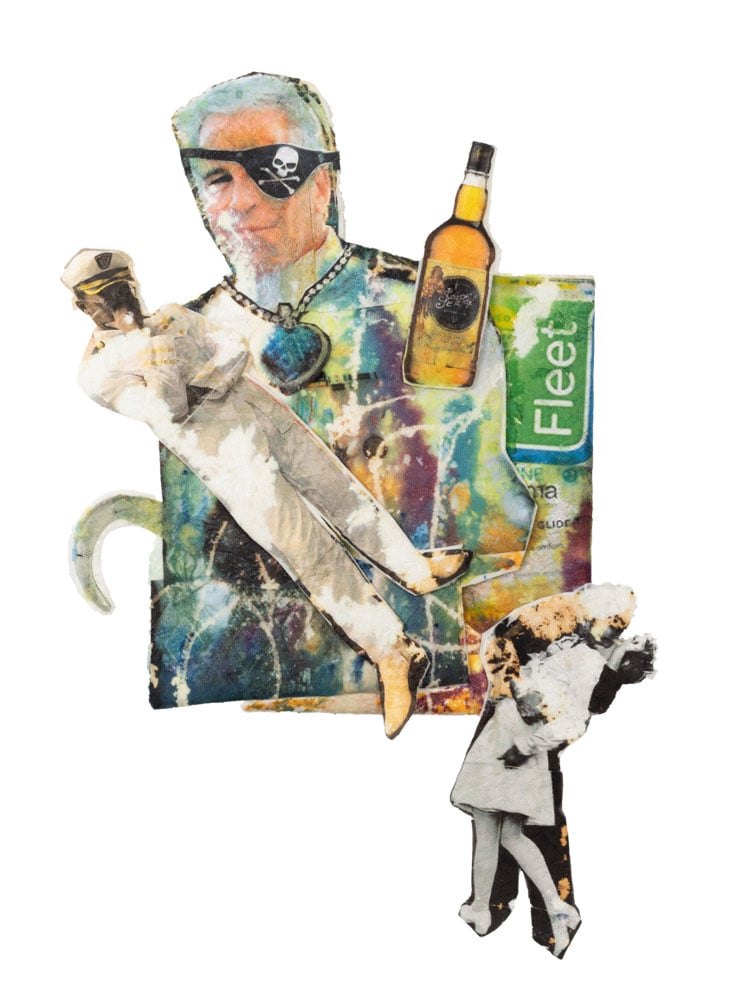
M: I’m really well known for these paper towels now, which is hilarious. You could not have told me 20, 15 years ago that this paper towel thing would have happened.
C: When I was researching it, I didn’t even see that much paper towel art.
M: Yeah, exactly. The paper towels just paid for my life, you know. But the performances, the video, the installations, the sculptures, that’s what people talk about more. But the paper towels, don’t get me wrong, I love them.
C: Why do you think people fixate on the paper towels?
M: Because it’s not a normal element people have used. Also because museums and curators love working with them because it helps them point to different things in their own collections, because of how historically referential the works are.
I’m always writing this essay on how terrible your fucked-up history is, and here it is all sped up for you on a paper towel. And museums can really work around that. Those works are being well collected by institutions, and I’m a magician, a wizard who found a way of making that shit last, you know, so they don’t worry, like, is that gonna decompose at some point?
And I’m like, well, the Hirshhorn has one, and they said it’s not going to, so go jump back up your mother, lady.
C: Well, how did you get into hair?
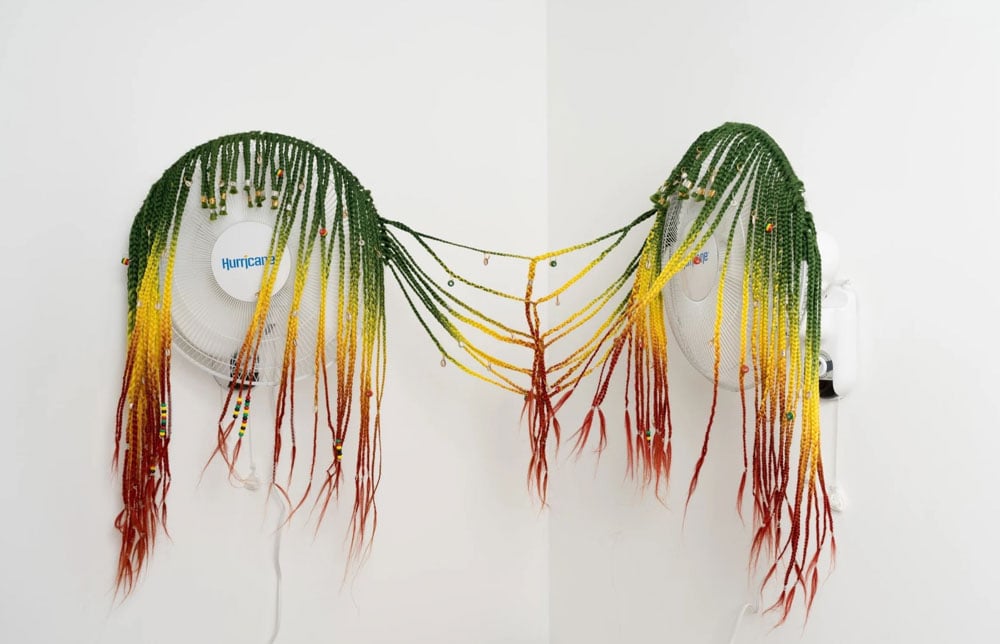
M: I mean, for me, all of it comes from all of the stuff that I grew up around. I grew up in an African home, you know, like fans and the packs of wig hair and Windex and all the birds of paradise.
There was always the early rule that if my mom doesn’t have access to it, I don’t care. It’s not part of my practice, you know? I just kind of find my way back into my roots and my history and, like, my Ivorian upbringing, and then go from there.
Because luckily, and thank God, everything in this world is racist or homophobic or whatever, all of which gives me enough things to talk about for the rest of my life. And no one’s stopping making plastic things, so I can sew some hair onto that.
C: What does your mom think of how you’re taking the things you grew up with? Does she appreciate it, or is she like, you little shit?
M: She thinks that it’s ugly and I should just make shiny, nice oil paintings, and I’m being too complicated. I’m going to scare people, is what she thinks. But I love that because it’s true. You know, I am. That’s exactly what I’m doing. I’m not here to charm anyone. It just so happens that these things become charming through this exhumation process that I’m interested in.
C: The puppy, for example, it’s charming, but it’s also like, whoa.
M: I’ve always thought of my art as this thing where you look at it and you go, “Ah.” And then you think about it for 10 seconds, you go, “Oh, no.” And if I could do that every time, I know I’ve done it. I’m like, does this suck yet? Is this funny enough it sucks yet?
C: So you’re sort of a comedian, but a bit of a Gallagher.
M: Yes, exactly. Object comic. I’m so inspired by Gallagher and so inspired by, what’s his name? Man on the Moon, Andy Kaufman. This kind of, like, what is the end of performance? You know, how does an object become real? How do we question the real while also deep diving deeper and finding these abject histories inside of it?
The new godfather of the media, of the practice, is Nathan Fielder. That show, The Rehearsal, is just… When that came out, I was like, “I should just quit. He gets it.” My ethos is to always be charming and disarming.
C: So what are you working on now?
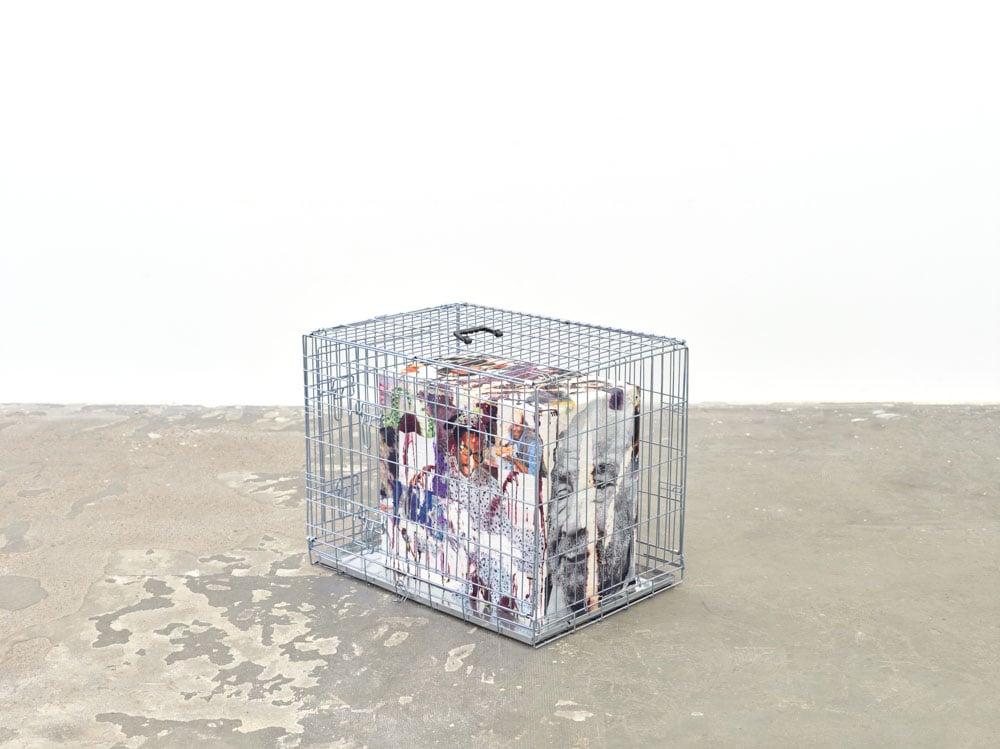
M: I’m working on this project on artist legacies and what happens to an artist’s life once they pass away. When a famous artist dies, a foundation gets set up to kind of uphold their memory. But that usually only revolves around their work, not necessarily their life.
In the case study that I’m dealing with, Felix Torres, he is this very, very prolific and important queer Cuban artist that was working during the epidemic. He does, like, when you see just a lot of string lights at a museum or a pile of candy on the ground, things like that. These are all his works dealing with the loss of his lover, temporality, kind of, like, body exchange and things like that.
But the foundation that’s been set up around him now, they don’t say gay edict thing going on, you know, where they’ve completely erased all of the, like, the kind of beautiful interpersonal poetry that kind of lives in his work for just, like, cold, hard-edge minimalism. So his foundation is held by this old American dealer and a large mega gallery.
The family has its own separate foundation and is thinking about his archive in a completely different way. When I started doing this project, I started coming down to Miami and looking for his life, you know, because the world had taken it away from us. I was looking for his friends, curators that had worked with him. And I stumbled upon his nephew, who is the arbiter of the family estate.
And the family estate, they don’t have the finances to run a full brick-and-mortar, and so he has been holding [the art] in storage in a closet in his house, which is very normal and exciting, but also, for me, is a gift that keeps on giving, you know. So the famous gay guy that society has pushed into a closet is actually literally in the closet somewhere.
So, with their beautiful permission, they’ve given me access to that archive in the closet. And I’m building a new closet in the gallery and inviting scholars and people to help do unboxings and go through his materials. And then we’ll do a live Zoom performance where people can chime in and learn about different things about his life. So this show will open October 17 in Miami at my gallery called KDR.
C: You have a gallery in Miami, and then you also have one in Berlin.
M: Yeah, in New York. I feel very, very, very fortunate that me and my little jokes and my favorite towels have taken me to everywhere and anything. I can’t take that for granted at all.
Especially because I live so far away. My home initially is in Richmond. You know, like, it’s really beautiful. I found that I really fell in love with this little quirky, weirdo, backwards city. It’s like, at the same time, it’s like a Benetton ad and a hostile powder keg where anything could go down at all times. And it feels like real work is happening there, and I’m being a part of it. I also like getting the hell out of there, you know.
C: You’ve been Richmond home-based, but you haven’t done a big thing there yet.
M: It’s been six years. I think because of Richmond’s gentility, you know, I’m a little too… everyone’s a little too afraid of what I’m going to say.
C: Okay, so you do Florida. What’s up after that for you?
M: I have a show coming up at the Museum of Contemporary Art Detroit. It’s a completely different investigation about safety. That show is called Nest, and it will deal with these ideas of how the systems that we put in place to protect us are actually just masquerading as violence systems.
C: Oh, I bet there’s going to be a lot of Flock cameras about that.
M: Yeah, exactly. I’m interested in the Flock camera. I’m interested in the Nest camera. I’m interested in smoke alarms. I’m interested in… what’s it called again? What’s the Macaulay Culkin movie where he assaults those people for breaking in?
C: Home Alone!
M: Yes, there’s the stand your ground, and it’s a very antiquated, racist archetype position between, like, crazy Texan or, like, stand your ground, with people thinking about it as, like, Kevin McCallister versus Tyler Perry’s Madea, who both exemplify the same kind of characteristic, but one is hostile and violent, and one is an adorable child. And I wonder why?
As we wrapped up the call, Zohore left me with this warning:
“The next few years, the next few months, I’m definitely not getting any safer. I’m definitely not being any nicer, and I’m definitely not trying to pretend that everything’s okay, you know? And, you know, I’m so sorry if your favorite appliance gets called out, but we gotta talk about it, baby.”
Support RVA Magazine. Support Independent Media in Richmond.
RVA Magazine has remained one of Richmond’s few independent voices. Since 2005, we have provided grassroots coverage of our artists, musicians, and communities, marginalized or otherwise, documenting the city’s culture that lies right under the surface and beyond the headlines.
But we can’t do this without you. A small donation, even as little as $2, one-time or recurring, helps us continue to produce honest, local coverage free from outside interference. Every dollar makes a difference. Your support helps keep us going and keeps the local creative spirit alive. Thank you for standing with independent media, and thank you for reading.
Show your SUPPORT HERE
Also, subscribe to the newsletter HERE
We’ve got merch HERE
Subscribe to the Substack HERE
And Reddit HERE
And YouTube HERE