
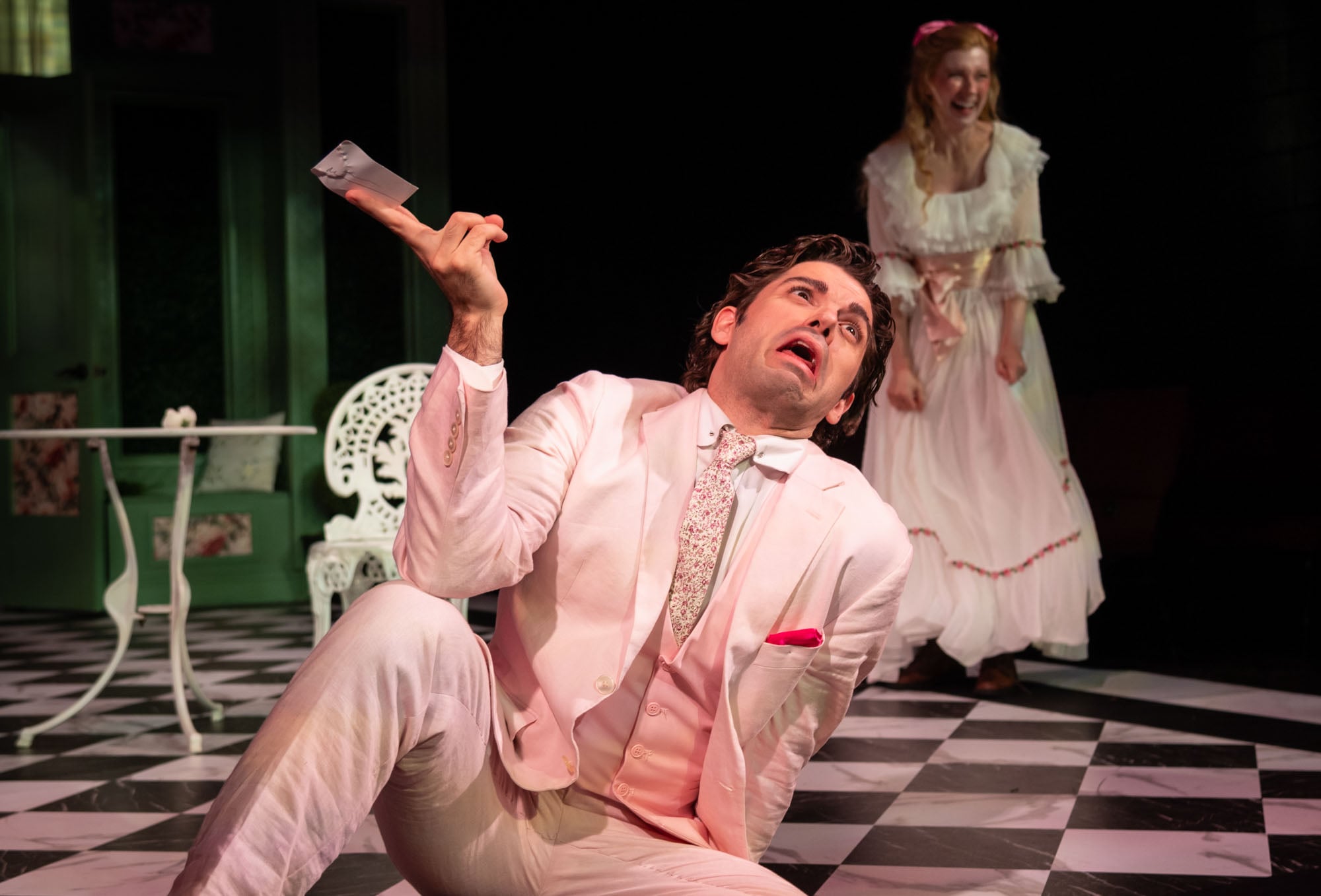
The Importance of Being Ernest has been on my radar since I was 13, when my beloved Morrissey mentioned Oscar Wilde in an interview. (Mind you, this was long before Morrissey’s far-right weirdo rants.) As a massive fan of the arch, wry, witty lyrics of the Smiths and being very influenced by British sitcoms— i.e., as a massive nerd — I had to see what was up with this other foppish misanthrope. So I read Wilde’s play in my high school library and understood the appeal immediately. You get the impression Wilde hates people, but he understands them better than they understand themselves. In fact, he may hate people because he understands them better than they understand themselves.
Wilde, to me, is the zombie of William Shakespeare reanimated for the Victorian era. Along with the nonsensical setups and the scaffolding of ridiculous conundrums, Wilde’s language and incisive skewerings can only be compared to the Bard. Their non sequiturs and edgy asides are thinly veiled insults wrapped in pretty words, like elegant bricks aimed at high-society windows. So it makes perfect sense that Richmond Shakespeare added Wilde to their Shakespeare sandbox by selecting Ernest to close out the 2026 summer season.
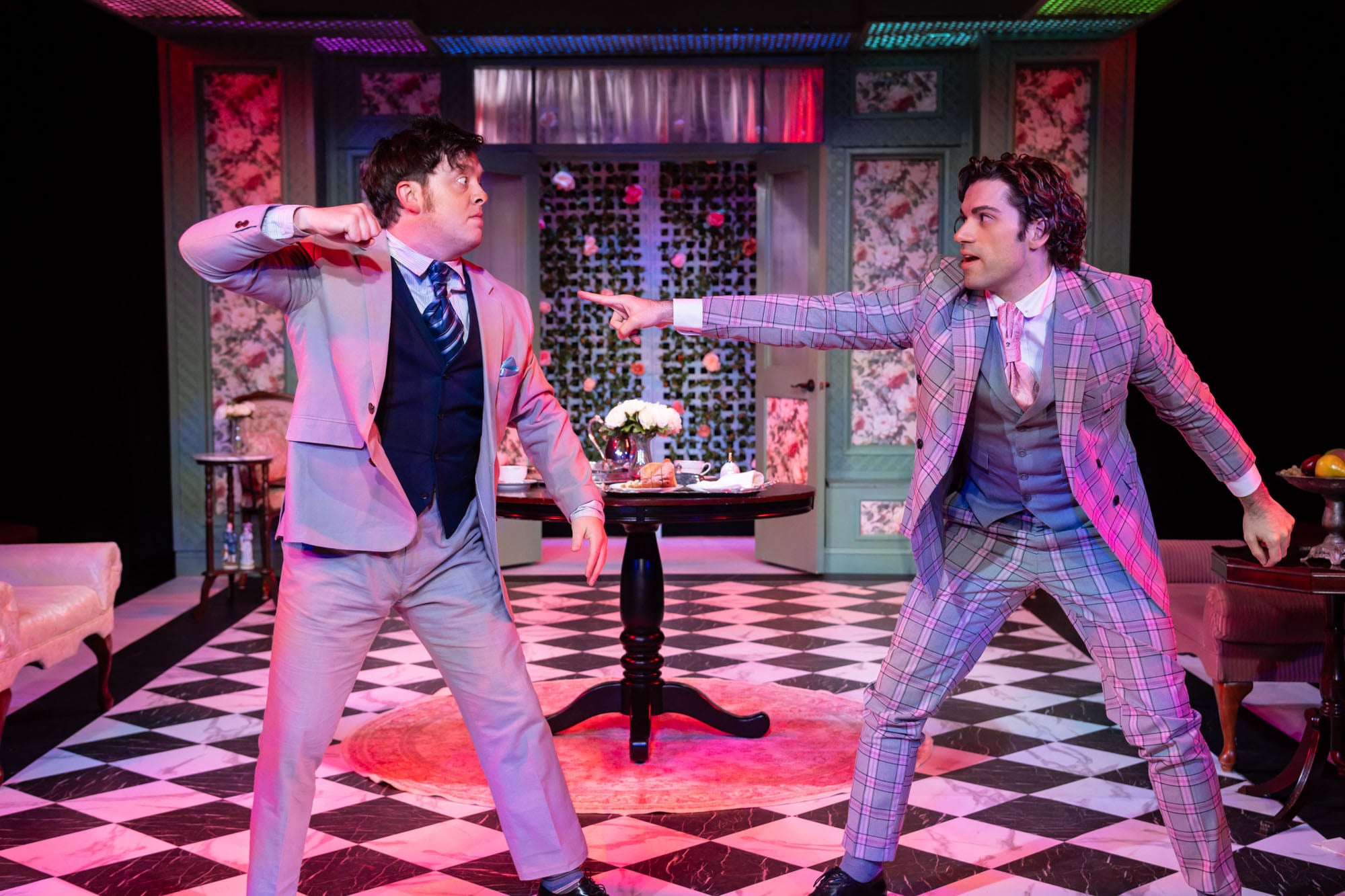
The premise of Ernest is kinda dumb, but that doesn’t stop it from being one of the sharpest, silliest dismantlings of English society this side of Shakespeare. It’s a comedy of errors in the traditional sense: mistaken identities, confused intentions, romantic misfires, etc. Plot-wise, the less you think about the logic, the better. It isn’t about that. You could say this, too, was Wilde expanding upon the legacy of Shakespeare.
First, the set. Director Irene Kuykendall creates a horseshoe arrangement for the audience, where the stage is flanked by seats on three sides. On stage, the placement of furniture is “just so” while the lighting is bright and even, inviting the audience to an English garden or a sitting room filled with tea cakes and cucumber sandwiches. Black-and-white checkerboard flooring enhances the sense of symmetry and, perhaps, the gamesmanship of romantic maneuvering. From where I sat, the forced single-point perspective was hypnotic and Kubrickian, like the last few scenes of 2001: A Space Odyssey. I half expected a confused astronaut to emerge from backstage.
Next, the costuming. Lamé and frills didn’t come in electric pink or luscious purple in the late 1800s, but they should have. Ernest’s costume construction was impressive indeed, and I sensed someone very clever behind the stylistic choices. Full points on presentation.
Likewise, the lighting and sound cues (I’m getting to the performances, hold your horses) were expertly done, allowing some unexpected entrances to hit like the Spanish Inquisition. Not enough attention is given to how timing like this can make or break a scene. Golf clap to the booth.
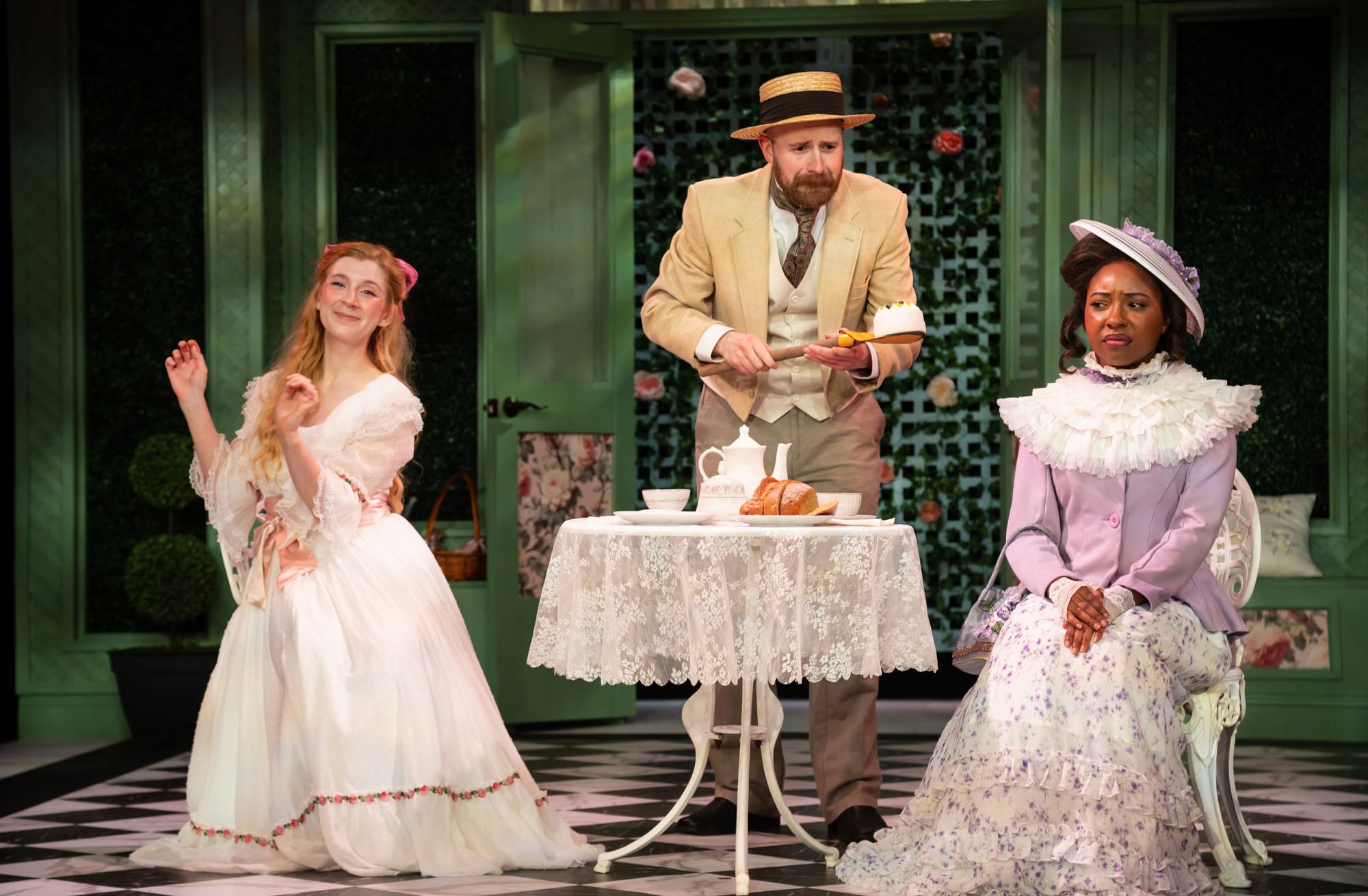
And the cast: Toby O’Brien takes the best of David Mitchell, Jon Lovitz and similar lovable losers/unlucky grifters to create his own stew of misadventure in flop sweat. His put-upon Jack Worthing (aka Ernest #1) is an amusing mix of good and evil, and you can tell he had a lot of fun with the role.
Felicia Fields (hoity-toity Gwendolyn) and Claire Wittman (bouncy, buoyant Cecily) take on roles Oscar Wilde wrote with an acid pen, one he often reserved for his female characters. Gwendolyn and Cecily have ridiculous beefs with their romantic entanglements and vacillating relationships with each other. Their scenes together are the best in the show, getting the laughs they deserve in some of the quippiest banter ever put to paper.
Boomie Pedersen gives pomp some circumstance to the imperious Lady Bracknell, the avatar of an aging generation chasing relevance long after the train has left the station. For anyone complaining about Boomers, this is a reminder that they’ve always existed, and you yourself might become one. It’s a warning to those who think their way is the only way. Pedersen adroitly cracks Wilde’s wit, dropping some legendary one-liners with timing befitting her experience.
Dixon Cashwell’s talent deserves exposure beyond this stage, great though it is. Here, in two roles, he’s the servant class: As one butler, he obeys with sarcasm; as another, he tries hard to please but sees his best intentions ignored and his work destroyed. Cashwell plays with each character like a rubber puppet, and he’s effortlessly funny in both. Each role benefits from his infectious energy.
Patricia Austin and Andrew Gall — whom I’m so happy to see on stage, since he’s usually the guy directing the show — reinforce the British sitcom connection, acting straight out of an episode of Father Ted. As the governess and the parish priest, their saucy characters serve as a template for that era of British comedy. Add a laugh track and it’s basically BBC Four.
Finally, understudy Benjamin Tarlton subbed for Korey Harlow, who must be incredible, given he was cast over this guy. As the selfish and scheming Algernon, no part of Tarlton’s performance didn’t seem rehearsed to perfection. His physicality and ready-for-TV timing helped keep the energy up as the silly soap opera unfolded. Tarlton was hitting his marks while breaking the fourth wall, confidently reacting to a few audience outbursts. He showed the difference between watching someone mindlessly dominate a stage versus seeing a sly operator cook with intent. I’m sorry I didn’t get to see Korey’s take on Algernon, but I’m far from unhappy to have seen Tarlton’s.
Thinking about actors and roleplaying takes on extra meaning in Ernest. Mostly, the play is about acting like someone else — playing a role to improve your chances for love, for money, for life. Maybe that’s why it still resonates with a modern audience. After all, as Wilde once wrote, “Most people are other people.”
Photos by Aaron Sutten
Support RVA Magazine. Support Independent Media in Richmond.
RVA Magazine has remained one of Richmond’s few independent voices. Since 2005, we have provided grassroots coverage of our artists, musicians, and communities, marginalized or otherwise, documenting the city’s culture that lies right under the surface and beyond the headlines.
But we can’t do this without you. A small donation, even as little as $2, one-time or recurring, helps us continue to produce honest, local coverage free from outside interference. Every dollar makes a difference. Your support helps keep us going and keeps the local creative spirit alive. Thank you for standing with independent media, and thank you for reading.
Show your SUPPORT HERE
Also, subscribe to the newsletter HERE
We’ve got merch HERE
Subscribe to the Substack HERE
And Reddit HERE
And YouTube HERE