
2025 has been a tough year for farming across the country, and from the outside looking in, it’s hard to tell what’s actually happening versus what’s being spun. So instead of guessing about beef prices or egg shortages, it made sense to ask someone dealing with these realities every day.
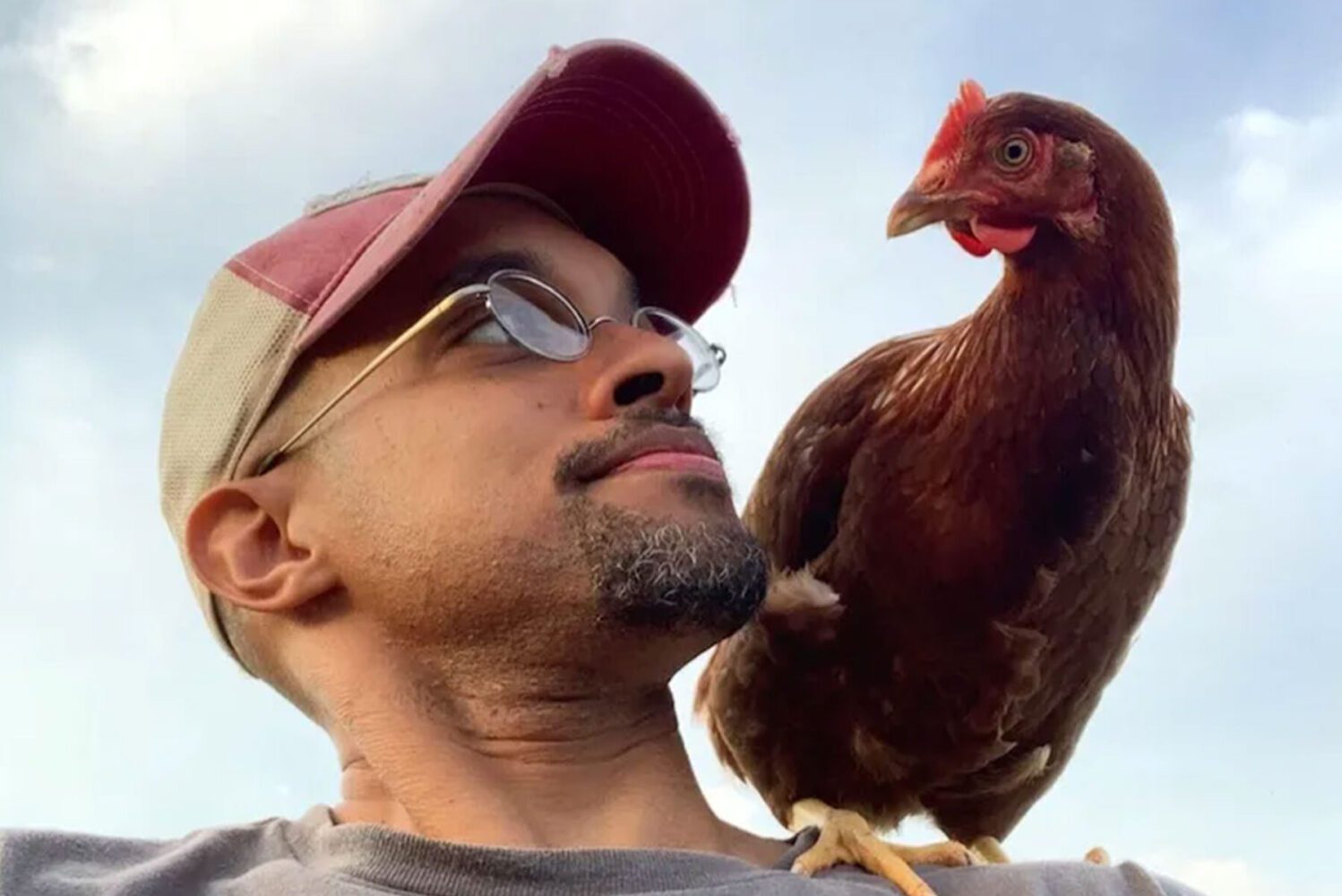
I spoke with Chris Newman, a Virginia farmer I interviewed a few years ago whose perspective has only grown more relevant since. Newman remains something of an outlier in the field. As a minority farmer and the force behind Blackbird, he’s actively building infrastructure meant to address the problems hitting agriculture right now, as well as the ones looming just ahead, in Virginia and across the country.
He didn’t hesitate.
“Business has been booming for a lot of terrible reasons,” Newman said.

The EGG Shortage
Early in 2025, bird flu sent egg prices soaring nationwide.
“Egg prices just went through the stratosphere,” Newman said. “None of our costs really got impacted by that. Bird flu bypassed us. We mostly dodged the tariff stuff that was coming out at the same time. I hate this about our industry. A lot of farmers raised their prices just because they could. Even if they weren’t hit by bird flu. Even if they didn’t have tariff issues. They saw grocery store eggs at seven dollars and said, well, I want mine to be nine or ten or eleven.”
“We did not do that, and that’s paid dividends. It turns out that not fucking people over is good business. Shockingly. People are just exhausted. They feel manipulated. They feel gouged. They feel like every large institution is trying to see how much they can get away with. That chaos sent a lot of people looking for direct-to-consumer farms that didn’t do that, and we benefited from it.”
Beef Prices
Beef was the other major pressure point this year, and Newman is careful to separate what is real from what is being exploited. “It’s both,” he said. “There is a real shortage of beef in this country, and there’s also some serious gouging going on at the same time.”
By the numbers, the shortage is undeniable. U.S. cattle herds are now roughly the size they were in the mid-1950s, a startling figure given population growth and modern consumption patterns.
“That’s being driven by very real things,” Newman said. “Mostly climate change. Persistent drought in the pasture belt and the high plains. People just can’t carry as many cows anymore.”
Pregnant cows, he explained, have especially high nutritional needs. When grass and hay disappear, farmers are forced to make decisions they would rather avoid. “When there’s not enough grass, not enough hay, not enough room to graze them, you have to cull your herds,” he said. “You end up slaughtering animals you didn’t want to.”
That supply pressure has been building for years. Newman pointed to auction prices to show how dramatic the shift has been. “The last time I bought beef at auction, five-hundred-pound calves were going for maybe $160 or $170 per hundredweight,” he said. “Now it’s pushing $300. It’s crazy.”
But where the money lands depends entirely on where you sit in the supply chain, and that’s where Newman says most consumers get lost. “The beef industry is extremely segmented, and people don’t understand how it works,” he said. “That makes it very easy to manipulate them.”
At the top are seed stock producers, who deal in genetics and bull semen.
Next come cow-calf operators, who raise breeding cows, produce calves, and sell them at auction once they’re weaned.
After that are backgrounders, who put weight on young cattle, and finally finishers, often large feedlots, who fatten cattle on grain before slaughter.
“The people making a killing right now are the cow-calf guys,” Newman said. “They’re selling calves at historically high prices.” The pressure then shifts downstream. “The people buying those calves, the backgrounders and the finishers, are getting crushed,” he said. “And over ninety percent of cattle still get finished in feedlots.”
“The feedlots are often, but not always, owned by the meat packers themselves, and they’re the ones that get to set the prices,” Newman said. “The prices are determined by what consumers are willing to pay, and right now they’re seeing how much they can get away with. It’s the same thing you saw with fast food and retail. Dynamic pricing. You push it until people scream, then you back off a little.”
“Consumers see high prices and assume it’s all scarcity, but a lot of it is companies capitalizing on the fact that people don’t know how the industry works. People feel manipulated. They feel gouged. And they’re not wrong.”
Small Farms Under a Microscope
“I know people charging ten dollars a dozen for eggs, and I know damn well it doesn’t cost anywhere near that much to produce eggs,” Newman said. “A lot of small farmers are riding the green trend. They price everything above the grocery store because their stuff is better, so that’s just what they do. That whole farm-to-table movement was about pay extra to be a better consumer, to protect the environment, to feel like you’re doing the right thing.”
“My eggs are better than conventional eggs. I love my eggs. They are not three times better. What people are really buying is living wages for employees, less environmental degradation, the fact that we do mutual aid, and diversity in our business. But there are fewer people now who can afford to be the better consumer just for the sake of being the better consumer. Money is more expensive. Credit is tighter. Everybody is getting squeezed from every direction, and expensive ass food is one of the easiest things to cut.”
“I call it the class of 2012 or 2013. Ninety-one percent of those people are gone. The farmers who are left tend to be the ones who could afford to lose money for a while, or the ones who locked in a very affluent customer base. Small farmers need to be careful. People’s bullshit detectors are calibrated right now. Farmers are under a microscope they haven’t been under since the Great Depression, and some of them are going to find out the hard way that branding isn’t a substitute for honesty.”
Expansion Without Losing the Plot
For Newman, the answer to everything breaking at once was not retreat. It was scale.
“Like I’ve said before, our business model has changed kind of dramatically,” Newman said. “What we realized is that if you don’t expand, you don’t survive. And if you don’t do it intentionally, someone worse will do it for you. We’re signing leases right now, one in Richmond and one up near Springfield, so we can serve Northern Virginia properly and also push further south into Virginia Beach, Norfolk, all of that.”
“We’re launching an eight-year plan, raising about six million dollars to get us to the point where we’re slaughtering a million broilers a year, running close to a hundred production units, about two hundred thousand laying hens, and roughly two thousand acres under management. We’re not trying to maximize shareholder value. We’re trying to maximize stakeholder value.”
“When you compare our prices to farmers markets, we’re thirty to forty percent less a lot of the time, and we’re only going to get cheaper. If your local egg farm disappears, most people don’t find another small farm. They go to the grocery store and buy Vital Farms or Happy Egg Company. These companies pay lip service to the letter of pasture-raised or regenerative, but they violate the spirit of it constantly.”
“Corporations are more powerful than individual farmers. That’s just reality. And if you don’t acknowledge that, you’re going to lose. If we’re going to survive this next decade, we have to be big enough to say no.”
Farming Isn’t Under Attack.
Newman rejects the idea that farmers are uniquely under attack by policy or politics.
“Farming isn’t under attack. Farmers have been one of the most coddled and politically protected classes in this country. Nobody gets the kind of support that farmers do, except maybe defense contractors. You’ve got the government paying for everything from fencing to greenhouses to well drilling. You’ve got insurance supports. Price supports. Loans on terms I would never get in any other industry.
“What we’re seeing right now is equality starting to feel like oppression to people who’ve been privileged. Farmers have had incredibly good PR for a very long time, and a lot of that goodwill is getting burned right now.
“There were grants designed to get people back on the land who were chased off it at gunpoint, and those got wiped out. But the real crisis isn’t that farming is under attack. It’s that the system we built only works when everything is stacked in farmers’ favor.
“And when the playing field starts to level even a little bit, you find out very quickly who was actually running a sustainable business and who wasn’t.”
The Succession Problem
For Newman, the most dangerous crisis facing American agriculture has nothing to do with yields, tariffs, or even climate. It’s age.
“The average age of farmers right now is around sixty,” he said. “In ten years, a lot of them are going to be in their seventies, and most of them are going to want out.” Nearly half of U.S. farmers are expected to retire within the next decade, and many do not have children or heirs willing to take over. “The kids don’t want it,” Newman said. “And honestly, I don’t blame them.”
That looming exit has not gone unnoticed.
“There are organizations like AcreTrader that are just waiting to snap this land up,” he said. “They’re not buying it to farm it. They’re buying it to stick it on their balance sheets and wait for it to appreciate.” In that model, farmland stops being a place where food is grown and becomes a financial instrument “They’re relying on older farmers not caring as much about price,” Newman said. “They’re trying to buy land for pennies on the dollar.”
Once land is absorbed into private equity portfolios, Newman argues, the possibility of building a new generation of farmers collapses. “They might rent it out,” he said. “But they’re never going to give you a twenty-year lease.”
Without long-term tenure, farmers cannot responsibly invest in soil health, infrastructure, or sustainable practices. “They want to be able to kick you off the second they find minerals, or the second it makes more sense to turn it into housing,” Newman said. The result is a system where land is technically “in production,” but farming becomes precarious and extractive. “You can’t build a life on a one-year lease,” Newman said. “You can’t build a food system that way either.”
Newman sees this as a direct threat to food security. As more farmland is parked by investors, fewer people are able to access land with the stability required to actually grow food. “That’s how you end up with more market concentration,” he said. “More power in the hands of big food corporations that don’t give a shit about your health.”
Once that concentration hardens, Newman warns, the consequences ripple outward. “When your neighbors can’t feed themselves anymore,” he said, “they come looking for food somewhere else. And that’s never fun.”
Rethinking Ownership, Not Farming
For Newman, the problem isn’t farming itself. It’s what people think farming is supposed to look like.
“I don’t think individual land ownership is the point,” Newman said. “Tenure is. Nobody thinks the restaurant industry is going to collapse because most restaurants don’t own the buildings they’re in. What matters is that they have leases long enough to build a business. Farming should be no different. What farmers need is tenure, and they’re not going to get tenure from private equity.”
Under the model he’s building, land is held through a mix of ownership, long-term leases, land trusts, and informal agreements with older farmers who want continuity more than a final payday.
“In our 2033 plan, we need about two thousand acres,” Newman said. “Not all of that is going to be owned. Some of it might be land trusts. Some of it might be twenty-year or ninety-nine-year leases. Some of it might be agreements with older farmers who don’t have heirs.”
What matters, he said, is whether farmers can make long-term decisions without fear of being pushed off the land.
“If you don’t know whether you’re going to be on that land next year, you’re not going to invest in soil. You’re not going to invest in infrastructure. You’re just going to extract what you can,” Newman said. “That’s why people burn out. People quit good jobs, move to the country, buy a few acres, get some goats because everybody buys goats. And it’s fun for a little while. Then the money catches up with you.”
The romantic version of small farming, he said, hides the tradeoff.
“You get the lifestyle, but you don’t get security,” Newman said. “And those two things are usually mutually exclusive.”
His goal is to break that equation and treat farming like a profession instead of a gamble.
“You can come in with no experience, no degree, and make twenty dollars an hour,” he said. “You can move into management. You can make seventy or eighty thousand dollars a year out here and be set.”
That, Newman said, is what stability actually looks like.
“You can have the farming lifestyle without the constant financial terror,” he said. “Most people don’t actually want to own land. They want stability. They want a future.”
Ownership, in his view, has become a distraction.
“Buying land is something rich people do to get more secure,” Newman said. “It’s not how working people build a life.”
A Hard Year That Clarified Everything
“None of this stuff is new. Climate pressure, consolidation, price manipulation, all of it was already happening. This year just stripped away the excuses. We’ve built a food system that only works when everything goes right, and everything doesn’t go right anymore.
“It’s not like the lights just shut off. It’s death by a thousand cuts. We’re at a moment where we can either reimagine this whole thing or we can keep patching a system that was never built to last.”
“People need to stop romanticizing how we got here. A lot of what we’re trying to preserve was never sustainable in the first place. If we’re serious about resilience, we have to build structures that can actually survive stress.”
“Because the next shock is coming. And it’s not going to wait for us to feel ready.”
Support RVA Magazine. Support Independent Media in Richmond.
At a time when media ownership is increasingly concentrated among corporations and the wealthy, RVA Magazine has remained one of Richmond’s few independent voices. Since 2005, the magazine has provided grassroots coverage of the city’s artists, musicians, and communities, documenting the culture that defines Richmond beyond the headlines.
But we can’t do this without you. A small donation, even as little as $2, one-time or recurring, helps us continue to produce honest, local coverage free from outside interference. Every dollar makes a difference. Your support keeps us going and keeps RVA’s creative spirit alive. Thank you for standing with independent media.
DONATE HERE PAYPAL
DONATE HERE CASH APP
We’ve got merch HERE
Subscribe to the Substack HERE
And Reddit HERE
And YouTube HERE