
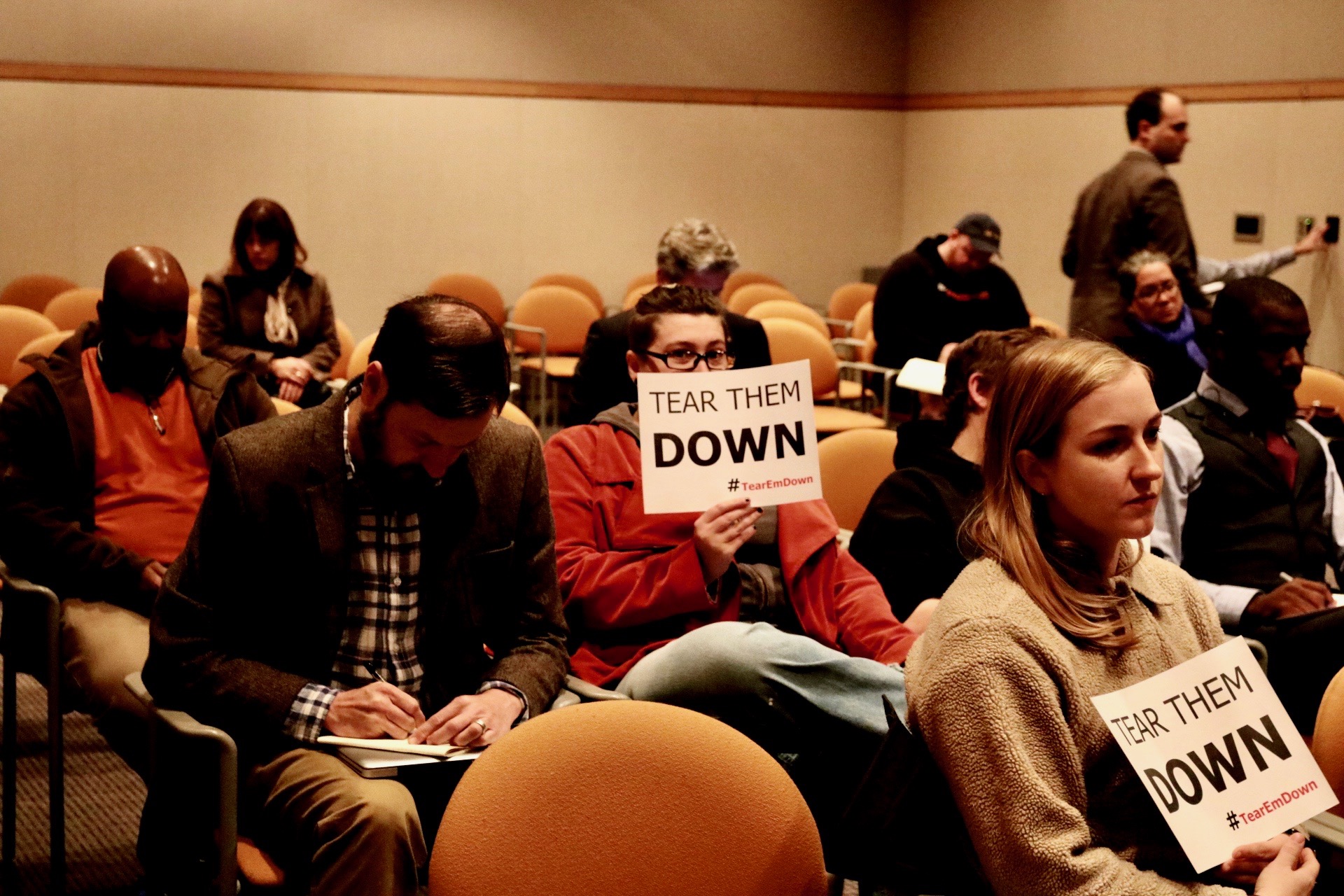
After a series of postponements, the Monument Avenue Commission met for the first time since the violent alt-right rally in Charlottesville on August 12, for a working meeting without public comment. Half of the 10 commissioners met before some 80 citizens and covered state laws concerning the preservation of monuments, an online exhibit by the American Civil War Museum, and discussions on public engagement and future meetings.
City Attorney Allen Jackson fielded many questions about state laws regarding monuments, with the final takeaway that neither alteration nor removal was permissible under law. Signage that points to the monuments is legal, only so long as it does not interfere with viewing the monuments as they currently exist. Commissioners challenged the finding, noting past additions of fencing or changes to the adjacent road surface, but none of the concerns impacted the legal opinion.

Jon Baliles. Photo by Landon Shroder
The next agenda item concerned public feedback. Commission co-chair Christy Coleman read some of the more than 1,200 letters the commission has received, noting that before the fatal rally in Charlottesville most letters were in support of keeping the statues. After the rally, letters shifted to safety concerns and preventing another tragedy. After many letters were read aloud, commissioner Julian Hayter asked if and when the letters would be available online, and in what format.
“We’re hoping for December 1st,” Coleman answered, before a lengthy description of a database system holding full text, summaries, and accompanying meta-data to signify what position the letter writer held, but noted that addresses and names would be stripped out for privacy concerns. City councilor and commission member Kim Gray cautioned the commission to proceed carefully, expressing concerns that Freedom of Information Act rules might be violated by a focus on privacy.
After the letters, a brief slideshow of an online exhibition for the “On Monument Avenue” website was presented by Stephanie Arduini and Chris Graham, respectively the director of education and a special curator at the American Civil War Museum. Arduini noted that people often say they want to hear different perspectives, but that many discussions turn to debates; in response, they are working on providing the viewpoints anonymously, so people can read without a back-and-forth.
Commission co-chair Gregg Kimball encouraged a similar approach for future meetings, pushing to move away from the public forum they adopted for the August meeting. “I did not find that very useful,” he said, referring to the heated, sometimes messy exchanges.
Gray agreed that small discussions were useful, but advocated for holding at least one public hearing. “I don’t think talking to small groups is enough,” she said, before describing public hearings as difficult but necessary. “As a public body, having a public hearing is important, it’s part of the process. It’s fundamental to democracy.”
Outside the meeting, former council member and mayoral candidate John Baliles, now a senior advisor to Mayor Stoney, drew a distinction between the Mayor’s opinions on the need to remove the statues and the legal opinion presented by the city attorney. He was in favor of more public engagement and the small groups. “You want to engage with people on this, and it’s hard to do that in a big open-mic setting,” he said.
Members of the Democratic Socialists of America stayed after the meeting, and throughout the session, they held signs reading #TearEmDown, as a way to generate discussion on monuments in a forum where public comment was not allowed. One member, Dean Sayers, talked about the impact of the monuments on oppressed communities and said it was a big issue for the group. “Every meeting we have, this comes up,” he said, before sharing his opinion on the progress of the commission. “It felt stalled.”
“I was disappointed by the focus on pro-confederate views instead of comments by people of color,” said Sarah, another DSA member who used only her first name, about the letters which were read during the meeting. The majority of letters selected for reading were in support of the monuments.
James Ray, second-in-charge of the Sons of Confederate Veterans Virginia Chapter – a pro-Confederate heritage group – was also critical of the process, but for different reasons. He supports keeping the monuments untouched without additional context, but was disappointed that the commission hadn’t reached out to his group. “They never invited us to participate,” he said, questioning if the commission was biased in favor of removal. He was encouraged by the opportunity for the small group discussions. “We’ll take them up on that,” he said, describing it as a good chance to share their perspective.
He was reassured by the legal opinion of the city attorney, but skeptical of the number of questions the commission asked, noting that the law isn’t very ambiguous. “It’s crystal clear,” he said, pointing to the conclusion the commission arrived at. He was confident that monument preservation would win at the General Assembly if the council did recommend removal.
“I played competitive sports, basketball, tennis. I’m not big on celebrating a loss,” offered one man who went by JB. Although critical of the monuments, he said he was just there to observe, not to push for removal or preservation. “But whichever way they go, if it’s not removal, the only way is to add more statues, right there on Monument Avenue. You have to tell both sides of the story. People who fought against the Confederacy, the people they enslaved, people like Nat Turner, they need to go up there. Tell their stories too.”