
At least four of the 180,000 African American soldiers who fought for the Union were buried in either East End or Evergreen cemetery on the outskirts of Richmond. Their stories were forgotten, in part because of the Jim Crow laws that disenfranchised Black Richmonders and their burial grounds.
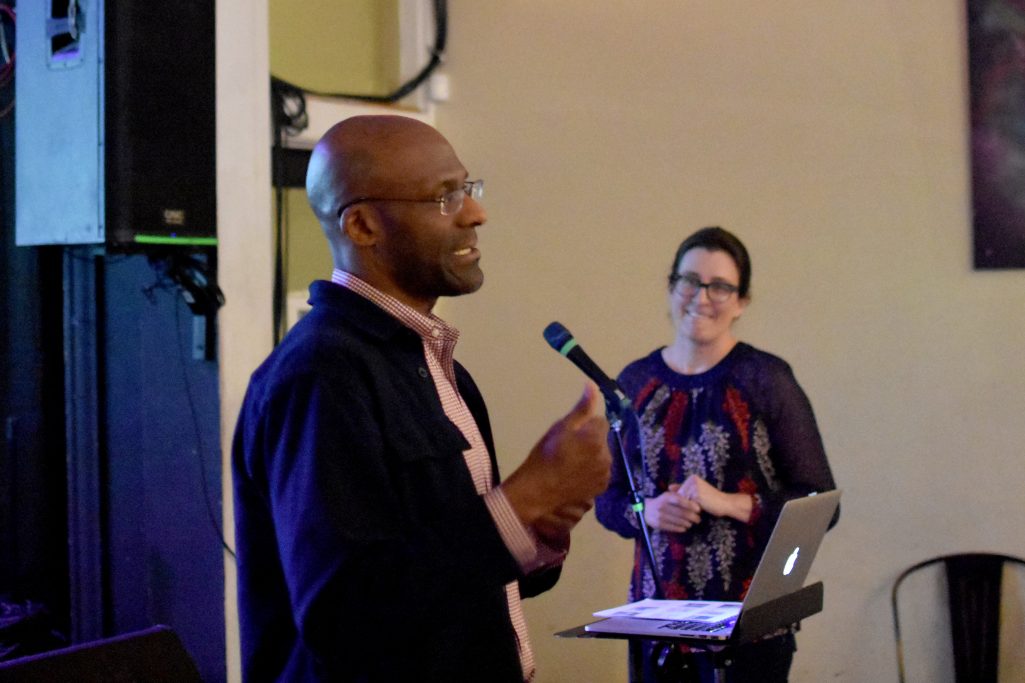
Two journalists, Brian and Erin Hollaway Palmer, brought some of those stories to life Monday night at The Camel, for 60 attendees of a History Happy Hour sponsored by the American Civil War Museum, titled “Freedom Fighters at Rest.” The theme and timing coincide with Black History Month.

Sean Kane Programs Specialist From ACWM
The Palmers became interested in local graveyards after Brian discovered his great-grandfather, Matthew Palmer, was buried in Camp Peary, near Williamsburg. Matthew had served in the 115th Regiment during the Civil War, in one of the many regiments of the United States Colored Troops (USCT), named during a time when the offensive term colored was in wide use.
Brian knew his father had grown up in Magruder, an unincorporated community where many African Americans lived following the Civil War before the Army displaced them to make Camp Peary during World War II. He was able to visit and see the grave of his ancestor, but that was the end of his story. Like many of the African American soldiers, Matthew had been enslaved before the war, and records for him and many other men were conflicting, contradictory, or non-existent.
The Palmers relocated to Richmond, from their home in Brooklyn, and began work on two ambitious projects: The first to document the classified site known as Camp Peary, and the second, to uncover and reveal the stories of local men and women buried in East End Cemetery.
The stories of soldiers they found gave them a little insight into Brian’s great-grandfather, from the extraordinary life of William I. Johnson to the more ordinary account of Henry Williams.
Johnson was a prominent and wealthy man when he died in 1938. The Palmers found his story in the Work Projects Administration, which he shared in 1937, a year before his death at 98. He recounted growing up, being traded from home to home, and witnessing acts of torture at neighbors homes that shocked him. Even families that didn’t use torture “thought nothing of breaking up a family and selling the children,” Johnson said to his interviewer.
“Virginia WPA narratives were more accurate because African Americans interviewed the subjects, instead of the descendants of slave owners doing the interviews,” Brian said, as he described reasons Johnson’s narrative was credible.
While Matthew Palmer never became rich, Brian theorized that he probably joined the Union army the same way that Johnson had, at the urging of Union soldiers held prisoner near the men.
“They explained to us about slavery and freedom,” Brian read from Johnson’s account. “They told us if we got a chance to steal away from camp and got over on the Yankee’s side we would be free. They said if we win, all your colored folks will be free, but if the “Rebels” win you will always be slaves.”
Henry Williams of the 51st, Henry Wheaton of the 62nd, and Coleman Smith of the 27th Regiment were the other three soldiers buried in East End or Evergreen. Williams led a mostly ordinary life in comparison to Johnson, and conflicting records place him at both East End and Evergreen, but a letter suggests Evergreen.
Wheaton served under Lieut. Col. David Branson, a notoriously tough commander who didn’t tolerate idle soldiers. When he entered the war his signature was a crude X; under Branson, he learned to read and write, and the Palmers have found documents archived with his handwriting.
The final man, Smith, is mostly documented only in his pension application, made long after the war when he was 82. Part of the pension process required documentation of age, which wasn’t easy for most of the men; they had no birth certificates or records, as they were legally considered property.
Smith claimed his age was 82, with a family anecdote to support it. Seventy years prior, he had helped his father, an engineer, and other men with dangerous work on the James River; after one particularly risky moment, another man asked his age, and his father affirmed he was only 12. He kept count from that day forward.
Brian and Erin continue to seek information on Camp Peary, and have made connections with other historians and archivists as they hunt for the story of Matthew Palmer. They know he was in Texas at the close of the war, but the official record ends there.
“We spoke with a historian who thinks he followed the path of other men before him,” Erin said. “Taking a boat to New Orleans, then heading to Charlotte probably.” Matthew’s story may end there, but for Brian and Erin, their work has just begun. They’re part of Friends of East End Cemetery, a local group that meets at the burial site every Saturday to uncover the history of the men and women buried there.
The two have found nearly 2,900 graves since they began this project, but it’s taken a long time for Brian to feel optimistic, he said. “Erin knew it from the beginning, but not me. I would pull vines and go home feeling angry. But now I see opportunity. Every headstone we uncover is a victory.”