
The opening shot of Euzhan Palcy’s 1989 film, A Dry White Season, in a bright sunburst gleam and green grass, depicts two young South African boys, one white and another black, playing soccer and laughing in warm, idyllic harmony.
This particular scene, as upfront as an opening shot can be, was absent in the film’s original script, but it offers a direct message about segregation to the audience early on. Palcy’s upfront imagery drives the powerful argument that racial harmony is not only simple and beautiful, but even natural. This uncorrupted image exists as a direct contrast to way the film reveals the oppression of South Africa’s black majority, and an indictment of the white apathy surrounding it.
Set in South Africa in 1976, a year in which the country’s apartheid regime faced mounting protests, the film stars Donald Sutherland as Ben du Toit, a good-natured history teacher who is ironically unaware of the current events surrounding his community, and the mistreatment of those not in his classroom. Ben’s middle-class life is quite peaceful; he has a comfortable existence, a wife, two children — a typical life for an educated white man. He is also warmly drawn to his black gardener, Gordon (Winston Ntshona), who he tells to call him “Mr. Ben” in a most affable way.
While things seem ideal for Ben, Gordon’s son Jonathan is reprimanded by the state for a peaceful protest and is severely punished. Gordon, horrified by Jonathan’s wounds and fearing this incident might lead to further targeting, brings his son to see Ben and ask what can be done. Having seen the bloody cane lashes on the boy’s backside, Ben naively concludes that Gordon’s son must have done something to warrant such a severe punishment. Since Ben is resistant to intervene, Gordon concedes and leaves.

While Ben’s wife, Susan (Janet Suzman), matter-of-factly assures Ben that the young boy “…probably deserved it,” the experience stirs unwelcome concern inside of Ben, leading him to doubt his own conclusion.
Things get worse quickly when Jonathan is killed by police. Eventually, while trying to find the whereabouts of his son’s body, Gordon is arrested and jailed for conspiracy. Ben initially sees it as an odd if unfortunate outcome for a man he considered to be quite likable. Things become even more serious when Gordon is tortured and murdered while in custody on these dubious charges. Gordon’s mysterious death, labeled a “suicide,” shocks Ben as he realizes that the police and the powers that be are in fact corrupt, and will do anything to maintain the status quo. This final straw is frustratingly slow to arrive.
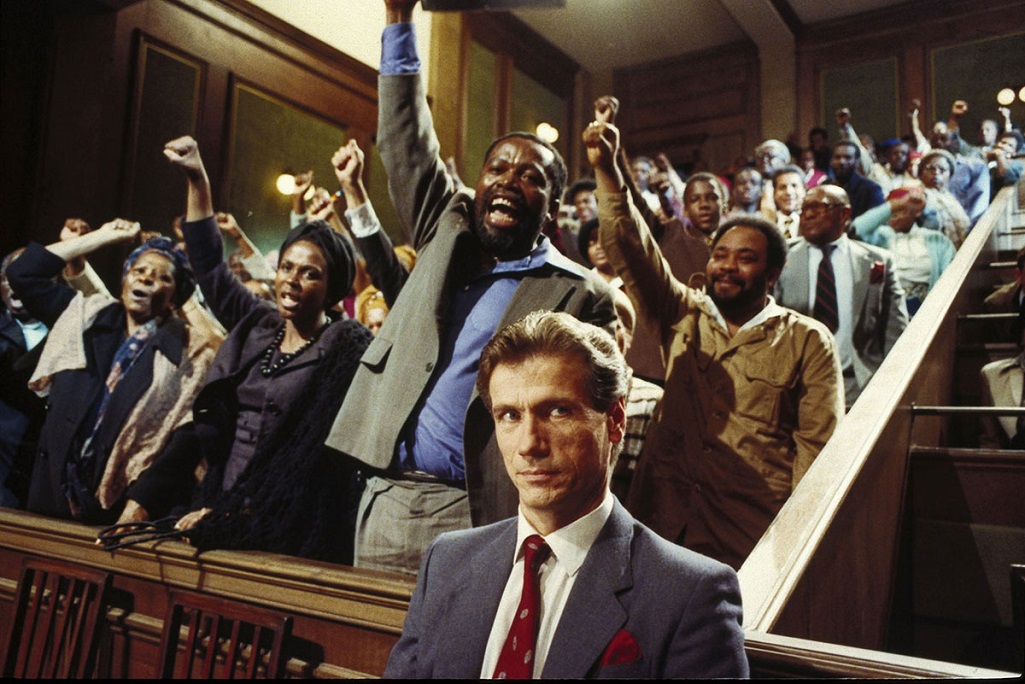
And so, Ben seeks justice and answers for his murdered friend in the only way he knows how; through the law. Season then follows Ben’s trials and tribulations as he becomes a political annoyance, undermining the powers that be. Ben approaches a human rights lawyer, Ian McKenzie (Marlon Brando, with his first role in about a decade), who warns him that his efforts are likely futile and would never stand with an apartheid judge. The film then becomes a mini-courtroom drama, McKenzie presents a case arguing that the government has done wrong.
While the case for foul play is strong, the system ultimately denies any acknowledgement of misconduct. In defeat, Ben befriends Melanie Bruwer (Susan Sarandon), a worldly reporter interested in the case, who leads Ben to further examine the injustice in his own society. After all, this is not a new problem.
This attempt to undermine the system is the beginning of the end for Ben, who is under excess pressure and scrutiny from his family (apart from his faithful son), his job, and his community to withdraw this cause and resume his business as usual. The cost of allyship is a fraught one, and unfortunately Ben is made an example, showing that even the most reasonable person can have blind spots.
Season was adapted from a novel of the same name by André Brink, which was released in 1979 and quickly banned by the South African government, due to its condemnation of the apartheid state. The message in film remains faithful, and is still sadly relevant.
While it is a studio picture, released by MGM/UA, the film was only a minor success commercially. However, it did earn Brando an Academy Award nomination for Best Supporting Actor, and garnered some strong reviews from critics, including an enthusiastic perfect score from Roger Ebert. Ebert felt the film was not only important but highlighted a range of depth and emotional nuance largely not presented for western audiences. He is completely right in that regard; American cinema is still pretty homogenous in its scope of world issues.
A Dry White Season comes to the Criterion Collection in a director-approved Blu-ray and DVD, complete with a digital 4K transfer upgrade and an uncompressed soundtrack. In terms of supplemental material, Season is packed, and surprisingly dense for a film that was somewhat overlooked at the time of its release. Included is a new interview with Palcy by film critic Scott Foundas, a feature with Palcy discussing five scenes in particular, a 1995 interview with Palcy and Nelson Mandela, a 1989 interview with Donald Sutherland from The Today Show, and a snippet of the 2017 South African National Orders awards, where Palcy receives the highest distinction given to foreign dignitaries. Also included is an essay from by filmmaker and scholar Jyoti Mistry. All in all, it’s hard to ask for a more complete package. It does a wonderful job of contextualizing Palcy as filmmaker, as well as the film’s compelling indictment of South Africa’s racist apartheid-era regime.
A Dry White Season
Euzhan Palcy
United States
Spine #953
Available on Blu-Ray and DVD