The Criterion Collection edition of silent-era comic Harold Lloyd’s classic film, The Kid Brother, proves that Lloyd could absolutely stand alongside his more well-remembered peers, Chaplin and Keaton.
Few silent-era comedy personas could top the legendary career that was Harold Lloyd’s. There were, of course, Buster Keaton and Charlie Chaplin, both pioneers and premier artists of their day, but somewhat lesser-known today is Harold Lloyd, often designated to be the third in line to his seemingly untoppable peers. In some ways, the retrospective comparison of Lloyd as the overlooked brother reverberates in his 1927 classic, The Kid Brother.
Mostly directed by Ted Wilde (also partially by J.A. Howe and Lloyd himself), The Kid Brother follows the familiar formula in many of Lloyd’s features from this era; his patented “glasses character” must not only prove himself worthy of his social and familial standing, but also brave his way through an adventure for his newfound sweetheart. The Kid Brother is a spirited saga of one Harold Hickory (Lloyd, of course), seemingly a hick with no real authority, who must prove himself equal to his big, virile brothers and his sheriff father, who see Harold as more of a homebody than a robust, manly man. Harold, presented here as seemingly small and gentile, has indisputable wits about him.
Through some charming vignettes and set-pieces, Harold presents clever ways of outsmarting his chasers, doing his household chores, and even featuring an unusual churn plunger and a pulley system for doing dishwashing, drying, and stacking all at once. Harold routinely uses his brains to outwit those around him (brothers included) and often looks the better for it. But still, his father and brothers still consider him to be merely a boy (one that looks about 30).
It isn’t until a medicine show featuring the huckster Flash (Eddie Boland) and roundabout Sandoni (Constantine Romanoff), rolls into town that a downtrodden Harold comes across a dark-eyed beauty named Mary Powers (Jobyna Ralston), the medicine show’s recently orphaned proprietress.
With stick in hand, Harold and Mary have a meet-cute and immediately get to know one another. When the brutish Sandoni comes looking for the seemingly angelic Mary, Harold defends her honor by picking up a stick that, unbeknownst to Harold, has a snake coiled around it. Sandoni flees in terror, leaving Harold with lifted spirits, feeling more macho than ever. Mary must return to her job, but they shall meet again, and Harold intends to properly win her over. While The Kid Brother does contain a heavy dose of romance and sentimentality, it’s still a quick comedy first and foremost. As swiftly as the romance plot is introduced, Harold springs into action and the comedy escalates.
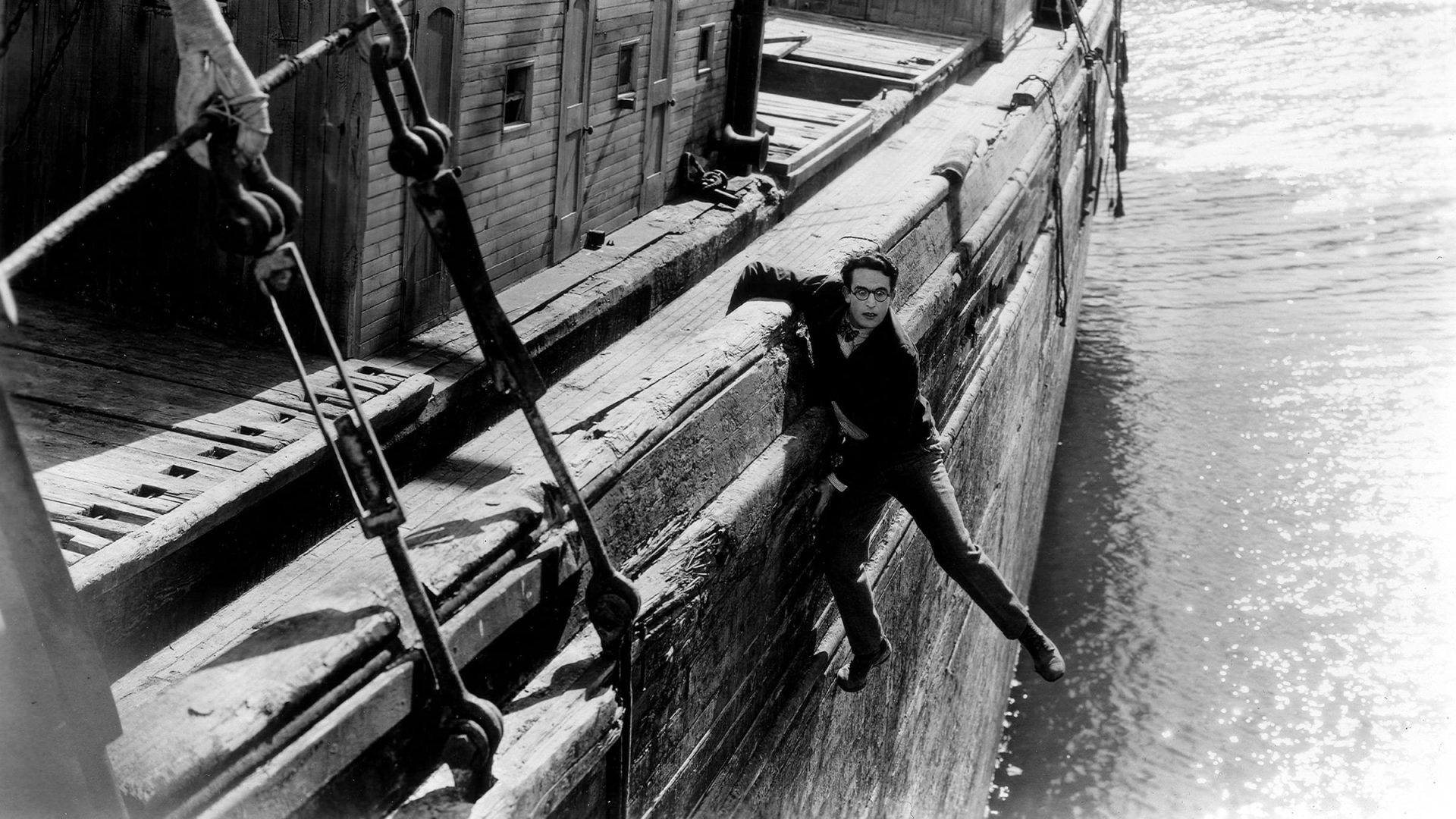
After a series of events, the money for a dam construction project that was being kept at the Hickory cabin goes missing. It is up to Harold to find out who took it (spoiler: Flash & Sandoni) and how to get it back. Only Mary believes he is capable saving his family’s good name, but she is soon taken by a rival suitor, and Harold is literally sent down the river unconscious. Eventually Harold winds up on the Black Ghost ship, and finds the former medicine show hucksters counting the money. A thrilling game of cat and mouse (involving a monkey no less) ensues, and Lloyd eventually wins out, satisfyingly saving the day.
It would be easy to write off Lloyd’s somewhat minimal story of an overlooked younger brother as a simple frame for his typical slapstick comedy of mechanical pratfalls, stunts, and gags. That conclusion would not be entirely wrong, but the willowy framework used here is an example of a strong narrative, built around and improved from simplicity in a charming manner. Everybody loves an underdog, and Harold’s rise and determination are rather infectious. It is also worth noting that, if Lloyd fails in his quest to be taken seriously, his father might be wrongly lynched, creating a rather compelling incentive and tension.
While this specific search for validity through masculinity and agency was nothing particularly new by this point, it does provide an intriguing formula for romantic conquest and creates a somewhat more compounded character. Lloyd ultimately finds triumph when given the proper motivation from the woman he is attempting to woo, and thus pivots from her sensitivity and infatuation. The film takes a delicate tone when it comes to the romantic facets of the story; it is perhaps the sweetest in Lloyd’s filmography. It is also Lloyd’s strength as a leading man that can showcase his many talents as not just a comedic actor but one able to create depth for a character between the silly and serious circumstances he continuously finds himself in.
This is the fourth Criterion Collection release starring Harold Lloyd, and it further showcases the silent-era comedic masterpieces he was known for. The Kid Brother was Lloyd’s personal favorite of his own work, and it hopefully will help gain him a new audience, as it has not only held up, but stands as a great example of how beautiful and mesmerizing these films can be.
This release sees a new 4K digital restoration, along with an orchestral score by composer Carl Davis from 1989, with the archival organ score performed by Gaylord Carter. The archival one may be slightly preferred over the newer one, as it fits the look of the film better, but both are great. A big asset is the active and very informative commentary, featuring filmmaker and Harold Lloyd archivist Richard Correll, film historian Annette D’Agostino Lloyd, and Harold Lloyd’s own granddaughter Suzanne Lloyd. “Harold’s Leading Ladies,” a new conversation between author Cari Beauchamp and Suzanne Lloyd, discusses the three main leading ladies in Lloyd’s silent-era work and how they differ. Also included is “Anatomy of a Gag: Monkeyshoes,” a new video essay by critic and filmmaker David Cairns on how Lloyd constructs his visual jokes.
If that is not enough, there’s a behind-the-scenes stills gallery curated by Harold Lloyd archivist Richard Simonton Jr; “Close to Home,” a new video essay on the film’s shooting locations by author John Bengtson; a Dutch TV interview with Lloyd from 1962; and a featurette from 2005 about Greenacres, Lloyd’s estate, hosted by Suzanne Lloyd. Also included are two rare restored early Lloyd shorts, a new Wurlitzer theater pipe organ score, and a discussion of early film formats by archivist Dino Everett, along with a new tour of the Wurlitzer organ with composer Nathan Barr and organist Mark Herman. Offering more insight into the film’s themes and production is an essay by critic Carrie Rickey. Criterion’s release of The Kid Brother is an impressive package, essential for any Lloyd enthusiast or anyone interested in silent-era comedy.
Ted Wilde
1927
United States
Spine #964
Available on DVD, Blu-Ray, and The Criterion Channel