
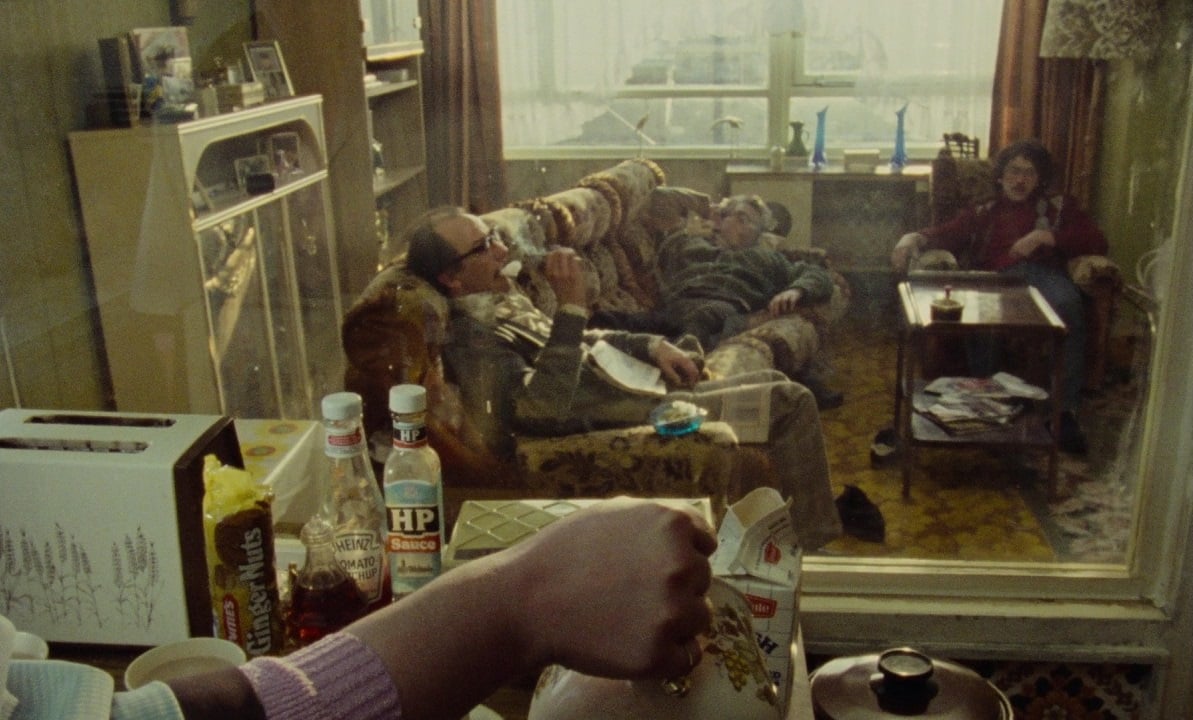
As political as it’s a social statement, writer and director Mike Leigh’s (Secrets and Lies, Happy-Go-Lucky) 1983 tragicomedy, Meantime, centers on the downtrodden poverty stricken Pollock family, amid the jobless working-class placed in the grim societal backdrop of Margaret Thatcher 1980’s Britain.
The Pollock family; headed by unemployed grump Frank (Jeff Robert) and the employed Mavis (Pam Farris), live in a flat in London’s East End with their two grown but also equally unemployed sons. The two brothers, quite co-depended of each other, are about as distinct from one another as they come. Mark (Phil Daniels), the thin bespectacled, quick, and irritating older one is cynical, irritating, and revels in the contrary. Then there’s the thick bespectacled Collin (Tim Roth) is naïve, withdrawn, and … slow, seemingly completely stunted by his overbearing brother’s aggression and his family’s destitute. The film’s humor is largely derived from the Pollock’s stepping over each other and their incessant quarreling and picking at each other.
The dichotomy between the two brothers is further exemplified between sisters, Auntie Barbara (Marion Bailey) and Mavis, who are sibling opposites again. Mavis is seemingly tortured by her continuingly exasperated family; Barbara has little outside of her husband who doesn’t seem too interested in becoming a father any time soon. The kind-hearted and somewhat educated, Barbara contends that Colin, “never been given a chance” after her husband, John (Alfred Molina), suggests his “retardation” is what truly is holding him back. Mark is just a lost cause altogether he contends. Colin’s mental capacity has probably more to do with his stunted emotional growth that invariably causes his slide into mental ineptitude than actual mental deficiency. Constantly teasing his brother and family, Mark is the clear dominate one while his father tries to control him (with very little luck) and perhaps is the biggest influence on the younger Colin. While constantly bickering with him, Mark declares that his father doesn’t own anything, and thus has no authority or opinion over him. Leigh’s characters may not be always subtle, but their motivations and psychological personalities usually are.
Early on we see the three work-shy Pollock men waiting in line for their unemployment checks with very different responses from the clerk handing their weekly distribution. Colin outright forgets his papers and continuously chews on the pen top he’s been given, Frank embarrassed by his sons and his own inadequacy is in “a hurry” and is curt with his answers, while Mark behaves like the great smartass that he is by correcting the clerk over whose pen it exactly is (“ours”). Not only is this scene wonderfully shot but we also understand the psychological apparatuses of each character as they tumble through the bureaucratic humiliation and disposition.
Mark also occasionally hangs out with a local skinhead (Gary Oldman), and busying himself by hanging out in pubs, drinking, playing pool, and chain smoking. It’s not crazy Oldman would go on to portray Sid Vicious as he’s entirely frightening playing a punk fool. Oldman’s character’s influence seems to never penetrate Mark, but Colin seems to be a little more receptive to his commanding posturing and starts to worry Mark.
Perhaps seeing a solution for the lack of money flow available, Auntie Barbara requests Colin to come over and help her spruce up her docile home in the suburbs and be her handyman. Seemingly for the first time in his life, Colin now has a job (everybody but Mark is joyous, seeing it as a slight) and something over his lovingly antagonistic brother. Sadly things don’t go so well. Mark inserts himself as a bystander and his round-about way sabotages his brother’s new job with his continuous hectoring questioning and playing on Colin’s emotions. Mark quizzes Barbara on her college experiences with slight contempt he continuously hides behind. Colin, before he can even start (and after coming in late), retreats into himself and quits his newfound job fearing it was some kind of family conspiracy of pity. He returns home to his family who understandably are upset by his “decision” to not work in favor of sparing his brother’s ego. It’s horribly frustrating to watch, and in the end we’re left with not too much change within the Pollack clan outside of more domestic squabbling and Auntie Barbara’s almost existential defeat following her incapability to help those around her.
While Mark destroyed his brother’s chances of helping out the family and creating his own sense of purpose/identity, he is shown to deeply care about and love his brother when Colin shows him his newly shaved head. Colin’s new haircut more or less represents his own stab at independence and less a change of heart or a new identity in fascism, and Mark realizes that he pushed him into it. It’s a slightly optimistic ending, but also sort-of sweet seeing the relief in Mark’s realization.
Leigh’s penchants for character-driven narratives and humanist stories are compounded in Meantime by the wastelands of empty pubs, rough laundromats, and impoverished urban sprawl. His characters seemed doomed and destined for squalor even despite themselves. Not only was Leigh commenting on human nature but the government’s apathetic answer to solving poverty and the mental toll that poverty inflicts. A pivotal shot of Oldman’s character, screaming, thrashing, and lashing out in a large metal barrel serves as the film’s most iconic and fitting image.
Meantime gets a stunning new 2K transfer and comes to the Criterion Collection on Blu-ray supervised by director of photography Roger Pratt and Mike Leigh, with an uncompressed monaural soundtrack specifically for the Blu-ray. While this was a made-for-TV production, the quality of the film is vibrant and beautifully shot even for a 16mm. For decades as the director’s stature grew, so did the film’s recognition and positive word-of-mouth. It was a rare film to track down (with a VHS quality transfer) and rarely got seen outside of Leigh’s home country. Having never seen it before, my attachment to the old transfer is not strong, but one can absolutely see how the rough-around-the-edges quality might actually compliment the film’s working-class motifs and raw character. Speaking of class, we are treated with an interview with Leigh and one Jarvis Cocker, who you may know from the rock band “Pulp” who as well often explored social class and British culture. It’s definitely the highlight of the supplemental material and brings two cultural minds together that undoubtedly complement each other. Also included are new conversations between actor Marion Bailey and critic Amy Raphael, an interview with Tim Roth detailing his work from 2007, and also an essay by film scholar Sean O’Sullivan. For fans of Leigh, it’s a required film and one of the best made of TV films of the 80s.
Meantime
United Kingdom (1983)
Mike Leigh
Spine # 890
Available on Blu-Ray, DVD, and Filmstruck