
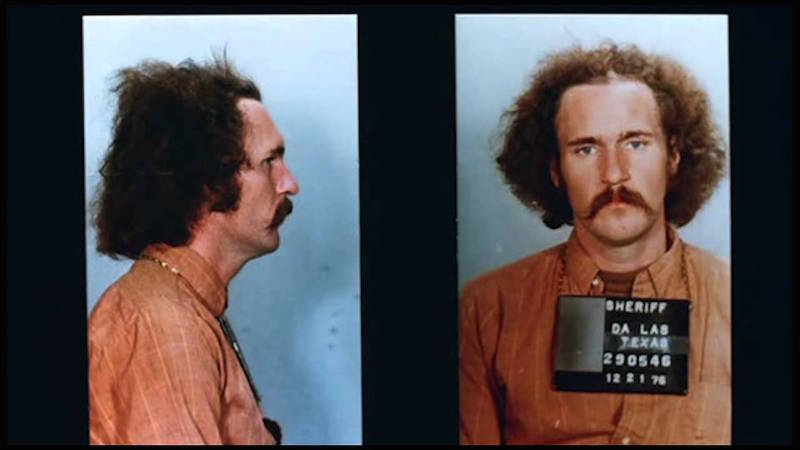
In 1976 Texas, a 16-year-old kid named David Harris in the midst of his own delinquent crime spree picked up a hitch hiker named Randall Adams.
In 1976 Texas, a 16-year-old kid named David Harris in the midst of his own delinquent crime spree picked up a hitch hiker named Randall Adams.
Adams had showed up for a new job that fateful Thanksgiving weekend only to find out the doors were closed for the holiday.
After joining the teen, the two smoked weed and drank, went to two bad movies, and drove back to Adams’ brother’s hotel room before watching TV and going to bed. Harris wasn’t allowed to stay and left feeling ousted by his new friend. Soon after, Adams’ nightmare began as he was eventually taken into custody and sentenced to life in prison for murder of a local police officer who worked the graveyard shift the night of his adventure.
Harris told friends he had done the crime, with his gun, and his car, but never had to prove his own innocence after he accused Adams of being a witness to the crime.
Years after the incident, director Errol Morris, a private detective in his own right, came across the story of Adams and Harris and uncovered a mystery which would eventually become the legendary documentary The Thin Blue Line.
Morris initially spoke to Adams for the movie, but It wasn’t until he actually met Harris that he come to the conclusion the police and the TX justice system completely got the wrong guy.
Not only that, it was probably on purpose as you can’t send a minor to the electric chair and the legal system wanted blood for blood.
Objectivity isn’t really the point or a huge concern of The Thin Blue Line, because the facts in the case are that strong. Eventually it becomes almost surreal as to how this man was actually sent to trial and then to death-row in the most bureaucratic way.
The initial start of the film is quite perfect at keeping you guessing who is lying, who is telling the truth, or at least their version of it. Morris is also much more interested in the way somebody tells the story; more so than the actual tale.
Like this last and equally important documentary, Gates of Heaven (also in Criterion), He is captivated by odd characters and situations, by unique word choice and speech, and how this little quirks are illustrated to the audience is just as entertaining.
In an off camera interview conducted early on, Morris asks “Is Randall Adams an innocent man?” to Harris who calmly states, “I’m sure he is.”
“How can you be sure?” Morris presses. “Because I’m the one that knows,” the killer responds.
Even as just an image of a recorder playing this slow, unnerving conversation, it’s the most chilling part of the film. Morris shows the truth in our society – how it can be unjust and terrifying.
Harris was eventually imprisoned and executed for an unrelated crime.
Joshua Oppenheimer, director of the Oscar nominated The Act of Killing, gives his take on the then unorthodox structure of the film and its importance today.
A short clip from “The Today Show” is also included in the Criterion release, when Adams first left prison and his initial reaction to it. Harris was notoriously hard to find after a while and even sued Morris for his life story rights.
It would have been nice to have gotten a commentary track from Morris himself, who is ever fascinating, informative, and leaves you wanting more as he goes through his triumphs and mistakes making the The Thin Blue Line.
In an extensive interview he explains how he got started on this project trying to cover a Dallas physician named “Doctor Death,” his initial interactions with Randall and Harris, and the aftermath of his creation. It’s an illuminating look at important filmmaking. An illustrated leaflet featuring an essay by film scholar Charles Musser is also included to provide more contexts for the film.
To describe The Thin Blue Line as anything but spectacular documentary filmmaking and brilliant storytelling would be a disservice to its influence and importance today. Frankly, the movie helped get a man off of death-row, mere days before his scheduled execution; thus saving his life.
From the subjects’ own personal narrative, every story-telling technique found in Morris’ earlier works comes to fruition and displayed in The Thin Blue Line.
The timing of this release could not have been better seeing as “The Jinx”, an HBO documentary series chronicling the suspected murderer and millionaire Robert Durst has caught on in a big way. Not to mention the success of the NPR series Serial which similarly documents a mysteriously convicted man for murdering his girlfriend.
Mirroring the interviews, the crime-scene reenactments, the counter-arguments, visual aids, even Jinx director, Andrew Jarecki, told Business Insider just how influential The Thin Blue Line is to his equally riveting and worthy series. It’s argued this film is a good early example of a post-modern exercise of a documentary with contextualizing a present narrative to show past events to offer some kind of truth to the viewer.
Morris would probably disagree to this, but in many ways, the film did just that through its complex maneuvering with a web of information and themes with a simple to digest presentation of facts and personal accounts. This use of fiction probably cost Morris an Oscar nomination. At its core it is a beautiful and gripping combination of social justice, art, and the ultimate search for truth.
The Thin Blue Line
1988, (United States)
Director: Errol Morris
Spine# 753
Criterion Collection Blu-Ray, DVD, and Hulu-Plus