

It’s hard to overstate the importance of the Stiff Little Fingers (SLF) to the development of punk rock. The Clash, Sex Pistols, and SLF can all be mentioned comfortably in the same sentence. Not only did they help define what punk would become, and the culture that grew around it, they did so in the middle of the urban conflict known as “The Troubles“ in Northern Ireland.
Bands like The Clash and Sex Pistols could sing about anarchy and revolution as ideas, but for the Stiff Little Fingers, this was their lived experience.
Coming to prominence in Belfast during that time meant navigating the street politics of sectarianism, car bombings, and factional violence. Terrorism was part of the landscape. Grievance was manifest. Set against this backdrop, four young men still chose to make brash, confrontational punk music. Even as the risk of being caught in the middle of this conflict was real.
Songs like Suspect Device spoke directly to that violence and gave an entire generation a way to name their trauma: “Inflammable material, planted in my head; it’s a suspect device that’s left two thousand dead.” By the time The Troubles ended in 1998, another 1,500 would also lose their lives.
That legacy is why I wanted to catch up with SLF guitarist and founding member Henry Cluney, who played an intimate show at Black Iris with local Richmond rockers Art School this past Sunday. As we enter into a period of political violence in the US, trying to understand how music can influence outcomes and sustain perspective feels more important than ever. Something we spoke about at length over breakfast on a gloomy morning in Richmond.
When I was thinking about how to approach this interview, I realized everything is political right now. So I wanted to start with the formation of the Stiff Little Fingers during The Troubles in Northern Ireland in the late 1970s. Looking back on songs like Alternative Ulster, Suspect Device, and State of Emergency, how do they inform the way you’re seeing events today?
Back when we started, it was still the middle of the troubles back home. We always said our politics were street politics, because we were never going to be doing party politics. That’s not how it works. You could stand there and come out for one side or the other, but that was never the way we saw it. So when I look at Alternative Ulster now, unfortunately, it’s still pretty relevant. On the surface, The Troubles have been over since 1998. But not really. They’ve just changed. You don’t get bombings every day. People don’t get shot every day. But it hasn’t brought people closer together.
I hate the word, but millennials that are coming up now don’t remember The Troubles. So they don’t have that feeling. I grew up in a Protestant Catholic area, but people never mixed. Now, it’s not quite like that, but there’s still the same mistrust. There are problems here [in the US]: Republican and Democrat, but people still live together, even though it’s still very divided. My view is until people start forgetting the whole legacy of a thing, it’s hard to see how it can ever be fixed. And I don’t think too many people have the drive to do that—to just be happy living the way they live. Anybody who lived through that time in Northern Ireland will understand why that’s an important thing.
You brought up Protestants and Catholics, which was a sectarian conflict. But sectarian politics is ultimately just street politics. When you think about your experience, your music, and connect those dots, have we circled back to a new era of street politics?
Unfortunately, it seems to be getting worse here [in the US]. A lot of it reminds me of back home, even though I’ve been here 28 years. It’s almost starting to get me scared. We had The Troubles. We sometimes had people being murdered for politics. You look at things here, this whole Charlie Kirk thing. What are people going to make out of that, how much are they going to use that as an excuse? And I find that way scarier here than it was back home. We never had politicians telling people that there’s going to come a time where you’re going to have to take up arms against the other type, which is a horrible thing to say.
Our songs back then still seem very relevant, even when I sing them now. Like I said, I’ve been living in the US for 28 years, you can take Alternative Ulster and see where it would still fit the same narrative. It’s weird, when I first came here, it was always the land of the free, there was a lot of opportunity. Now, I’m not so sure.
When you were writing punk songs during The Troubles were you ever worried? That was a time when punk was emerging as a scene, it was misunderstood, and I could see a scenario where that made you a target of political violence.
The first time we brought out Suspect Device and were on local news and TV, I did wonder what that would be like. A lot of people didn’t like what we were saying because, the word to use here would be—too centrist. But it was never one way or the other. Our songs were anti-terrorist because of what was going on. So when we went on TV, of course, the first thing you think is: ‘well now they know what I look like’ and while it never happened, you get that feeling. If anyone wanted to get us, they now know where we are.
In the early days, we had a couple of bomb threats and strangely enough they were in England. The police would have sniffer dogs searching the venue. But back home that never happened. We were never on one side or the other. And whether this is the way people think or not, you almost got the opinion that they were thinking ‘these are our guys’ and the other ones were thinking the same thing.
That’s funny, as much as it can be funny. But it does raise a bigger question: how did you exist as a musician in that kind of environment, when you weren’t considered fully Irish or fully British enough by the people you were playing to?
Growing up, that was a question of identity. As far as I’m concerned, I’m British. I’ve always been British. My passport is British. But that gives people the opportunity to, let’s just say—approve. I’m like you. Or not like you. People would say, ‘you didn’t criticized people who were killing other people for their own aims.’ So when we did, especially in the early days when we did gigs, you were never sure who was going to be about. It only takes one, and you try to avoid that. Looking back on the first five years of us going there was nothing, and that was surprising to us.
Do you think that’s because there’s a universal appreciation for music and that gave you a pass? Even if you were totally immersed in the street politics of the moment, which you weren’t, people could still say, “yeah, but that’s Stiff Little Fingers, they’re making great music.”
We have a phrase back home; a football phrase, because there’s no such game as soccer [laughing]. That phrase is “by-ball.” It basically means you kick a ball out just for the other team. Before Stiff Little Fingers, I used to play in some small cover bands. So I would play for everyone. If we would get into an area that was say, heavily Republican, heavily Catholic, people would always say because you’re a musician, you get a by-ball. Meaning exactly that. It doesn’t really matter what you are because you’re there to entertain people. And that’s the general rule. Sometimes it was broken, but that’s always been the way—you get a by-ball because you’re a musician.
I love that. That might be the most inspiring thing I’ve heard in a while. Maybe a glimmer of hope on our dark horizon.
Sometimes it’s all you can do.
Stiff Little Fingers came up during a really incredible moment: The Clash, Sex Pistols, Buzzcocks, The Vibrators. Bands that not only shaped punk at its origin, but really confronted politics head on. When you look at punk now, do you still think it carries the same confrontational spirit? When I was coming up in the scene the music was driven by the scene. Now it seems more about the business model than the actual music. So what’s your diagnostic on punk in 2025?
Punk is popular. And I hate to say this, especially in America, but it became very mainstream. Obviously, some of the songs from bands like Green Day and Blink 182 have energy and meaning behind them, but they don’t have the same feeling as the bands I grew up with like The Clash, Sex Pistols, Ramones, and Johnny Thunders. It could also be an age thing. The music you grow up with is hard to leave behind. It’s also easy to be biased, where you find yourself saying it is never as good as it used to be.
But with age also comes clarity and wisdom.
Does it?
Ok, that’s a really good point.
Are you not then distilling it down to a lifestyle or idea that was never meant to be? People really wrote songs back then. You were never really meant to sit and study it 50 years later. While you’re right, as you get older you get wisdom, but as far as I’m concerned, Im still seven years old up top.
A band like Dropkick Murphys, they definitely 100 percent believe in what they’re saying. 100 percent, a lot of bands out there do. But a lot of it became too easy, too mainstream. Back when we started, you couldn’t get a punk song played on the radio. You couldn’t get on Top of the Pops, which was our big program. You couldn’t get gigs because you had to be a show band playing top 40—slick suits and things like that. So we had to fight hard against that to get gigs.
And I’m sure it’s the same now. Like the bands that played last night, it’s not always easy to get gigs. But there are far to many successes that don’t have the same spirit that music used to have and that’s disappointing. I also wonder if AI is going to destroy all this, destroy originality? I think so. Scary to think that bands are going to come along that aren’t even bands. That’s already happened back home. There has already been an AI top ten hit. By the same token, you can’t ignore technology. You can’t ignore the way things are moving.
What continues to motivate you? To keep writing and playing music today.
I’ve always loved it. I’ve never seen doing what I do as a job. I never did gigs because I had to or because I needed the money. My big belief is you just play—should there be ten people or 100 people. If you just go through the motions people can see that, people can notice you’re just putting on an act. If you’re still enjoying it, people see that really easily. I have always loved doing that; I don’t see that changing.
But if you still have the belief in doing what you’re doing and you still find it fun, it doesn’t matter if there’s ten people or 100 people. You’ve done what you came to do.
When you think about your legacy and contribution to punk, the wider cultural body of work you contributed to, how do you see your place in that?
That’s an easy trap to fall into. Some will say that we were bringing people together. But was it really bringing people together or was it only for the time they were in the club together? As soon as they leave, they’re going back to their areas where they’re not living together. So people would say to us, ‘you helped bring people together.’ But was it lasting? Sometimes people would say, ‘you made me think.’ And it’s always nice to know that people listen, but I would never make it more important than what it was.
Legacy to me is knowing there’s two buildings in Belfast, one of them has Alternative Ulster painted, and the other one is just a step up there. These are in the city center and it shows what we meant to people. So maybe it’d be easier for someone who came to see us to answer this question. Because our legacy is going to be different to some guy that came to see us in 1979. Our legacy is we meant what we did. And we went out and did the thing.
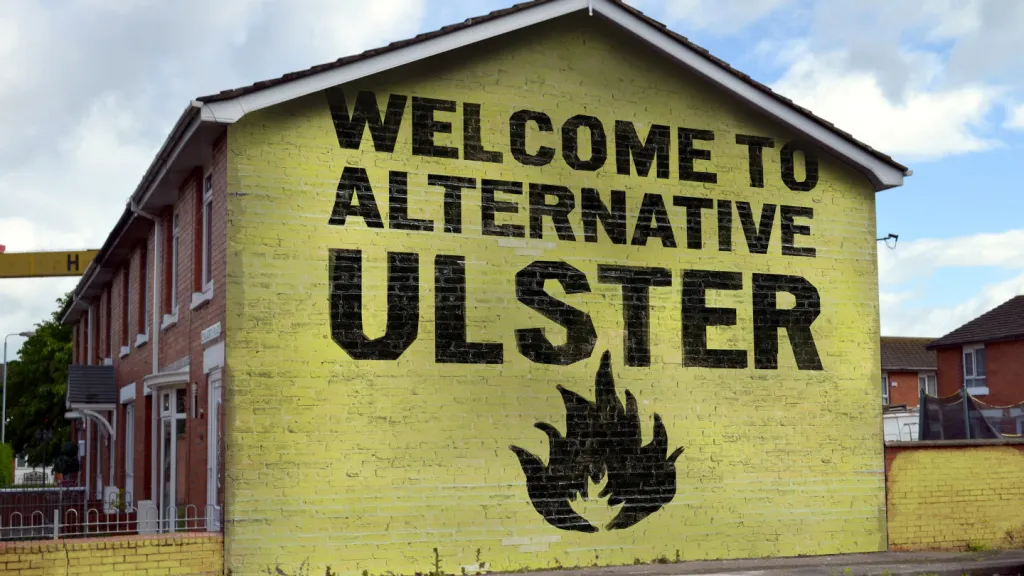
So I think the whole legacy from our side is that we were an important band in the context of Northern Ireland, and then in the context of the UK, and then America. Our lyrics were important because we didn’t put out songs that were just about strolling down the boulevards. It was always heartfelt in that we believed what we said. Because you can put words into people’s mouths very easily, but then you’re not really any sort of performer. They’re just a glove puppet, aren’t they? Younger people now, who don’t know what The Troubles were, can still listen and say, ‘yeah, I can understand what that meant.’ And to be able to have something like that and people still asking about it 45 years later—you don’t get that sort of luck very often.
Shaping context in Northern Ireland, UK, and the US. That’s a legacy through-line, which tied together a really violent and transitory period. That’s one of the things I hope our readers take away from this. Thank you so much Henry for such a fascinating interview.
Thank you. I also used to do a radio show where I interviewed people [laughing].
Photo by Landon Shroder
Support RVA Magazine. Support Independent Media in Richmond.
At a time when media ownership is increasingly concentrated among corporations and the wealthy, RVA Magazine has remained one of Richmond’s few independent voices. Since 2005, the magazine has provided grassroots coverage of the city’s artists, musicians, and communities, documenting the culture that defines Richmond beyond the headlines.
But we can’t do this without you. A small donation, even as little as $2, one-time or recurring, helps us continue to produce honest, local coverage free from outside interference. Every dollar makes a difference. Your support keeps us going and keeps RVA’s creative spirit alive. Thank you for standing with independent media. DONATE HERE.
We’ve got merch HERE
Subscribe to the Substack HERE
And Reddit HERE
And YouTube HERE