

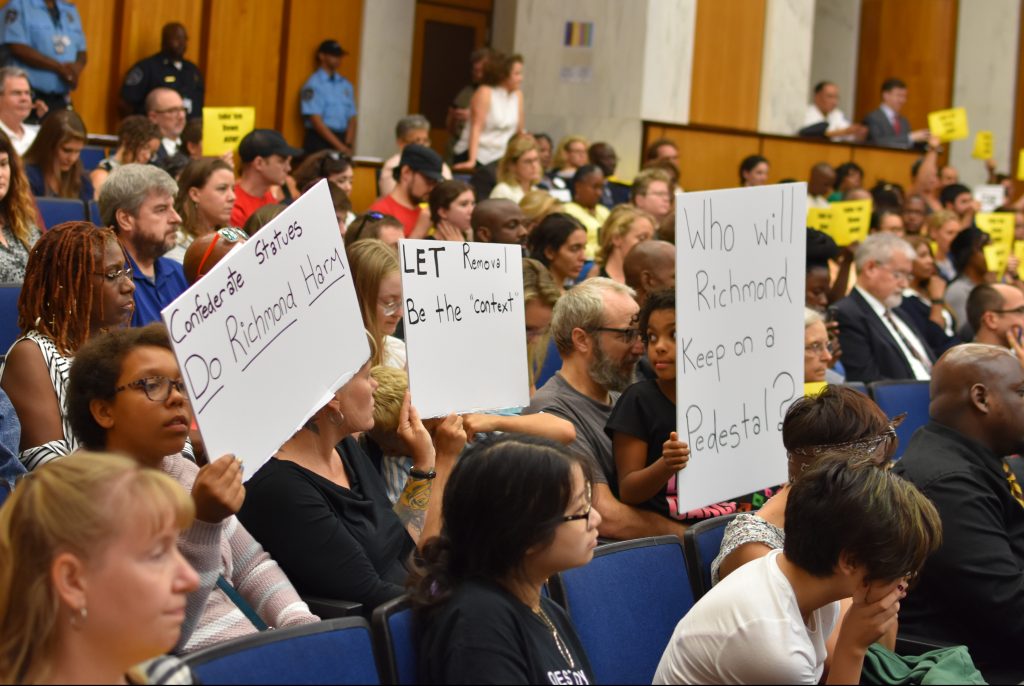
Last night’s City Council meeting almost filled the 260-seat chamber, thanks to online buzz around a resolution asking the General Assembly to permit Richmond to remove its Confederate monuments, introduced by Councilman Michael Jones. Nearly every seat was occupied by a supporter of the resolution, some standing near the back of the room when they could not find a chair, on a night when public testimony would be limited and the resolution merely introduced, not voted on. They came to support former NAACP of Richmond president Lynette Thompson, Councilman Jones, and a proposed plan to memorialize the victims of slavery in Shockoe Bottom.
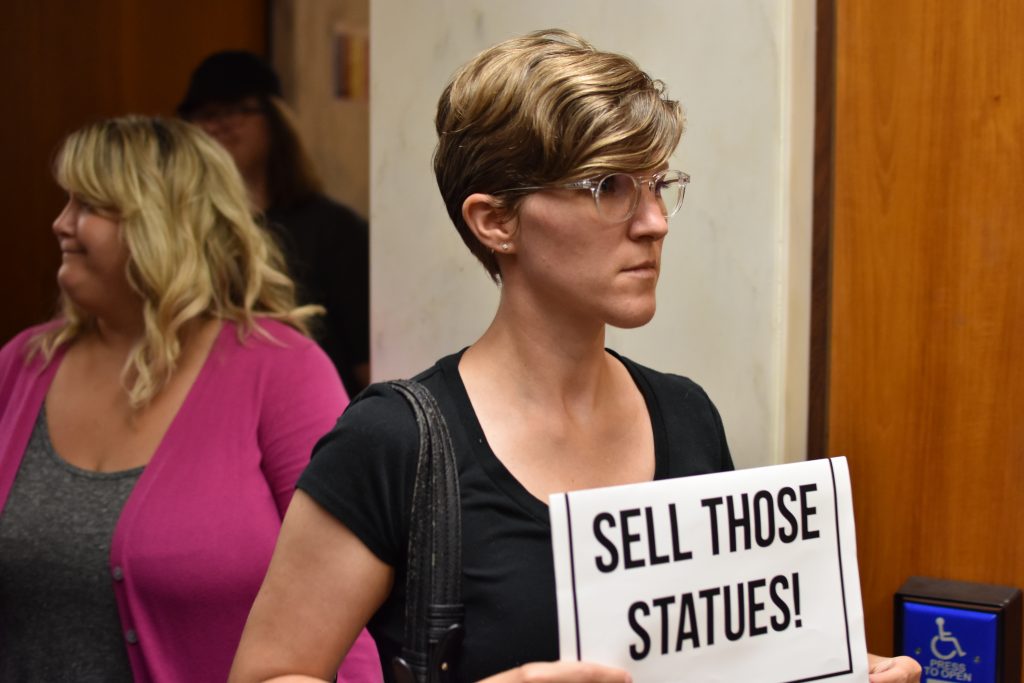
The resolution is not binding. It would merely permit the City Council to ask the General Assembly to allow Richmond to vote on removing any Confederate monuments in the city, listing J.E.B. Stuart, Robert E. Lee, Jefferson Davis, Thomas “Stonewall” Jackson, and Matthew Fontaine Maury on Monument Avenue as examples. Despite a clear show of support from the public, the resolution is not expected to pass. Council members Chris Hilbert, Andreas Addison, Ellen Robertson, Kim Gray, and Parker Agelasto all favored waiting for the Monument Avenue Commission to finish its work, with Hilbert, the Council President, calling the issue a distraction. The meeting tonight only had a few speakers, four of them speaking about the statues, all of whom had signed up in advance.
Lynette Thompson spoke first, urging the commission to remove the statues and to expand the Lumpkin’s Jail Site memorial to include the rest of the 9-acre area where people were sold as slaves. Shockoe Bottom was the site of the second largest slave market in America behind New Orleans, and Thompson expressed worries that African American history would be erased by future development if the area wasn’t protected. The project she referred to is known as the Sacred Ground Historical Reclamation Project, and has been brought before the City Council before. Applause is not permitted, but Council patiently waited as nearly the entire room cheered for Thompson and her proposal.
Thompson brought many of those in attendance, and Phil Wilayto of The Virginia Defender brought the bright yellow signs that read “Take Em Down Now.” After the meeting Wilayto offered his group as volunteers to remove the statues if a museum could not take them.

The second speaker, former Councilman Marty Jewell, was also against the statues. “They were enacted as a middle finger,” he said, in one of his characteristically blunt speeches. He tied the memorials and monuments to Jim Crow laws, and ended his remarks by calling for a full truth and reconciliation process in Richmond.
The theme of history erased was taken up next by Carmen Terrell, who spoke following Jewell. “I’ve seen our black history be removed. If the whole truth can’t be told, why have any statues at all?” She pivoted to classism and lack of opportunities for the poor, before calling for unity and support of Jones’s bill.

Baugham, near center, was the lone dissenter
Only one voice spoke out in dissent; Raymond Vance Baugham, Jr., was the last speaker to address the monuments. He equated General Lee to General Sherman, calling both men controversial, and made a slippery slope argument about other historical figures who kept slaves, asking why we honor George Washington, for instance. He went on to list every US President who owned slaves, and drew a few claps when he described the memorials as an attempt to heal wounds and create unity.

The meeting also had a proclamation making October ‘Walk and Bicycle to School Month’
Statues weren’t the only item of discussion, though. The meeting opened with an awards and recognition ceremony for several different individuals and organizations. Among them was an award for Richmond Kinship Month, recognizing the many people who care for children and another for RAM Camp, thanking VCU and the organization for its role in making Richmond a better place to live. The Council also had a proclamation on bicycling, naming October Walk and Bicycle to School Month, and setting aside the first Wednesday of the first full week of October as Richmond Bike to School Day. Parents and bike activists were on hand to accept the proclamation and pose for a quick photo.
The Council kept quiet during testimony, until the last speaker, who was there for a slightly different issue. “At the risk of sounding ridiculous after all these other concerns, I’m here to talk about trains.” Rebecca Stein, a Carver resident, was talking about the regulation requiring trains to give loud toots at crossings, something which starts every morning between 3 and 4 AM and continues, producing a 90 decibel noise comparable to a lawn mower. She was hoping the Council would consider adopting an ordinance that would replace the loud train horn with a different safety measure. For her, Hilbert had an answer; the Council had considered this in the past, and he’d be happy to let her know what happened with the previous process.
After that, the public largely filed out, leaving a much emptier hall to the Council for their remaining 40-odd agenda items. The next meeting is October 9th, but it’s unclear if the Council will vote on the resolution at that date.
*Photos by David Streever