
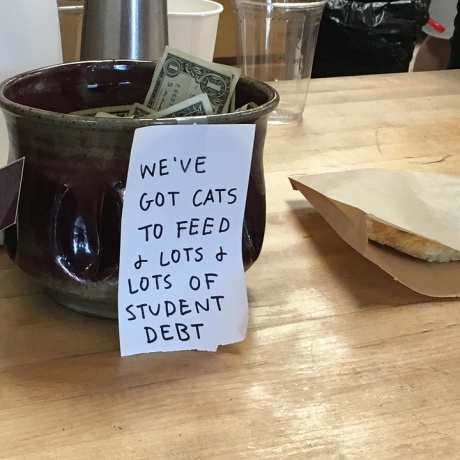
Virginia Senator Mark Warner hopes to help alleviate the burden of college debt with
bipartisan legislation that he is introducing to Congress.
The two bills are the Dynamic Repayment Act, co-sponsored by Sen. Marco Rubio (R-FL), and the Employer Participation in Repayment Act, co-sponsored by Sen. John Thune (R-SD). While the first bill aims to simplify paperwork and keep payments affordable, the second encourages employers to help their employees pay off student loan debt.
The average student loan debt from public universities nation-wide tops $37,000 per graduate. Nationwide, Americans currently owe more than $1.3 trillion in student loans. According to Warner, this surpasses credit cards and auto loans as the country’s top source of non-housing debt.
“As the first person in my family to graduate from college, if I had that much debt coming out college I’m not sure I would be sitting where I am right now,” Sen. Warner said in a group conference call Monday. “I got out of college and law school combined with a total of $15,000 in debt, and most of that was from law school debt, rather than college.”
He and his co-sponsors hope to simplify and improve loan payment methods in ways that can be beneficial to many.
The Dynamic Repayment Act states that “federal student loan programs include numerous protections for borrowers to avoid default, but most students don’t utilize them because the system is so complicated.”
The bill suggests that due to the paperwork required to prove income changes, adjusting payments is burdensome during times of unemployment, another issue facing recent college grads who are either unemployed (5.6 percent) or under employed (12.6 percent).
To remedy this, the act would keep payments affordable by allowing a borrower to pay a reasonable percentage of their income until the load is paid or the time limit is reached. A borrower who is earning more income would pay more during times of fiscal prosperity, but the bill would protect all borrowers during periods of unemployment or lower earnings. Interest would not compound during payment which allows borrowers to actually make progress on their payments.
There would also be tiers of loan forgiveness that could be helpful for borrowers who unexpectedly realize their loan balances may be permanently unaffordable. The tiered forgiveness would also, according to the bill, minimize incentives for people to “engage in unnecessarily risky borrowing.”
“As someone who once owed more than $100,000 in student loans, this issue is personal to me, and I will continue working to simplify this complex and bureaucratic student loan system,” Sen. Rubio said in a press release.
Meanwhile, the Employer Participation in Repayment Act aims to expand upon an existing federal program that could benefit both employers and student-debt-riddled employees.
Presently, the Employer-Provided Educational Assistance Program allows employers to contribute pre-tax earnings in order to help employees pay for continued education. However, it does not allow this for people who have already incurred student loan debt throughout the course of their undergraduate or graduate studies. That’s where the Warner-Thune bill comes in.
Through amending the Internal Revenue Code of 1986, the Warner-Thune bill would allow employers to contribute up to $5,250 pre-tax to their employees’ student loans, which would not only give those with student loan debt some relief, but may serve as a new tool to recruit and keep quality employees.
“We should be looking for creative opportunities, like the one Sen. Warner and I have proposed, that would help Americans capitalize on their investments in higher education, enter the workforce, and pursue a career,” Sen. Thune said in a press release. “Our bill would give graduates the flexibility they need to work with employers to secure lower interest rates and pay part of their student loans back tax free. This is an obvious win for graduates, but it also helps businesses attract and retain talented employees.”
Warner referred to the bill as a “no brainer.”
“It definitely, I think, would help students in those first few years coming out of college to give more freedom and flexibility,” Sen. Warner said.
Warner explained that he hopes the bill will encourage more companies to help students pay their debt. He feels this could also be beneficial for smaller companies because the tax advantage may increase participation.
“I think these are both important bills, but they’re not going to totally solve the problem,” Sen. Warner said. “The bigger problem exists of ‘how do we make sure that college inflation and higher education inflation doesn’t continue to go up at such a rapid rate?’ Everyone talks about health care inflation and the unfortunate thing is in the last 10 years, higher education inflation is even higher than health care inflation.”
Both pieces of legislation were introduced to Congress last year and failed. However, this year Warner feels more confident they may actually go forward successfully.