Virginia’s divided legislative branch doesn’t agree often, but when it does, it’s usually a sign of some solid lawmaking – but that didn’t seem to be the case for two laws dealing with Virginian’s pri
Virginia’s divided legislative branch doesn’t agree often, but when it does, it’s usually a sign of some solid lawmaking – but that didn’t seem to be the case for two laws dealing with Virginian’s privacy.
Gov. McAuliffe proposed some amendments to a four bills – HB 2125 (Cline R Rockbridge and Gilbert R Shenandoah), SB 1301 (McEachin D Henrico), HB 1673 (Anderson R Prince William), and SB 965 (Petersen D Fairfax) – all of which dealt with how police departments use drones and how long they can keep data from license plate readers.
All four bills were passed with bipartisan support.
“It is difficult to understand why the Governor would propose amendments to pro-privacy legislation that would authorize unrestricted mass surveillance of Virginians by police and government agencies,” said Claire Guthrie Gastañaga, Executive Director of the American Civil Liberties Union of Virginia. “The Governor’s recommended amendments to these bills… are equivalent to vetoes.”
Here’s the ACLU’s breakdown of the bills and the proposed amendments:
House Bill 2125 and Senate Bill 1301 would require law enforcement and regulatory agencies to get a warrant from a court before they could use a drone, except in certain emergency circumstances, like Blue and Amber alerts and in situations not involving law or regulatory enforcement. As presented to the Governor, the bills prohibit evidence obtained by a drone without a warrant from being used in criminal and enforcement proceedings. The Governor’s amendments would gut the warrant requirement in the legislation. As passed by the General Assembly, the legislation would strengthen privacy protections beyond the protections now offered by the Fourth Amendment as interpreted by the courts in pre-digital age decisions. If the Governor’s amendments are accepted the new statutory warrant requirement becomes meaningless.
House Bill 1673 and Senate Bill 965 would clarify that current Virginia law (the Government Data Collection and Dissemination Practices Act) prohibits law enforcement agencies from using mass surveillance technologies to collect and store personal information (including license plate numbers) unless engaged in an active criminal investigation. The bills would create an exception to current law that allows the use of license plate readers to collect personal information and keep it for a maximum of seven days, unless part of an ongoing investigation. The Governor’s amendments would eliminate restrictions on the use of mass surveillance technologies by law enforcement and allow law enforcement to maintain data collected by license plate readers for 60 days or more depending on whether the data is related to a criminal investigation.
“Virginians’ liberty is at risk when police surveillance and data collection practices intrude on their privacy when there is no evidence that they have engaged in any wrong-doing,” Gastañaga said. “The legislation to regulate new surveillance technologies that was presented to the Governor was compromise legislation that offered Virginians greater protection of privacy and liberty and preserved the ability of law enforcement to investigate and prosecute criminals,” Gastañaga said.
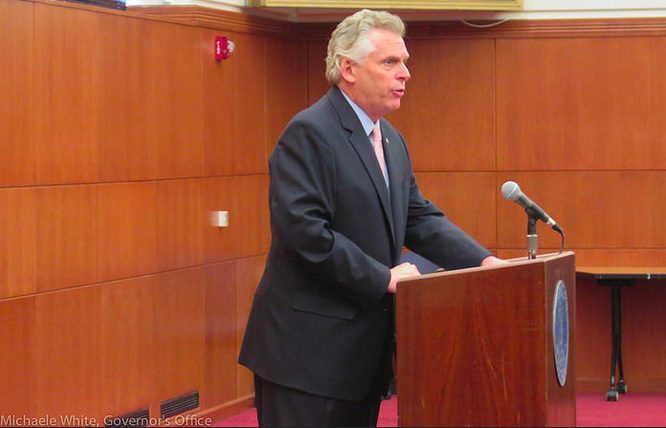
In a press conference over the weekend, McAuliffe said all the vetos and amendments he passed down on the 800 bills which crossed his desk were judged on two simple merrits:
“Does this legislation make Virginia more competitive and improve people’s lives,” said McAuliffe. “And if not, can I amend it to ensure that it does?”
The Washington Post got a statement from McAullife’s office on the changes:
Brian Moran, the Secretary of Public Safety and Homeland Security, said Friday that he had “been informed by numerous law enforcement agencies that license plate readers result in salient and compelling information. The governor’s amendment…represents a significant compromise by law enforcement. The governor believes 60 days is a more appropriate period of time and reaches a compromise with the legislature that’s reasonable.”