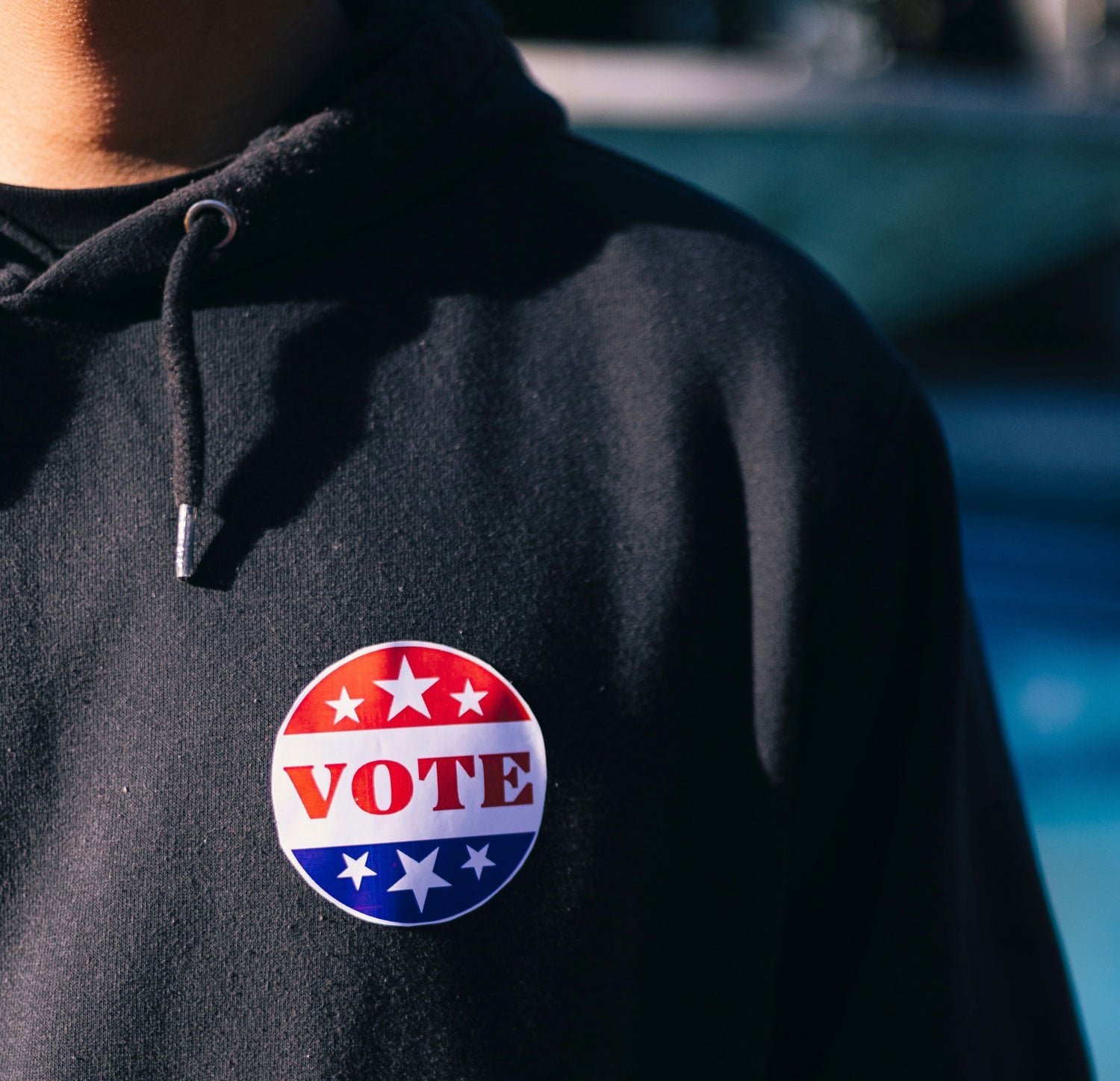
Early voting is already underway in Virginia ahead of the Nov. 3 midterm elections, with congressional seats and three proposed amendments to the Virginia Constitution on the ballot. Congressional races depend on where you live, but every voter in the state will see the same three amendments, on reproductive freedom, marriage equality and voting rights.
Here’s what’s on the ballot:
Proposed amendment #1 Reproductive Freedom: Would establish constitutional protections for reproductive healthcare decisions, including contraception, abortion, miscarriage management, and fertility care, while allowing certain restrictions on abortion in the third trimester.
Proposed amendment #2 Marriage Equality: Would remove Virginia’s existing constitutional prohibition on same-sex marriage and guarantee equal recognition of lawful marriages between two adults, regardless of sex, gender, or race.
Proposed amendment #3 Voting Rights: Would establish the fundamental right to vote in Virginia’s Constitution, automatically restore voting rights to people convicted of felonies upon release from incarceration, and narrow restrictions on voting for people found by a court to lack the capacity to understand the act of voting.
More information about the proposed amendments and the November election is available through the Virginia Department of Elections.
With these issues on the ballot, we asked students at Virginia Commonwealth University what matters most to them in this election, what motivates them to vote, and why they think so many young people don’t participate.
Reproductive Freedom: A First-Time Voter’s Perspective
Fighting for reproductive rights is one of the biggest reasons why first-year crafts student Olivia Johnson said she will be voting in the midterms, as she believes in being pro-choice when it comes to what someone wants to do with their body.
“Why can’t a woman or someone with a uterus choose whether or not they want to have kids?” Johnson said. “…It’s like you’re going to force us to have kids, but what if we don’t want them and we put them up for adoption? You’re still going to criticize us.”
Johnson is voting for Rep. Jennifer McClellan (D-4th) to stay in office, who made history as Virginia’s first Black congresswoman in 2023. McClellan is a strong advocate for reproductive rights as a member of the Congressional Pro-Choice Caucus, which is a big reason why Johnson is voting for her.
“The candidate for the district I am in, she looks great,” Johnson said. “She seems great. So I’m excited to vote for her.”
Johnson, a first-time voter, believes in the importance of voting to secure your own rights, especially as a Black woman in America herself.
“You know, we didn’t have votes for a long time,” Johnson said. “So now that we’re able to vote, you need to.”
She also wants to vote in the midterms to be able to have more of a say in future races in government.
“The midterms kind of let you be able to put who you want into Congress, and if we have more people that are focused on our rights, when it’s time to vote for a new president we’ll be like ‘okay yea, maybe we can get Trump impeached,’” Johnson said. “Who knows?”
Marriage Equality: Removing an Old Constitutional Ban
The second amendment is to protect same-sex marriage from being banned or not seen as equal to other marriages. This amendment would repeal the current clause in the Virginia Constitution, which states that “only a union between one man and one woman may be a marriage valid in or recognized by this Commonwealth and its political subdivisions.”
Third-year political science student Killian Korchnak said they believe that repealing the clause is the baseline for what the Virginia government should have.
“I think the fact that there is a constitutional clause in the Virginia Constitution that says, ‘Hey, gay people can’t get married even though it is federally completely now fine,’ has no place in our constitution anymore,” Korchnak said.
The clause was approved by voters in 2006 but has been unenforceable since 2015, when the U.S. Supreme Court ruled that same-sex marriages are legal nationwide in the case of Obergefell v. Hodges.
“The federal electorate has decided against it, so there’s some consistency issues with that in terms of just straight-up law enforcement,” Korchnak said. “Cause how are we going to enforce a Virginia law when the federal law says the exact opposite? And yeah, I mean gay people deserve to get married, man. I feel like that’s pretty basic.”
Voting Rights: What Happens After Incarceration?
The third proposed constitutional amendment would establish the fundamental right to vote in Virginia and automatically restore voting rights to people convicted of felonies upon release from incarceration.
Fourth-year political science student Bryce Kaslik believes restoring voting rights after incarceration is an important part of giving people their constitutional rights back.
“I feel like the permanent removal of one’s voting rights is not something that is very ethical, especially when they’ve already served their time,” Kaslik said.
Kaslik first entered VCU as a mechanical engineering major, but fell in love with political science after taking a required class on the subject and quickly switched majors.
“Why do I specifically vote? Well, I think it’s one of the most important things you can do,” Kaslik said. “Not voting is giving up on this right, this thing that everyone has access to. It’s just free. It’s out there for anyone to use, and not taking advantage of that is a waste.”
Kaslik also believes that Gen Z should vote more in elections, as the policies that the government will pass affect them for the rest of their lives.
“We make up a very large percentage of the US population, and if we’re not taking advantage of that and getting politicians and policies that we support in office, then we’re crippling ourselves. We’re setting ourselves up for failure in the future,” Kaslik said.
Why Aren’t More Young People Voting?
In the 2024 presidential election, 47% of young voters between the ages of 18 and 29 cast their ballots, according to CIRCLE at Tufts University. While that was slightly below the 50% turnout recorded in 2020, it was still significantly higher than the 39% who voted in 2016. In 2022, just 23% of eligible young voters cast their ballots, compared to 28% in 2018, according to CIRCLE’s youth voting research.
Fourth-year political science student Ella Milton-Benoit said that she thinks the percentage difference has to do with older generations having more time on their hands to vote.
“We’ve proven that, especially once you start getting up into the 60s, people in their 60s or older are quite often retired,” Milton-Benoit said. “If you are retired, you don’t have to worry about missing school or your children’s events or a thing at work that you simply can’t skip out on.”
Milton-Benoit also said that she believes older generations have more time to research candidates and amendments on the ballot and feel more secure in voting compared to Gen Z.
“People kind of shy away from [voting] because you have to do research beforehand, so if you find yourself caught by surprise by the midterm and you don’t think you’re properly equipped to vote, you start putting all this pressure on this one vote,” Milton-Benoit said. “And it’s like you either think ‘well, my vote doesn’t matter at all’ or ‘I have to get this vote right.’ And the reality is way more in between.”
Milton-Benoit said that she personally votes in order to fix the very policies and politicians she takes issue with and believes that others should do the same.
“I think the funny colloquial thing that people say is ‘if you don’t vote, you can’t complain.’ And while that is very much like a joke [and] not the whole purpose of voting, it kind of feels like it is,” Milton-Benoit said. “…If I’m not voting to do anything, to change anything I might be upset about, what gives me the right to sit here and complain about the things I don’t enjoy? …If you’re volunteering and you’re complaining about the systems that are not providing people with what they need, and then you do not go and vote for people who would hopefully provide those systems, it’s a little like you are treating the symptoms and not the disease.”
Early voting in Virginia has surged ahead of the 2026 midterms. As of Oct. 14, more than 568,000 Virginians had already cast their ballots, an 85% increase over the same point in 2022, according to data from the Virginia Public Access Project. First-year political science student Darwin Salazar believes the increased participation reflects a desire to preserve American democracy.
“And that’s my top number one, preserving our democracy,” Salazar said. “Seeing what’s going on with the current federal [government] and saying we need people… we need people to rein in, to actually stand up and fight back. So, that’s really what’s been motivating me to go out and vote and to get other people to vote.”
Salazar, a first-generation American, got into politics after the pandemic and, specifically, the Jan. 6 riots.
“I remember COVID happened and I was in sixth grade and I didn’t know what was going on. My parents only spoke Spanish, so they didn’t know what was going on either… And I watched the news for the next two years, and I learned a lot about our country… But I didn’t know I wanted to do something until January 6th… I was glued to the TV. I saw everything that was going on, and I said, ‘If I want to change the world or if I want something like this to never ever happen again, I need to start right away.’”
Salazar then became a civic advocate in his hometown of Alexandria and hopes to work in policy-related careers after graduation. He believes that people should vote because “our democracy is dependent on a conversation.”
“A conversation that everyone needs to have. And a conversation is very different from a debate. A debate is performative. You’re never going to get anywhere. You’re trying to come into an audience as not yourself. A conversation is where we all come to the table and get things done,” Salazar said.
Pointing to Kamala Harris’s book 107 Days, Salazar paraphrased her observation that roughly a third of the country voted blue, a third voted red and a third did not vote.
“That’s two-thirds of the country that did not vote for what we have right now. And to me, that’s not democracy. Not everyone is participating in that conversation,” Salazar said. “So, I think especially the Gen Z voters… need to start getting out to vote because they’re the ones that really change and influence elections.”
You can vote early until Oct. 31 and learn more about the candidates in your district at the official Virginia Department of Elections website.
Photo by Eduardo Ramos
Support RVA Magazine. Support Independent Media in Richmond.
RVA Magazine has remained one of Richmond’s few independent voices. Since 2005, we have provided grassroots coverage of our artists, musicians, and communities, marginalized or otherwise, documenting the city’s culture that lies right under the surface.
But we can’t do this without you. A small amount, even as little as $2, one-time or recurring, helps us continue to produce honest, local coverage free from outside interference. Every dollar makes a difference. Your support helps keep us going and keeps the local creative spirit alive. Thank you for standing with independent media, and thank you for reading.
Show your SUPPORT HERE
Also, subscribe to the newsletter HERE
We’ve got merch HERE
Subscribe to the Substack HERE
And Reddit HERE
And YouTube HERE