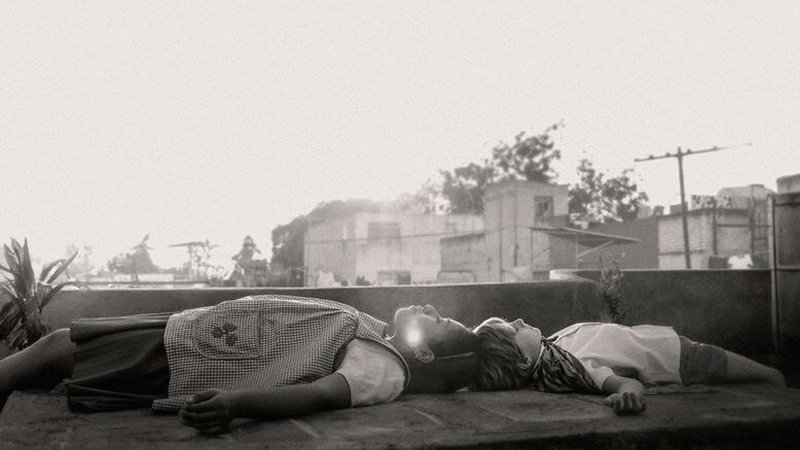
The latest film from famed director Alfonso Cuarón turns the story of a family’s difficulties into one of the year’s best films.
Roma, a film written and directed by the acclaimed Mexican auteur and Academy-Award winning Alfonso Cuarón (Children of Men, Gravity), might just be the best film of the year. Cuarón, known for his exquisite visual flare and plethora of stunning one-shot takes in the sci-fi realm, reels it back for a semi-biographical, deeply personal, and polished 88mm black-and-white affair.
That is not to say Roma, with its quaint beauty, isn’t a marvelous sight to behold. It is quite stunning to look at, but also contains an understated splendor that doesn’t try to dazzle you as much as it creates beautiful portraits with its restrained camera work and eloquent staging. With scenes as big as a wildfire on Christmas, revolution, and gun fights in the streets, and as small as shots of people scraping up dog shit, there is a mesmerizing, serene quality embedded into it.
Set in the early 70s in Mexico City, Roma follows the life of Cleo, a domestic worker for a middle class affluent family, who unexpectedly becomes pregnant. Her new suitor immediately and dishonorably deserts her when he learns of her condition, and Cleo is essentially left alone in her predicament. Her life is held together by the foundation of her job and the family she takes care of.
But then the family patriarch, a doctor, leaves the family to run around with a mistress, continuously claiming he’s away on business in Canada. This creates a shared sense of powerlessness between Cleo and Sofia (Marina de Tavira), the children’s mother and the most powerful woman in the home. “No matter what they tell you — women, we are alone,” she angrily tells Cleo once the separation is apparent, a lesson of which Cleo is already all too aware.
The film skillfully blurs the lines of family; Cleo occupies a role somewhere between surrogate mother and housekeeper; often included and beloved by the children, she is nonetheless always engaged in menial tasks, while mostly keeping to herself. Roma thus largely explores the hardships and joys that center around the abandoned family and Cleo’s everyday routine, as she struggles with her station in life and her impending uncertainty and motherhood. Since Cleo’s life is already so closely intertwined with the family, it quickly becomes her only support system, one she clings to.
Cleo herself makes for an unlikely protagonist. She’s the type of character you’d usually notice in a couple of scenes, opening a door here or there, filling in the background and literally serving other characters. Actress Yalitza Aparicio is not an average lead; in fact, this is her only film to date. Her expressions are properly nuanced and restrained, but give immaculate manifestation of her character’s feelings and inner turmoil. Cleo speaks sparingly, but the sadness felt in her eyes is ever haunting.
Roma is a film that unfolds with small moments, details in the margins that build and build. Slowly and subtly, the visuals and the subtext start to piece together, becoming clearer and more intriguing from scene to scene. There is plenty of foreshadowing in the minute niceties that are carefully crafted and sequenced into the film. They never feel distracting or showy. Much like in life, nothing feels quite predictable or certainly expected.
The delicate beauty found in Roma might not hit you all at once at the story’s end; it is mostly a film that spreads important moments throughout its length, interspersing them with lesser ones that do still create a bigger picture. The film is essentially a stunning tribute to Cuarón’s own childhood and the woman who raised him, one that seems truly made from love.
For Cuarón, the film documents his version of a long transition beginning in Mexico, with social and political vestiges appearing throughout, while also capturing both the exterior and interior lives of a family, showcasing the good and the bad. The anomalous, surreal nature of events never feels implausible; instead, the understated strangeness of the events makes you wonder if this is all a dream. The film shows us an odd and curious year in a woman’s life, and meditates on its bittersweet happenings.
Throughout Roma, social and political changes are juxtaposed with the personal highs and lows of our uncommon heroine, Cleo, offering a deeply rewarding storytelling and viewing experience. Seek it out on the big screen and you will be indubitably rewarded.