
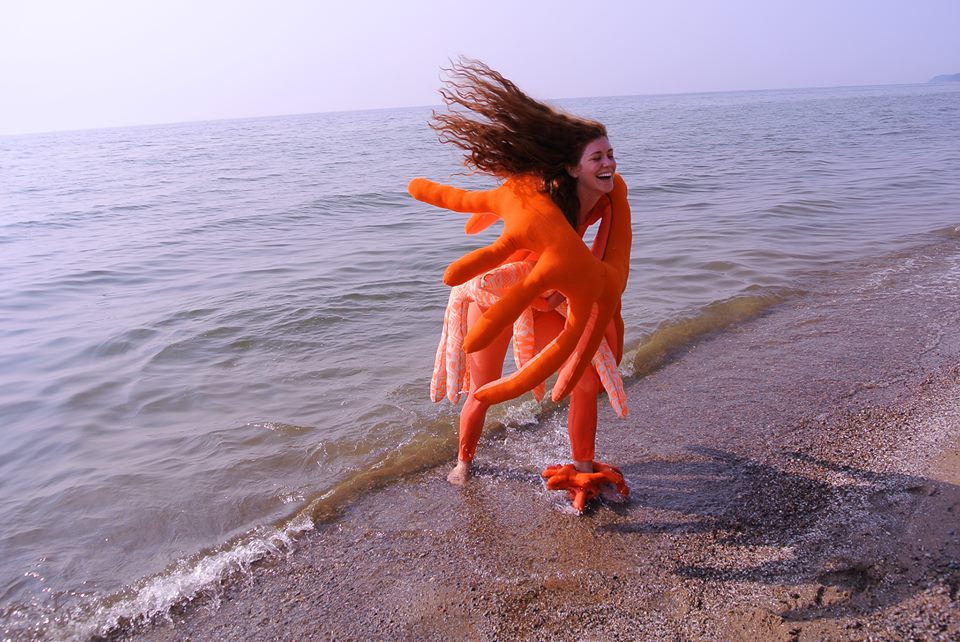
A huge, brightly colored creature resembling a jellyfish walks up a beach. A large purple monster vomits endless strands of yarn from what seems to be its mouth. An elephantine, faceless being interrogates a statue. These are the sorts of images you will see in Braxton Congrove‘s art, which the artist intends to be “both a performance and a sculpture.”
A huge, brightly colored creature resembling a jellyfish walks up a beach. A large purple monster vomits endless strands of yarn from what seems to be its mouth. An elephantine, faceless being interrogates a statue. These are the sorts of images you will see in Braxton Congrove‘s art, which the artist intends to be “both a performance and a sculpture.” The James Madison University Studio Art major, who hails from Midlothian, has not been content to receive education through university programming, seeking outside opportunities through residencies at artistic communities such as Michigan’s Ox-Bow School Of Arts, Tennessee’s Arrowmont School Of Arts And Crafts, and more. Her drive has paid off, leading to a VMFA Fellowship Award for her undergraduate work in the field of crafts, which she received in February 2014. We spoke with her recently about the relationship between her art, the world, and the people in it, as well as many other topics.

How would you describe your art?
I am interested in connecting bodies, or integrating people into a group temporarily, through a relational garment that becomes both a performance and a sculpture. I have also been thinking about extensions of or modifications to the body so that the body is obscured and the form that results references the body. The idea of connecting bodies in nature then taking over the landscape is a challenge I am experimenting with. Metaphors of skin, such as where we touch the world around us and where the world touches us relates to these garments. The extension of the body’s skin shifts the relationship to things around us. There is a proposition of movement and shared experience when participating in the relational garment. Where does the space of the viewer and that of the participant start and stop? What is felt or embodied and what is seen? Who participates? What is the relationship between the body and space? These are some of the questions that drive my making.
What material do you use for your work?
My art practice can be described as a material exploration. I work with traditional craft practices such as weaving, knitting, and soft sculpture in order to create a non-traditional object and experience. Although much of my work is fiber based, I am also working in video and performance.

What topics/ideas does your work deal with?
I have been exploring themes of identity, gender, and growth, through movement, form, shape, space, structure, and performance. Color has recently become an important formal aspect in my work. Moving away from a neutral palette has allowed for exploration and freedom within my making. With this came the possibility for experimentation and collaboration. In my work there is a connection to multiples, in thinking about forms, bodies, and shapes. I am currently working interdisciplinary, exploring the idea of form as an extension of the body, as well as performance and the challenge of documentation in regards to ephemeral work, while still focusing on material exploration.
Have you faced any challenges with your art?
One of the biggest challenges I have encountered is the lack of contemporary art discourse at JMU. This pushed me to look for outside opportunities, such as summer programs and shows, which greatly influenced my art making in a positive way.

What is your favorite project so far?
I would have to say that the video projects have been my favorite so far. I have enjoyed working with fiber and performance and have found the new direction my work has taken to be exciting.
What is your inspiration for your work? What artists inspire you?
While taking a workshop at Ox-Bow last summer I was introduced to the work of Lygia Clark. She is an important influence in my most recent body of work. Clark has built a visual language around her practice, and I find that much of her research and explorations help me in my research of what I am trying to answer through my work.
She was one of the artists at the forefront of the idea of participatory art. Through her works, the object becomes a mediator for participation, and the viewer becomes the participant. Her work deals with the body, the senses, and everyday life. She also explores the idea of integrating art and life. Through her works, there is a performative interactivity between the art object and the spectator.
How has your experience at JMU shaped your experience?
Over the past two years I spent a lot of time working with artist Jesse Harrod who challenged me to take risks within my art making and experiment with materials and processes. I think this has helped to develop my visual and critical voice within my practice. Throughout my first years at JMU I also worked with Sukjin Choi, and this early influence can still be seen in my work.
How would you compare the art scene at Harrisonburg to Richmond?
The art scenes in Harrisonburg and Richmond are very different. Harrisonburg is a much smaller city, so the art scene is still developing, whereas in Richmond there are far more galleries and exhibition opportunities.

I really like the Dialogue videos on your website, can you tell me a little more about them? What inspired them/process behind them? What message do you want them to convey?
I want to present the narrative to the viewer so that not everything is revealed and there is room to take what I have presented and construct their own version of the story. I am thinking about making the immaterial–such as language, words, thoughts–into something material. The images focus on form, line, and abstracted moments of the body rather than the entire form.
Your website highlights your extensive participation and awards in the art community; do you have any advice for aspiring artists?
The best advice I have gotten was to apply to many shows, residencies, and summer programs, as well as continue being engaged in things outside of the art world.