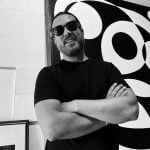
New York artist Ron English is universally recognized as the godfather of the modern street art movement. His distortions of pop cultural iconography, from fast food logos to Marilyn Monroe and Mickey Mouse, have brought his pointed critique of modern consumer capitalism into the mainstream in striking and unforgettable ways. He’s worked with Super Size Me filmmaker Morgan Spurlock on multiple films, painted album covers for The Dandy Warhols and (uh) Chris Brown, and even designed imagery for the Obama presidential campaign in 2008. The term he coined for his iconoclastic, culture-jamming artwork is “POPaganda,” and his work was chronicled in the 2005 documentary film of the same name by Pedro Carvajal.
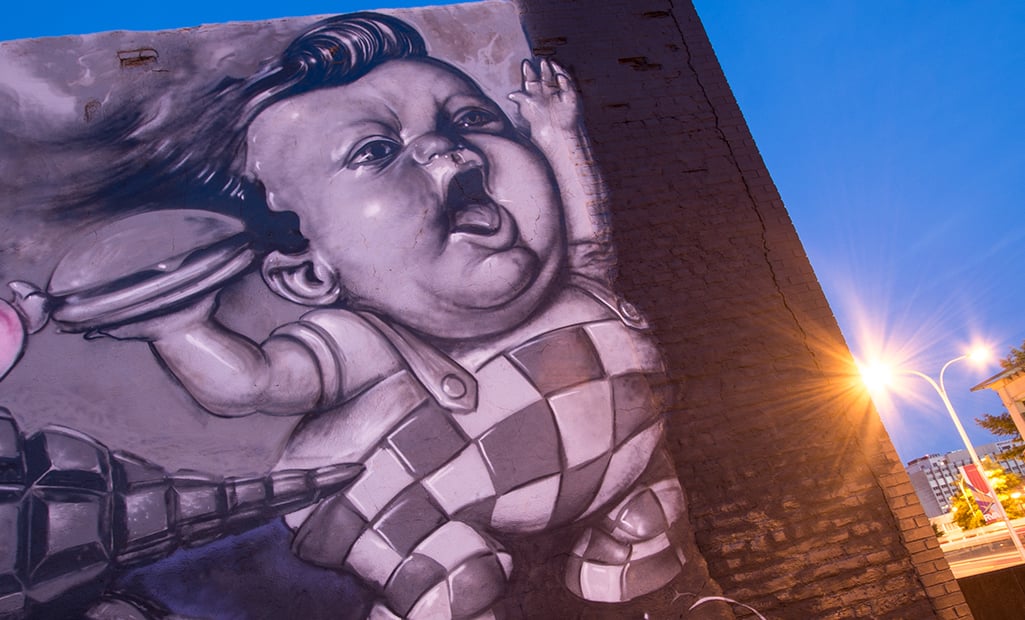
All of these things make Ron English’s participation in this year’s Richmond Mural Project a true honor for the project and the city–but as English warns in this interview, they may also result in some uncomfortable questions for the RMP organizers to answer later. English’s creation, overlooking eastbound commuters on Leigh St downtown, is yet another of his over 100 modified interpretations of Pablo Picasso’s legendary Guernica. This one features enraged fast food mascots waving pieces of meat in the air with malicious intent, centered around a “Have A Nice Day” smiley-face that splits open at the mouth to reveal a grinning skull. It’s an outstanding painting–one that reveals English to have lost none of his edge over the past decades of his artistic career.
While he was in town, we sat down with Ron English to discuss a wide range of topics, from Guernica and “Abraham Obama” to his experiences creating public art in the South–and quite a bit more. Here’s but a small sampling of all the ground we covered during the interview; we’ll have a selection of the best outtakes for you next week.
What do you think of Richmond so far?
Richmond’s very nice. They have a lot of walls here, and it looks like this thing can keep expanding for quite a while without covering mine up. Mine will be the first to get covered up—mark my words.
It’s funny. I was thinking everything was going so perfectly, everybody seemed so into it, and as soon as I said that, the next lady said, “You’re not painting on my building.” It was weird.
I guess the tenants presented themselves as the owner because they wanted a mural. When we showed up at night to paint it, the owner thought we were vandals wrecking her building and went ballistic.
So you should never say things are going great, because five seconds later everything falls apart.
The Obama/Lincoln image we used for the poster struck a chord with people. Where did the idea to combine those two come from?
Well, the whole thing happened rather quickly. Obama was still running against Hillary [Clinton] at the time, and they knew the youth vote was going to be critical. Their staff was looking for ways to reach young people, right when street art was starting to blow up.
They contacted Matt Revelli at Upper Playground, since he was heavily involved in the early street art movement. They basically said, “Give us an artist, we’ll make prints with him, and use those to promote the candidate.” The first one was Shepard [Fairey], the second was David Choe, and I was the third.
They asked me on a Monday if I could have a piece finished by Friday. The talking points that week were that Obama wasn’t qualified, that he didn’t have enough experience. That’s when I realized he had the same experience Lincoln had. You know—he’s a skinny intellectual from Illinois. And then, of course, the whole slavery thing.
Slavery doesn’t end the day you issue the Emancipation Proclamation. You’re talking about people who don’t own property and don’t have a long-term stake in the country. So, for a Black man to become president—it’s a very important step in the process. There were just a million reasons to do it.
I submitted the piece, and I was having a party at the time, so I sent out a bunch of invitations with the image. I think one of the people I sent it to before it officially came out passed it along to someone else, and it went viral on the Internet. I don’t know how it happened—it just happened quickly.
Then the print officially came out and sold out in about two seconds. I have a band called The Electric Illuminati, and [band member Don Goede] called me up and said, “We have to tour this image. Just go city to city and put up this one single piece.”
Like a billboard or something?
Billboards, buildings—anywhere we could put it. And I said, “That’s great, I have all this other stuff! I have a billboard of McCain that says ‘I wanna get erected,’ it’s a Viagra ad. I have a Republican retirement home, and a lot of stuff against McCain.” I had a whole lot of imagery queued up that I was starting to put out there.
And Don said, “No—one image.”
I said, “Can we at least do it in different colors?” and he said, “You can do it in different colors.” But you know, he’s smart. McDonald’s doesn’t have a different version of the golden arches. They just focus their message on one singular thing. We don’t need to show how smart we are, or how clever you are. This is more about getting Obama elected.
We went to ten cities. We did a legal mural in Baltimore that was sponsored by a gallery. That night, the guy who came to help me—Daniel Lahoda—stayed up all night putting posters up all over. He wreaked havoc.
The next day, we were driving back to New York on the 4th of July, so we were stuck in traffic all day. About an hour and a half into the ride, we get a call from the gallery and the guy was freaking out. He said, “The mayor’s here, all these people on the city council, CNBC is here, CNN’s here. I don’t know what the fuck to do—people are flipping out.” So it made the national news while we were still on the road.
What really lit the fire was trashing the neighborhood with all those posters. They were really mad about the mural, but because it was legal, they couldn’t be that mad. It doesn’t become a story until somebody breaks the law. So [Lahoda] did me a huge favor by doing that, I guess.
Maybe the absolute first street art festival ever was in Baltimore, back in July 2002. They built me a billboard for the festival, so I did T“The King of the Jews For the King of Beers.”. I painted it on a big piece of paper that we posted when we got down there.
They got nervous, and I said, “Well, I have another one—the “KISS: Kids On Coke” image.” And they said, “Fuck it, we’ll do the Jesus one.” That weekend, people burned the thing to the ground.
They had 200 Christian radio stations calling me Satan. It blew up, and the organizers were scared because they thought they were going to lose their university funding. They didn’t expect the firestorm that came from that billboard.
Did you feel like it was going to make that kind of impact?
No. When we left, everything was fine. Then they had the festival. That’s when everybody saw it and flipped out, so we were gone by the time the shit hit the fan.
I didn’t really understand that the South started at Baltimore. In the North, nobody cares—but once you hit the South, it’s different.
Do you do a lot of work in the South?
I did the same billboard in Texas and the same thing happened—it made the national news. The South is funny.
Do you remember when the big censorship thing happened in 1989? When they tried to get rid of the NEA? First it was Dick Armey, then it was Jesse Helms. They were trying to destroy the NEA, so we put together this art show called The Helms Degenerate Art Show, named after Hitler’s Degenerate Art Show.
We got about a thousand artists. There was no curation—you were in the show if you wanted to be in the show. We did it in ten venues around New York, but we also wanted to take it to the South. So we went down to South Carolina.
There was this gallery that wanted to host it, but eventually they said, “We can’t do it. We’re too scared. You’ll come here, make a big statement, make the national news, and then you’ll leave. We’re trapped here.”
My friend went down, and they drove him around town. Everything was Helms Dry Cleaners, Helms Grocery… They said, “The Helms own this town. You cannot fuck with them.”
And that’s the thing with small towns—there’s usually some very powerful people who own the town. If the gallery pulled something like that, they’d probably lose everything.
I’m sure. Richmond’s not a big town–there are definitely some major influences here.
That’s the thing when you get to parachute in somewhere, wreak havoc, and then leave; whoever helped you there is stuck. It’s always a weird situation.
What was the inspiration for the piece you did here?
Well, Shane [Pomajambo of Art Whino] wanted a Guernica. I think he saw the one I had at the Juxtapoz show in New York. I’ll never do the same thing twice—I’ve done over a hundred versions of [Pablo Picasso’s] Guernica—so I just came up with something new.
It’s the fast food Guernica. On the left are the Ronald McDonalds, and on the right is Bob’s Big Boy.
Do you ever come into conflict with corporate sponsors in festivals like this one? We talked about Altria a little bit.
Well, they could be awfully mad when I leave town.
I know there’s a statement in there, with the references to corporations, but nothing specific to Altria’s smoking.
Yeah. What if I’d had a bunch of little kids smoking?
That’d be really interesting. That’d be a difficult conversation for us later. [laughs]
Actually I’ve been more tame recently. The thing I actually designed for the wall was a giant brontosaurus painted like a zebra. [Shane] really wanted Guernica.
Why did you want to do your own version of Guernica? Why such an iconic image?
Well, originally it was during the first Gulf War. All my friends went to D.C. to protest. I was going to go, and then it occurred to me: “I’ll just be another face in the crowd. What could I do here? I’m in the media capital of the world.”
So I painted a Guernica—a 10-by-22-foot billboard—and I wrote The New World Order across the top in big fluorescent letters.
I thought about how Pete Seeger would take a song and add new lyrics to old melodies—the folk tradition, the way art gets made. So I figured, “Well, I’ll reinterpret something.” Because everybody already knows what Guernica means. It already has that meaning embedded in the image, and then it translates to the next image.
I always think it’s interesting when you can associate yourself with something that iconic. Remember the Apple advertising, “think different,” with Albert Einstein?
We did a “think different” with Charles Manson, and yeah, that was too easy. And the funny thing is on the Apple website they posted the picture of Charles Manson.
By accident?
No, no, no. One of the guys said it was funny. That’s [when] I realized: there is no “they.” Or if there is an “us” and a “they,” there’s us inside they. Do you know what I mean?
There’s a lot of normal people within the machine.
Yeah. If you watch the movie POPaganda, it’s kind of subtle, but basically everywhere we went, people were secretly helping us. We went to Kinko’s, making all these big printouts, and when we went up to the counter the guy said, “I can’t charge you—leave. I can’t risk my job, but I’m looking the other way and you’re not gonna pay.”
Another time, a guy called me up and said, “We want you to do ads for Camel cigarettes.” I had been doing anti-ads for a couple of years at that point. I looked at my wife and said, “Are they trying to buy me off? What the fuck’s going on?” She said, “Just use their money to make your billboards and fuck with them.”
I had this trompe l’oeil technique that I developed in college, so I was putting that on billboards, and they were putting them up around the country—until one of the executives stood underneath one and realized it was all skulls. From straight on it looked like a weird pattern, but up close you could see it. They were trying to get the trip-hop kids to smoke, but once they saw what I’d done, they realized we’d screwed them.
Finally, I talked to the guy who hired me. He said, “Well, the deal was that I’m a 40-year-old gay man. I have a condo, this is my job. I don’t like selling cigarettes to kids, but I wanted to strike back in some way. I thought you would know what I was doing and you would do your thing. Because I can’t do it—but you can.”
Do you think street art has gotten too trendy?
My experience with art is this: I went to college and tried to show my work in galleries, and everybody said, “We’re not gonna look at your slides. We don’t care. Throw them away.” Or, “Why don’t you come back when you’re 30, and maybe we’ll look at them then.”
You realize there’s actually no way into that world. That’s when I started doing all the billboards. But now, there is a way in—you can put your art on the streets, and people decide instantly whether you’re good or shitty. Everybody has access. It’s an incredible moment in history.
I think about it like baseball. Why am I such a fan of the sport? Because when I was a kid, I played. At some point, I realized I might get a year in college, but I wasn’t good enough to go further. Still, I grew to love the sport by participating in it.
It’s the same with street art. Kids go out and make their own pieces. Maybe later they’ll think, “Fuck it, I’m gonna be an accountant or something,” because they don’t have what it takes to go all the way. But they’ll still be fans. They’ll know who all the street artists are, and they’ll have made their own art.
So they’ll be fans for life. They can truly appreciate it. And I swear, when you’re up on the lift painting, then you come down and sign autographs for the kids, it’s like you’re buying those fans for life.
All my life I wanted art to be popular—and it’s finally popular.
It reminds me of what Wu-Tang said: they’re for the babies, because all those babies grew up to be hip hop fans.
Exactly—and hip hop happened because of access. If I’m a kid in high school and I rhyme, I’m a rapper. I don’t need a $6,000 synthesizer. To rap, you just rap.
Street art is the same—you just go out on the street and paint something. Now you’re an artist. You don’t need special equipment or a Harvard degree.
People love sports because the best players prove themselves. There’s a clear standard: get the ball through the hoop. Imagine if Michael Jordan had never once made a basket, but was still considered the greatest player because his dad owned the team and everybody was paid to say, “He’s great!” That’s what the art world has been like for the last hundred years.
If they don’t even look at anybody’s slides, how do they know they have the best artist? They don’t. It’s a very small clique of people.
Street art has blown that whole thing apart. Now it’s more like sports—everyone can see who’s the best. And because the doors are open, the artists are better than ever. There are more great artists now than at any point in history, and it’s because access and competition have raised the bar.
I used to run track, and as soon as I ran against other people, I got faster. That’s what’s happening here—it’s competition, but it’s good competition.
This article is taken from the Summer 2014 print edition of RVA Magazine, out now! Look for copies available for free at your favorite local Richmond businesses. To read a digital version of the full issue, click here.
Introduction by Marilyn Drew Necci