
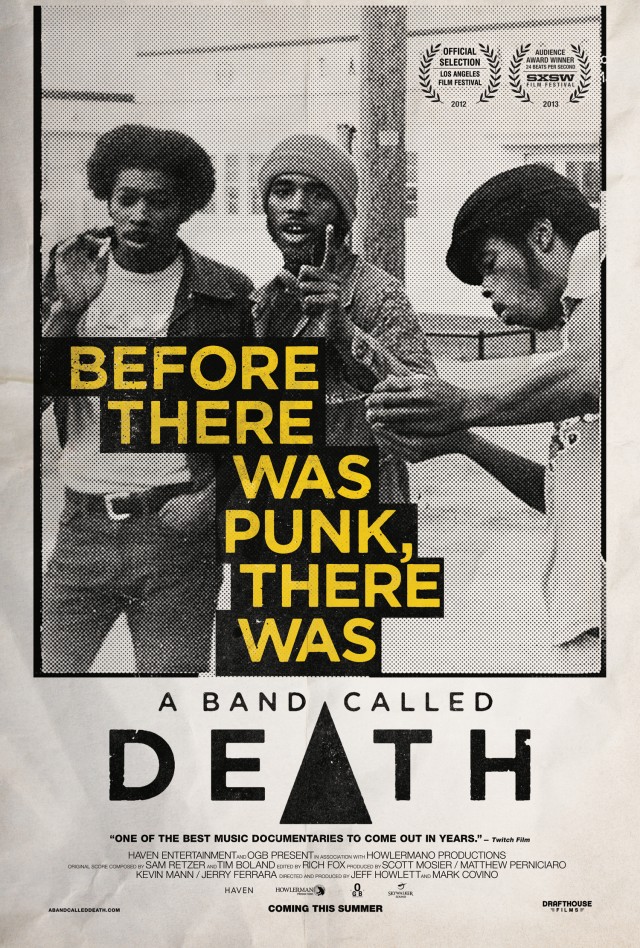
In 2012, the Los Angeles Film Festival premiered A Band Called Death, an American documentary by Mark Christopher Covino and Jeff Howlett that introduced the masses not just to a band that started the punk music genre, but to the nearly four-decade journey that it took for three brothers from Detroit to have their sound heard and appreciated for exactly what it is: punk music at the bare roots.
This documentary tells three distinct stories that all weave together to form a rich tapestry of family, loss, support, courage, inspiration, and the love of music. The film begins with the origins of Death, a band formed in the early 70s by three brothers from Detroit. The two remaining original members, Dannis and Bobby Hackney, take audiences back to where it all began for them. The group started out as R&B, but was inspired and pushed by the eldest brother, David, into fusing rock and funk, ultimately creating the “punk” sound. Dannis and Bobby enthusiastically take Covino and Howlett on a voyeuristic journey back in time to 1970s Detroit. Audiences get the chance to re-live these past moments in time with the very people they meant so much to.
Dannis and Bobby take us back to the house they played in as teenagers and to the recording studios that wouldn’t take them on, then tell the story of the bandmates parting ways after various post Death projects. Normally, this would make for a sadder, less unique story of a band trying to make it. However, it is the passion and feeling that Dannis and Bobby convey in every frame that pulls the spectator deeper and deeper into the toll that the pursuit of dreams can have on one person, much less three brothers.
The second story resonates throughout the entirety of the film. It is the story that everyone connected to the Hackneys tell with so much love in their eyes, you can feel it through the screen. It is the story of David Hackney, the band’s creative genius, visionary mastermind, and to whom they credit every step of the way. David found an old guitar and learned how to play after seeing The Beatles on the Ed Sullivan show. Dannis learned how to play the snare by using butter knives. David and his brothers, being African-American in a Motown era, wrote songs about the oppression they faced from their environment every time they tried to play their rock and roll style. “Keep On Knocking” was inspired by angry neighbors who repeatedly called the cops on the brothers when they would practice. The door was pounded on repeatedly, but they never stopped.
David changed the name of the band from Rock Fire Funk Express to Death after their father passed. Dannis and Bobby recall how the severe reality of death as a concept affected David in unchangeable ways, and thus not only the name, but also the concept of their band was born. David’s refusal to budge on the band’s name lost the brothers many opportunities. After several post-Death projects, the band broke up in 1982 and David went back to Detroit. Throughout all the struggles, the trio consistently supported each other–Dannis and Bobby made it a personal vow to “always back up your brother.” Though the audience never officially meets David–he passed away in 2000–David is in every scene, in every word of Dannis and Bobby’s story, in every laugh they share and in every tear that falls in remembrance of their brother. David was so full of love, life, spirit, and knowledge that he was truly ahead of his time. He expressed it the best way he knew how and his devoted brothers carry on his legacy to this day.
The story that completes A Band Called Death is Death’s rebirth, and everything that comes with it. David had told his brothers to hold onto the demos they had made back in the 70s, with the assurance that the world would come looking for their music one day. Eventually, Dannis and Bobby’s kids discover their fathers’ musical past when Death’s lone single is played at a college party some thirty years after it was made. Dannis and Bobby’s kids create a tribute band called Rough Francis, where they paid homage to the decades their fathers struggled through with Death. Dannis and Bobby wavered between shock, awe, and heightened emotions, not only at the knowledge that their kids found their music; but that, just as David predicted all those years ago, the world wanted to hear it. After some time, Dannis and Bobby Hackney re-formed Death and began touring with Rough Francis to finally live their dream, borne of the love they hold for each other as family, and for the love of the music they created with their fearless leader all those years ago. [And they’re still awesome, as those who attended Fall Line Fest this year will attest-ed.]
With a documentary like this, the content alone may be enough for most viewers. However, the editing style of Rich Fox and Covino gave the documentary a complete one-of-a-kind look. Like the band’s music, it is unique to the film itself. The usage of old snapshots crosses over with cutouts from the family album. Home video is intercut with original haunting recordings of David’s voice. We the viewers are led by the hand through Death’s rise, fall, and rebirth by the Hackneys as well as those who knew them best. Viewers can often connect with documentaries on many levels of empathy and knowledge, but it is a true achievement to connect with so many by having family be the focal point of a story about music, even more than the music itself. The Hackneys never once waver in their credit to their brother. It is a thing of beauty to watch the story unfold from such a universal point of origin. A Band Called Death is a must see for anyone who loves the genre it helped create, but it is also for anyone with a vision of what could be, and who would go beyond their limits to make that vision a reality.