It’s been described as a marathon of the mundane; a work of art built around household chores and boredom, or perhaps even the most relevant films about subtextual feminism. “Jeanne Dielman, 23, quai du Commerce, 1080 Bruxelles” is a seminal work of the 70s and still a very unique experience as a film.
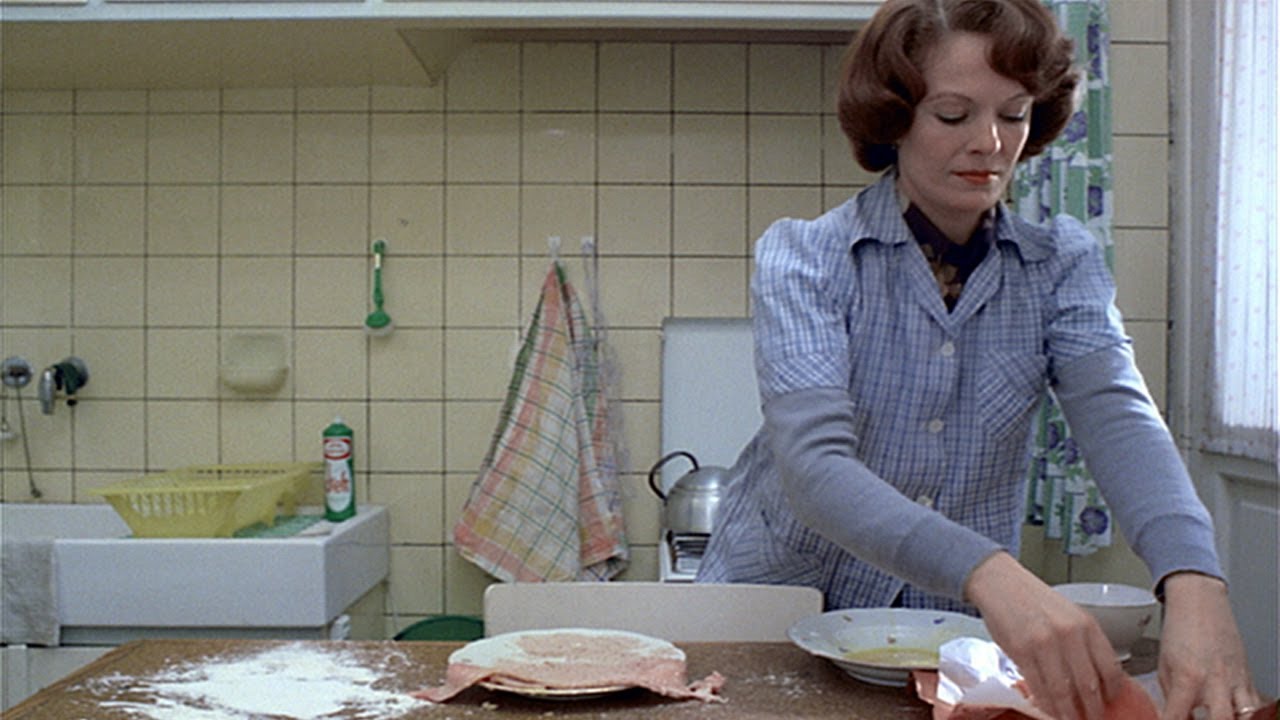
The film follows the seemingly all-encompassing daily routine of a middle-aged Belgium widow and stay-at home mother raising her meek teenage son. Not only do we follow the titular Jeanne (Delphine Seyrig) character throughout her daily routines of her cleaning, washing, assembling dinners, and trying to find the occasional replacement button, we get a glimpse into a very starkly un-romanticized existence delivered through openly passive mise-en-scène voyeurism from writer-director Chantel Akerman.
With Akerman’s lingering shots and grid-like stagnate frame, you’ll find your poor brain and attention wondering tangentially within the world of Jeanne’s hypnotic domestic routine filled with folding, cooking, eating, drinking, and washing in various orders. Motivation besides habit seems to be at your discretion. Nothing is too out of the ordinary at first, which is caustic enough on your attention, but soon the mind drifts and fantasies flourish. We know not much of this woman besides her teenage son who likes to read at the dinner table, she is a widow and has a sister in Canada, and she does occasionally turn tricks out of her own bedroom. Now that’s probably the most provocative events of the film outside of watching somebody make a meatloaf, which I found just as interesting. But even that bit of juicy narrative is really just part of the routine, and we even grow accustomed to Jeanne putting her money in a vase after every nondescript visitor.
But soon things become slightly askew, and everything seemingly has some meaning, some impetus of why it even occurs. Intent looms large in “Jeanne Dielman” with such a bare minimum of conflict or story, one starts to imagine if this is an all-encompassing commentary on the human condition or how the audience’s own voyeuristic nature has somehow betrayed itself into not “getting it”. You start to feel passively held hostage by Jeanne’s domesticity and perhaps even our own conditioning as viewers. We expect to be told what to pay attention to and what cues to follow. What we’re given is a barely filtered endurance test of sorts. To say that Jeanne Dielman’s existence is hollow would be a lazy interpretation, but it’s certainly not for everyone. It is truly an experience with that your mileage and curiosity may vary. It’s something out of Warhol or Mike Snow’s wheelhouse of non-narrative experimentations but more valiantly more cohesive. One’s interpretation is likely their own and really is the beauty of Jeanne Dielman and her mesmerizing ways.
Constantly we observe one another through our social media gamut as part digital living and active performance, the stark difference between Jeanne and her own controlled existence is it’s only for herself. I can’t help but wonder what happened to her husband and what may have led to his fate….
“Jeanne Dielman, 23, quai du Commerce, 1080 Bruxelles” is a 201-minute epic with that of a reputation for being an experimental, artistic gem that’s scarcity meant it truly needed to be sought out to be truly experienced. The film had a reputation of being unavailable for home-video consumption and one wonders how this work holds up in the age of instant gratification. Thankfully the Criterion Collection had brought it back into circulation with a 2009 DVD release that has finally been upgraded to Blu-Ray standards. Finally those wanted to watch a woman peel potatoes for long stretches of time can do so in glorious high-definition sound and audio. Kidding aside, it’s a wonderful director approved digital transfer that was undertaken by the Cinémathèque royale de Belgique and supervised by cinematographer Babette Mangolte, with uncompressed monaural soundtrack specifically for the Blu-ray. Also featuring “Autour de ‘Jeanne Dielman,’” a documentary—shot by actor Sami Frey and edited by Agnès Ravez and Akerman made during filming, interviews with Akerman and Mangolte from 2009, an episode of French television, “Cinéma de notre temps”, from 1997 featuring Akerman’s work, an interview from 2007 with Akerman and her mother, Natalia, and excerpt from a 1976 television interview featuring Akerman and actor Delphine Seyrig, plus “Saute ma ville”, Akerman’s 1968 very first film introduced by the director. Included with all of that is a wonderful essay by film scholar Ivone Margulies in a booklet featuring some still shots of the film. It’s a great reminder of how elegant and well designed a lot of Criterions have been and why the booklets are sorely missed. Akerman did get an Eclipse Series release but this is the first for her on the Blu-Ray front. Sadly this might be the last release we get from her but it does a fantastic job with the supplements.
Jeanne Dielman, 23, quai du Commerce, 1080 Bruxelles
Belgium, France (1975)
Akerman
Spine #484
Available on DVD, Blu-Ray, and Filmstruck