
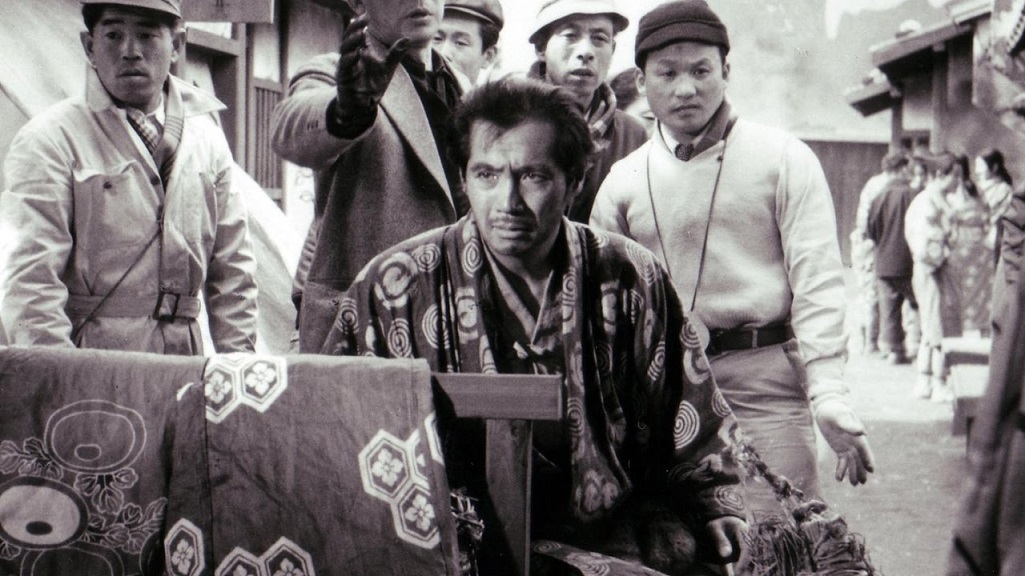
Few films are as highly regarded or as revered in Japanese cinema as Kenji Mizoguchi’s haunting, fantasy fable “Ugetsu”; a timeless masterpiece of post-war cinema that not only works as a fatalistic fable but also a critique of class and patriarchy told through a kaidanshu-lensed ghost story. Through themes of greed, karmic retribution, suffering, and the chilling influence of the dead on the living, “Ugetsu” embodies folklore taken to film using Buddhist mythology and marrying it though the supernatural and war. “Ugetsu” often fixates on questions of fate and choice and how these concepts often intertwine.
“Ugetsu” is also a “gender tragedy” that primarily focuses on two couples during a civil war, Genjuro (Masayuki Mori), a poor potter looking to rise above his meager standings, and his devoted wife Miyagi (Kinuyo Tanaka) along with their young child. The dynamics between the two usually facilitates two diverging frames of thought. While Genjuro would rather strike it rich with the booming civil war economy, his wife would prefer them to seek safety first and not take chances for purely financial gain. It’s these two overlapping needs that provide the tensions throughout “Ugetsu” and critique the tragic nature of not only 16th century Japan, but modern sensibilities as well.
The other couple is Tōbei (Eitarô Ozawa), a brash peasant who assists Genjuro but dreams of glory by becoming a renowned samurai, and his wife Ohama (Genjuro’s sister) who is more down to earth and ridicules her husband’s delusions. Throughout the film, the two men pursue their lofty goals of class ascension (and buying nice things for their ladies) with varying degrees of success; their wives are ironically and ultimately punished for it. While this is the bedrock of the film, “Ugetsu” becomes otherworldly when a mysterious apparition disguised as a noblewoman notices Genjuro’s pottery and requests that he himself deliver her newly bought merchandise, leaving his family to fend for their selves. While Tōbei pursues becoming a renowned samurai legend, bandits come upon Ohama and raped her. Having feeling abandoned and disgraced; she resorts to prostitution in her husband’s absence. Genjuro on the other hand, is seduced by this mysterious rich specter (played perfectly by Machico Kyo) and pays for his mistake by the loss of his wife and child. We see Genjuro return to his home to find his wife cooking and child sleeping. It’s only upon waking does Genjuro and the audience realize that this is only reality setting in and that our hero has only become aware of his folly. The recurring cycle of temptation and fate inform the other, and thus tragedy is sometimes just unavoidable and not always just.
While the story certainly is engaging and notable in its complex moral paradoxes combined with an alluring erotized version of traditional Japan, the direction and cinematography of “Ugetsu” simply outclasses most of its cinematic peers. The acting by the stellar cast is also natural while ethereal whenever the supernatural comes into play. Mizoguchi often fit the profile and reputation of an obsessive perfectionist and uncompromising auteur. Using many crane shots and one takes, it’s impressive and engaging in ways that directors will soon take note and borrow following its acclaimed release. “Ugetsu” is still a stalwart fixture in world cinema even today and an often-cited influence for the likes of Kurasowa, Goddard, and even screenwriter/director Paul Schrader.
“Ugetsu” comes in an upgraded packaging and 4K digital restoration and for the first time on Blu-Ray since its 2005 Criterion DVD counterpart. Filmmaker, critic, programmer Tony Rayns provides a very insightful commentary track that really illuminates the context of the film and Mizoguchi’s technique. Also included is “Kenji Mizoguchi: The Life of a Film Director”, a documentary by Kaneto Shindo from 1975, “Two Worlds Intertwined”, an appreciation of “Ugetsu” by Masahiro Shinoda from the original 2005 Criterion release, “Process and Production”, an interview with Tokuzo Tanaka, first assistant director on “Ugetsu” also from 2005, and a 1992 with cinematographer Kazuo Miyagawa. Also carried over is the booklet featuring the three short stories that inspired the film, along with an essay by film critic Phillip Locate. Locate gives a great summation of the film’s literature origins, varied philosophy, and the cultural standing and relationship to Mizoguchi’s own film catalog and director’s aesthetics. It’s a beautiful upgraded transfer (the DVD was less than impressive) coupled with a great collection of supplemental materials, especially the thick booklet is a quite a gem. It is just a great improvement to an important work. If Japanese cinema is your thing, this should be a required having and highly recommended, or even as a film fan it holds its own and continues to be effectively captivating film its own right. As poetic of a film it is, the blending of genres and atmosphere are bar-none with some of the most exquisite and mesmerizing of its time and worthy of being considered so highly influential.
Ugetsu
Japan (1953)
Kenji Mizoguchi
Spine #309
Available on Blu-Ray, DVD, and Filmstruck