
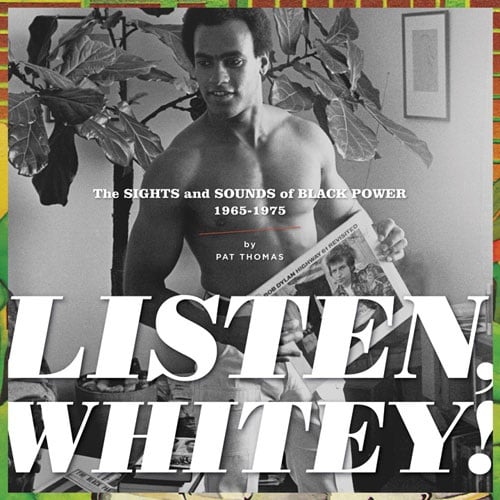
When we consider a particular, spectacular, over-stuffed and overdue book by Pat Thomas – entitled, Listen Whitey! The Sights and Sounds of Black Power, 1965-1975 – we can’t help but shout, “What it is!” That’s not because we’re insensitive, insecure and unfunny – or at least, it’s not just because we’re insensitive, insecure and unfunny. It’s also because a book like Listen, Whitey! needs to be approached with the knowledge of what it is.
When we consider a particular, spectacular, over-stuffed and overdue book by Pat Thomas – entitled, Listen Whitey! The Sights and Sounds of Black Power, 1965-1975 – we can’t help but shout, “What it is!” That’s not because we’re insensitive, insecure and unfunny – or at least, it’s not just because we’re insensitive, insecure and unfunny. It’s also because a book like Listen, Whitey! needs to be approached with the knowledge of what it is.
Listen, Whitey! is not a book about politics, necessarily, though it is, of course, highly politically infused. Listen, Whitey! is not solely a book about music, either – though the music is there, along with a love for it that clearly pulses through Thomas’ core. And Listen, Whitey! is also not all-encompassing, not a history lesson, and not a collectors guide. We understand that many may not be able to separate The Black Panthers from the concept of “Black Power,” or may not even be able the tell the difference between Black Power and Black Sabbath. Listen, Whitey! doesn’t concern itself too much in this arena, either.
Yet in the introductory chapter of the book, the subject turns to the history of the phrase “Black Power,” including the words and legacy of the largely-forgotten Representative Adam Clayton Powell, Jr. In his 1967 book, Black Power: A Form of Godly Power:
”Unless man is committed to the belief that all mankind are his brothers, then he labors in vain and hypocritically in the vineyards of equality.”
What Listen, Whitey! is, then, is a book-length discovery and celebration of how the concept of Black Power – one of the many historical means towards liberation – influenced culture at the time of it’s inception and popularity, as well as the culture today. It is also, without question, one of our very favorite books of the year. The discussion of why, exactly, that is the case is perhaps framed best by our chat below with author Pat Thomas, who was kind enough to respond to our ridiculous questions. Enjoy.

Is it surprising to you that – after your many dedicated years as a music fan, music performer, writer, label owner, etc. – your first proper book to be published would be one where the political context equals its musical content?
That’s a very a good question, as I had two dreams in life – to either be a rock star or a student agitator (you know, one of those guys in the 1960’s who had taken over the college president’s office). I didn’t get too far on the rock star thing – although I had a mildly successful career as a “B” or more like “C”-level indie-rock musician and slightly more successful career as an “A”-level reissue producer and “B”-level record company maverick. So, the Listen, Whitey! book basically combines both ambitions into one… and when I lecture about Listen, Whitey! on college campuses – which I’ve done quite a bit of, from UCLA to USC to San Francisco State to Evergreen College – I feel like that student agitator!
Do you see yourself as someone who has spent much time thinking about what you ultimately “want to do” musically (for lack of a better term), or more as the type to take action and figure out its fit into your work at a later date?
Wow, you’re kind of blowing me away with these questions, as they are more insightful than most interviews I’ve done. I have spent decades of my life trying to decide “what I really want to do” – yet, I’m not one to sit around, so while I’m “thinking,” I’ve generally been really busy actually doing stuff – recording music, releasing CDs of my music and that of many other people (such as in my A&R position at Light in the Attic Records) – either new or old stuff, occasionally doing the odd bit as a music journalist. I’ve written for Crawdaddy, Mojo, and The San Francisco Bay Guardian. I’m a Doer and a Thinker, I guess. But I don’t retroactively give it meaning, although some ex-girlfriends might beg to differ.
In your teenage daydreams, aside from magically turning into Arthur Lee, what did you most hope to accomplish from your perspective as a music fan?
I had a pivotal moment around 1976 when I saw a Paul McCartney Wings Over America TV special – and I thought, man, I’d love to just play music and tour. At that point, I made a commitment to learn the drums and join a band – and I did about a year later.
What was the first awareness you had as an adolescent regarding the existence of “black power” as an expression through music?
As a kid? I don’t think I grasped the concept of “Black Power” then – I was too young – despite (or because of) being born in the early 1960’s. Watching the TV show Soul Train (which was not a political act unless you came from a white, middle-class background like I did) just baffled the shit out of me – I didn’t understand that music at age ten. I’ll concede that I didn’t grasp how damn amazing that music was until I was around thirty, and then I knew that black really was beautiful.

What misconceptions did you hold at the time about what “black power” meant as a mode of musical expression, specifically? What misconceptions, if any, did you hold later in life that were dispelled by the writing and research of Listen, Whitey!?
As I said, I didn’t really grasp it back in the early 70’s – but I did grasp that Abbie Hoffman and the YIPPIES were incredible funny and wild and that ultimately led me to Bobby Seale and eventually the Black Panther Party… but that process took a long time.
Speaking of research, the mere scope of Listen, Whitey! contains an almost terrifyingly broad cross-section of areas of note – from relevant social sciences to music industry distribution techniques – all handled with considerable balance and aplomb. How did the scope of the book evolve from the origin of the idea to the finished product? Given the proper resources and dedication, we find that every chapter of Listen, Whitey! could ultimately translate into a book-length investigation.
Wow, thanks again. I should hire you as a publicist – you nailed that one, better than I could have.
Well, originally, the project could have been a “box set” of music and spoken word CDs and some DVDs of movies, but too many cooks spoiled the pot as they say, and so I decided to rethink the whole thing and do it as a book – with myself as Captain Trips. I kept the story of the Black Panthers to a minimum, as that story has been told before – but I did want to tell the genesis of the story and tell it with a warm and fuzzy glow – as I love those guys and gals a lot – and wanted to do the Party justice. Originally there was a bit more about the Civil Rights era that led up to the Black Power Movement – but my publisher wisely yanked that, as again that story is elsewhere, but I wouldn’t have minded leaving a couple of thousand words about that. Yes, someone else should expand the Jazz section of my book into a whole separate thing – I’m not the right guy to do that, but I’d love to see, say, journalist Derk Richardson of Oakland and legendary jazz producer Michael Cuscuna tag-team that someday.
What content do you wish you could have had the time or space to elaborate on even more fully?
Again, the jazz section could have been bigger – better? – but I got overwhelmed and I also knew that space was a consideration – as well as my patience.
What relevant content which was excised completely brings you the most pain?
Damn, I wish my had my old computer on right now, and I’d cut and paste what got taken out that I didn’t want to have taken out – it wasn’t super exciting, but a couple of things about Black political and/or music gatherings of the early 70’s that did NOT result in any recordings, hence the reason that they got yanked – for space reasons. Precursors to WattStax, if you will. When I mentioned that to my fellow archivist Rickey Vincent, he was shocked, but he’s published a few books, so he knows the game.
Listen, Whitey uncovers so much source material that has remained un-catalogued for years – why do you think that is?
As my pal Rickey Vincent said, “What took so long?” That, I can’t answer. Part of the reason is that most of what I wrote about is NOT easily available on CD, iTunes, YouTube, etc. – and people are no longer patient to do the research. Pre-internet, it was nearly impossible to do a book like this, as I didn’t know what I was looking for, ’til I found it on a blog or Ebay.

It really is mind-blowing to think of a label like Motown, with so much to lose fiscally, being willing to release an album like Guess Who’s Coming Home.
You got that right! The companion book took another decade or so, for Wallace Terry to find a publisher, and a couple more years for a PBS movie to go with it!
Can the above-ground music industry be rightfully accused of losing any nerve it may have once had, or do you think this reflects the changing priorities and “de-politicization” of the music-listening public as a whole? Some combination of the two?
I think a combo of the two (and again, these are some damn good questions, my good man!). Lots of nerve has been lost – in fear of offending someone – as in not being politically correct, but more likely, in fear of being TOO political – as everyone likes their entertainment to be kept “lite and breezy!” these days. So, you are correct.
Was there a particular record or performance that by description alone sounded like something that must be included in the book… but ultimately resisted your archeological efforts?
There was a record on Ebay that ultimately sold for way more than I could afford that I never saw again – a Black female folk-blues singer named Mable Hillery who had an album called It’s So Hard To Be A Nigger, released in 1968.
Is there one record in the book that took more effort to uncover than any other?
Well, mmmmm… some records were harder to find than others – some of the Black Forum Records on Motown are easier to find than others – but most of the time, I didn’t know what I was looking for until I found it, such as that SNNC album of gospel songs that I stumbled upon in a dusty old record store in Seattle – and then good luck trying to find out “more info!”
How much – if any – resistance did you receive during your research regarding the fact that an overview of the sounds of Black Power was being compiled by (for lack of a better term) a white dude?
As I’ve mentioned in previous interviews – the Black Panthers treated me with respect and love . They were way more “down to earth” than half of the hipster (and white) indie-rock musicians I’ve met in my life!

We’d like to get your thoughts on two of the more stunning songs included on the companion Listen, Whitey! compilation. The first being “Who Will Survive America?” by Amiri Baraka, and the second being “I Hate the White Man” by Roy Harper. Baraka’s track is not only musically distinctive, but has a distinctive attitude as well, expressing an almost joyful nihilism, while the Roy Harper song fits snugly within his overall musical output, with unforgettably poetic lyrics “written in response to the many injustices that the peoples/tribes of Europe had inflicted on greater Humanity in the modern age,” in the words of Harper himself. Can you describe the first time you intersected with both of these songs, and why both were chosen to fill the limited space available on the compilation album?
“Who Will Survive America?” is THEE song on the compilation, never on CD before – never reissued anywhere. I love the lyrics and the groove – it must have gotten played a hundred times while working on the book. I don’t always agree with Amiri’s personal politics – but I do respect his ‘tude. “Joyful nihilism” – that’s brilliant! “I Hate the White Man” was not a track that I originally planned to include, but others suggested it and I’m glad I caved in (I didn’t really put up an argument), as I loved the sentiment and the fact it was not only a white guy, but also a British one. The Harper song I’d known for decades, in my pre-political years, as just someone who loves English folk-rock (dating back to the 1980’s). The Amiri song I didn’t discover until I dove into this whole project, and when I heard it – I was transfixed. Amiri was the final “hold-out” to agree to be included and I was freaking out that I might not get it. It took some sugar in my mouth and some honey in my heart to get it.
Can you pinpoint any specific books from your own experiences that radically transformed the way you think about a specific time for music, a specific genre, or a specific artist?
From the perspective of the Listen, Whitey! project, I was greatly inspired by two autobiographies by two key Black Panthers – Elaine Brown’s A Taste of Power and This Side of Glory by David Hilliard. Those are both “must reads” for all humans – white or black. In terms of music books that inspired me in some way for this project – perhaps Julian Cope’s Krautrock Sampler is the best example.
When was the last time that you were legitimately blown away or otherwise fully enthused about a music-related book or longform journalism piece?
Another very good question! A Seattle writer named Chris Estey did a piece about Phil Ochs that was like Lester Bangs, more about Chris (growing up in Spokane in the 1970’s) than Phil’s music, that was brilliant. More details here.
What else? Let me think for a moment. Ok, one more, a detailed study of Van Morrison’s music – not his life – it digs into what literature inspired Van’s lyrics, what other music inspired his music, some of the origins of the songs in general. It’s called, Hymns to the Silence: Inside the Words and Music of Morrison, by Peter Mills. I wrote an essay about that book that can be found here.
What elements to you look for in books and other writing about music?
One thing I look for is accuracy – it’s amazing how many books have bone-headed mistakes. Books about specific bands or albums that have the wrong year for when the records came out – the 33 & 1/3 series has mistakes like that. Not all of them, but some. I also look for stories that I haven’t heard before – new or freshly uncovered information about records I know well.
What music have you been listening to lately?
Nearly all vintage music–by the likes of Kevin Coyne, Sandy Denny, The Who, The Kinks and Shirley Collins, to name a few.
If push comes to shove, what’s your favorite Barbara Manning song of all time?
That’s a difficult one – as I love so many of them – but for today, let’s go with… “Pulp” from a Manning LP called Truth Walks in Sleepy Shadows.
Indian novelist Arundhati Roy – a massive, massive Tangerine Dream fan, no doubt – said the following in her 2003 book, War Talk:
“Our strategy should be not only to confront empire, but to lay siege to it. To deprive it of oxygen. To shame it. To mock it. With our art, our music, our literature, our stubbornness, our joy, our brilliance, our sheer relentlessness – and our ability to tell our own stories. Stories that are different from the ones we’re being brainwashed to believe. The corporate revolution will collapse if we refuse to buy what they are selling – their ideas, their version of history, their wars, their weapons, their notion of inevitability. Remember this: We be many and they be few. They need us more than we need them. Another world is not only possible, she is on her way. On a quiet day, I can hear her breathing.”
Your thoughts?
Not sure what to say on this one – although I do like it.
What’s next for Pat Thomas?
Already working on my next book – which will be similar in format to Listen, Whitey! – focusing on the 1960’s YIPPIE radical leader Jerry Rubin and his pals, such as Abbie Hoffman.
—
Order Listen, Whitey: The Sights And Sounds Of Black Power, 1965-1975 from Fantagraphics Books HERE
Order the Listen, Whitey compilation LP from Light In The Attic Records HERE
By Ryan Muldoon/originally appeared at revoltoftheapes.com