
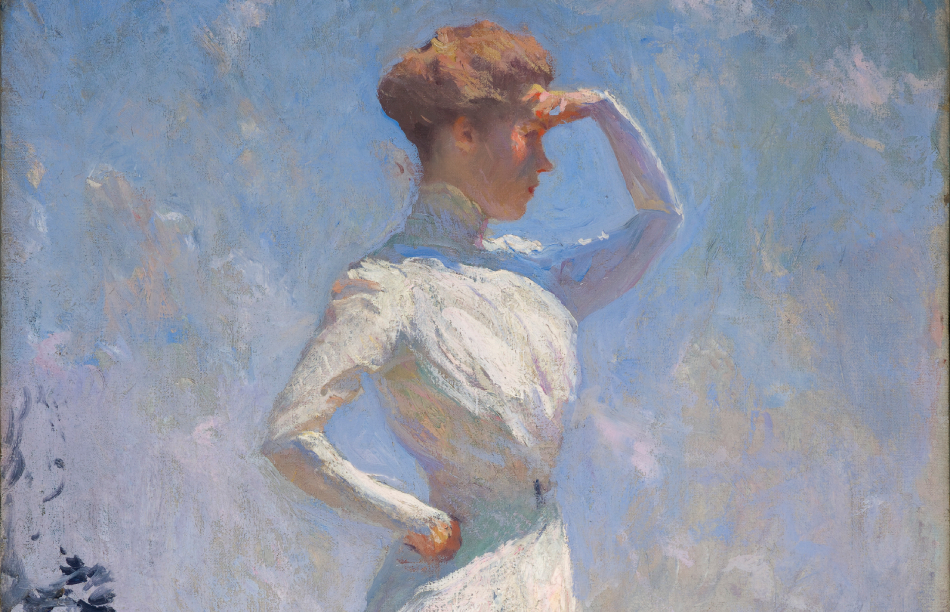
At Whistler to Cassatt: American Painters In France, on display now at the VMFA, viewers see American artists explore history through an expatriate’s eye and move through the artistic evolution from tonalism to impressionism’s attempt to capture life as it happens. RVA Mag’s S. Preston Duncan explains.

In the beginning, art is exact, moral, exaltant. It’s human, but human in its drive for perfection, for purity. It is a dream for humanity rather than the current of its dreams. The epic poem and the symphony — an offering of virtuosity. All trumpets and no jazz. And it’s brilliant. This is the oil and hue of a breathtaking academia, reaching its peak just as the emerging artists of the era began pulling in a different, less perfect but more perennially true direction. The VMFA’s Whistler to Cassatt: American Painters in France exhibit chronicles this shifting epoch with immersive accessibility.

Most of these artists didn’t make the pop culture collective memory A list — the Midnight in Paris cut. But they aren’t exactly hidden behind history, either. Every piece in the retrospectively gentle stylistic evolution from tonalism to impressionism explored throughout the exhibit is a work of mastery and vision. It’s the particularities of the vision that set them apart from one another. And tie them together.

Monuments take many forms. Sculptural, psychological, emotional. We humans are in the monument-making business. We each build our own according to the medium of our lives. But all monuments, whatever their form, are the artform of idealism. The exhibit opens in 1882, and the paintings are monumental. Frank Myers Boggs’ masterpiece, La place de la Bastille en 1882, serves as a kind of singular expression of the journey to come. Its fusion of impressionism and tonalism encapsulates both a rebellion from, and reverence toward, the Academie des Beaux-Arts — the authoritative institution of artistic excellence in France until 1863, when Napoleon III withdrew governmental control of the school, renaming it L’Ecole des Beaux-Arts.

Previous academic attitudes that favored the allegorical over the experiential and exactitude over expression were being called into question by the end of the 19th century. The narrow spectrum of portraiture, historical representation, and religiosity were abandoned in favor of impressionism’s perennial endeavor to capture life as we know it to be, with all its imperfections. Where before French artists hid their hand with carefully blended colors and soft strokes, the impressionists sought to capture the movement of both light and artist in their richly contrasting, brightly dream-swept compositions.

The exhibit pulls back before charging forward into the (quite literal) new school of painting. The muted colors and richly detailed realism of Henry Mosler’s biblical Le Retour (1879) exemplify the old guard with all its institutional wonder.
While debates around what constitutes art generally draw more pretension than consensus, few are those who would argue that art can exist without experimentation. As we move forward into a staggering collection of individual innovation under the collective movement that would become known as impressionism, an experimental spirit emerges. And it’s one that will alter the course of art history to this day. From Dennis Miller Bunker’s Wild Asters with its living waters, to Mary Cassatt’s iconically vivid yet hauntingly soft portraiture, Whistler to Cassatt accelerates through the stylistic evolution of artistic intelligence that categorized one of the most significant eras in painting. It’s a true wonder to stand in the presence of not just these pieces, but the narrative behind them. That narrative is a kind of blossoming that opens artistic focus, from a prescribed vision of human potential to a lucid dream of human reality.

Whistler to Cassatt builds on the photographic narrative that comprised the Man Ray exhibit that previously inhabited the space. That chronology makes these experiences educational in an internalized, experiential sense — you don’t need to be an art historian to enjoy this. It’ll teach you. It’ll tell you a story. It’s a story I didn’t know until I walked through it.

Whistler to Cassatt: American Painters In France is on display at the Virginia Museum of Fine Arts through Sunday, July 31. Tickets are $16 for adults, $12 for seniors 65+, $10 for youth and students with ID. Order tickets at VMFA’s website.

Top Image: Sunlight (detail), 1909, Frank Weston Benson (American, 1862–1951), oil on canvas. Indianapolis Museum of Art at Newfields, John Herron Fund, 11.1. © The Frank W. Benson Trust