
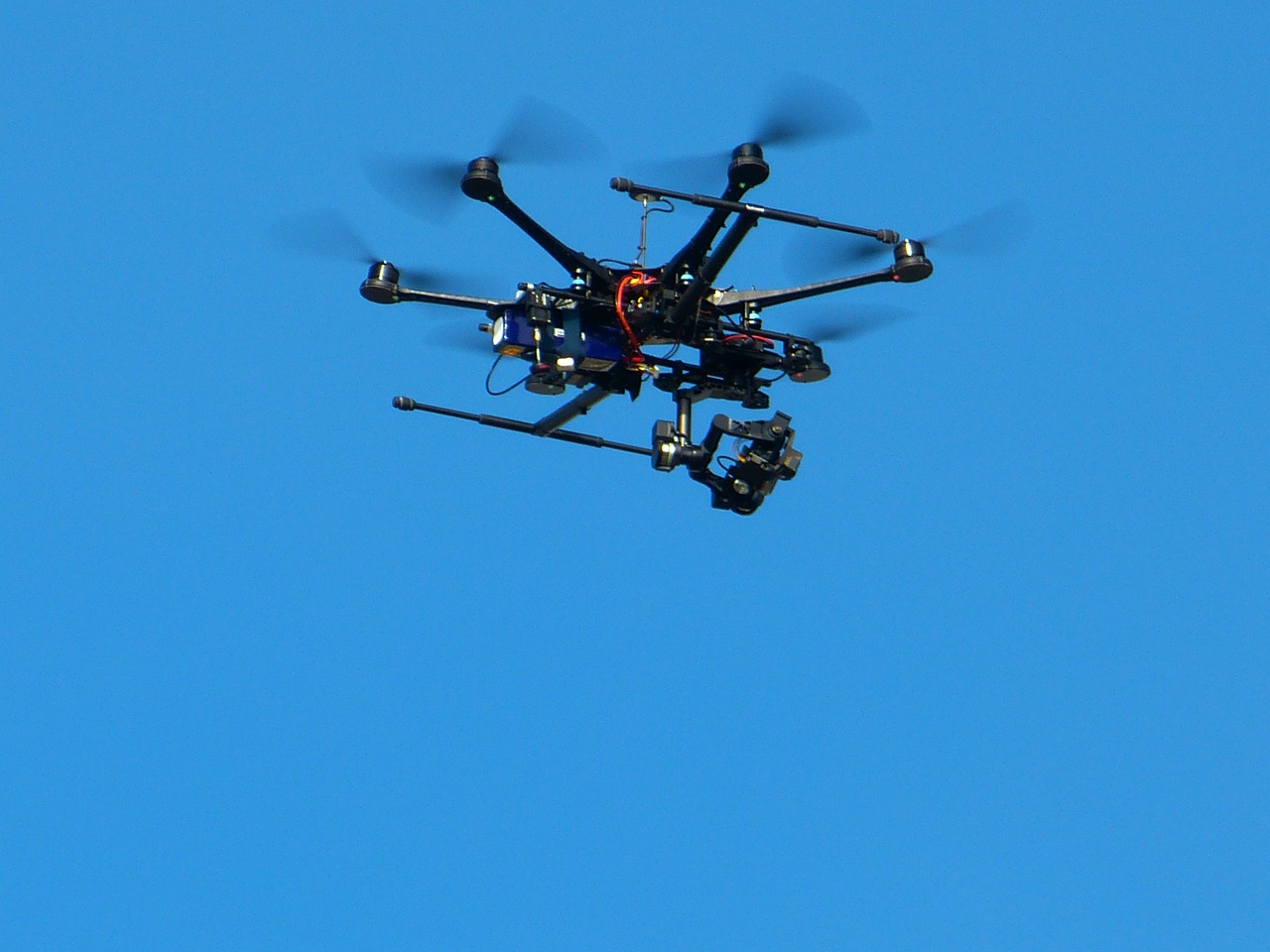
The Federal Aviation Administration on Sunday proposed rules allowing commercial use of drones, opening the skies to business activities that supporters say would create thousands of jobs and generate billions of dollars in economic impact.
The Federal Aviation Administration on Sunday proposed rules allowing commercial use of drones, opening the skies to business activities that supporters say would create thousands of jobs and generate billions of dollars in economic impact.
The rules are the first step in integrating small unmanned aircraft into the U.S. airspace. The proposed regulations will go through a lengthy period of comment and review before they can be adopted and take effect.
Check out the FAA release here
The rules would require drone pilots, now designated as “operators,” to seek a license from the FAA, pass a knowledge test every two years and maintain visual line of sight of their aircraft. Moreover, drones must not be flown at night, above 500 feet or within five miles of an airport.
“We have tried to be flexible in writing these rules,” FAA administrator Michael Huerta said in a statement. “We want to maintain today’s outstanding level of aviation safety without placing an undue regulatory burden on an emerging industry.”
Many businesses, from media companies to farms, are eager to use drones. They saw the announcement as an overdue step in the right direction, because the FAA rules would not require drone operators to obtain a pilot’s license or get an airworthiness certification for their vehicles.
But the rules may be a setback for companies like Amazon that hope to use drones for automated delivery. Such deliveries would be prohibited if the FAA requires operators to keep their aircraft within a visual line of sight.
The proposed rules govern unmanned aircraft under 55 pounds, with a potential for less stringent regulation of craft under 4.4 pounds. The new rules would not apply to model aircraft or those flying unmanned aircraft as a hobby.
“Technology is advancing at an unprecedented pace, and this milestone allows federal regulations and the use of our national airspace to evolve to safely accommodate innovation,” Transportation Secretary Anthony Foxx said in a statement.
The FAA authorized the first use of an unmanned aircraft in the U.S. in 1990, and the 2012 FAA Modernization and Reform Act passed by Congress mandated that the FAA commercially integrate small unmanned aircraft into the national airspace by this September.
With safety of the national airspace as the top priority, the FAA opened six test sites across the country to conduct research on unmanned aircraft systems. One research center is at Virginia Tech in Blacksburg.
Tech is focusing on highway safety, power line and cellular tower inspection, agriculture, air quality monitoring and “fail safe” technologies like the return-to-home function found in some unmanned aircraft systems that consumers can buy online or in hobby stores.
Beyond technological hurdles, the FAA faces a more fundamental difficulty in the specific language of safe flight, according to Chief Mark Carmel of the Aviation Integration Office of the U.S. Department of Homeland Security.
Specifically, Carmel refers to “well clear” – the stipulation that unmanned aircraft stay out of the way of manned aircraft and all other devices operating in the national airspace. Government records obtained by The Wall Street Journal revealed that near-collisions between commercial aircraft and unmanned aerial vehicles are on the rise across the country, especially in areas like New York City that already face congested airspace.
“There isn’t a clear definition of what ‘well clear’ means, so that is something I think the FAA will be coming to terms with soon,” Carmel said. “That will be a key negotiation between regulators and the industry because it will define what sensors need to be present on the aircraft to meet basic standards of safety.”
In order to stay “well clear,” unmanned aircraft employ a traffic collision avoidance system, or sense and avoid. Onboard all commercial aircraft is a transponder that transmits a steady code to air around it so other aircraft can pick it up – a feature called squawking. Sense-and-avoid systems use transponder signals to tell not only where other aircraft are located but also what their trajectory is so that collisions can be avoided.
Carmel said an important technology for the future is to expand sense-and-avoid systems to detect and avoid. A detect-and-avoid system interacts with transponders in the same way as sense and avoid, but it uses an onboard radar to look for other aircraft such as crop dusters that may not have a transponder.
Most aircraft radars today are forward facing and sweep around a 60-degree arc in front of the aircraft. Debate still exists as to whether that arc is wide enough for an unmanned system or if it needs to be larger. These details will be a part of the ongoing negotiations between manufacturers and policymakers moving forward.
“The FAA is looking to industry for answers, and they will know it when they see it,” Carmel said. “The Department of Homeland Security is committed to cooperating with the FAA in this effort.”
The FAA intended to release the proposed rules later this month but was forced to do so earlier after a document about the regulations was accidentally uploaded to a federal website on Friday.
The Association for Unmanned Vehicle Systems International, a trade organization, says that during the first three years of commercial use, drones could generate up to 70,000 jobs and $13.6 billion in economic activity.