
Editor’s Note: We’re sharing this essay from community content partner Jon Baliles of RVA 5×5. If you enjoy his work and want more in-depth coverage of Richmond politics and history, consider subscribing to RVA 5×5 on Substack. The views expressed are those of the author.
As the 250th Independence Day weekend winds down, we take a peek back at what Richmond looked like 100 years ago at the sesquicentennial of the Declaration of Independence in 1926. We apologize for getting a little behind schedule because there was/is so much to include and we’ll continue this series in the days ahead.
The first thing to remember about Richmond back in 1926 is that the boundaries were much smaller than it is today. The city had been growing in the early 20th century, mainly by annexing land from Henrico County bit by bit. Ironically, in 1926, the Henrico County courthouse and government offices were located in Shockoe Bottom at 22nd & Main Streets (and remained there until 1974.) The Romanesque style building was built in 1896 and replaced the previous courthouse that had served the county since 1752.
Richmond added four square miles in 1906 that included Oakwood, Fulton, Randolph, Hollywood Cemetery and what is now Byrd Park and the Museum District. Following the annexation of the city of Manchester in 1910, the city added another 12 square miles including Woodland Heights, Maymont, Scotts Addition, Ginter Park, Barton Hills, and Highland Park in 1914.
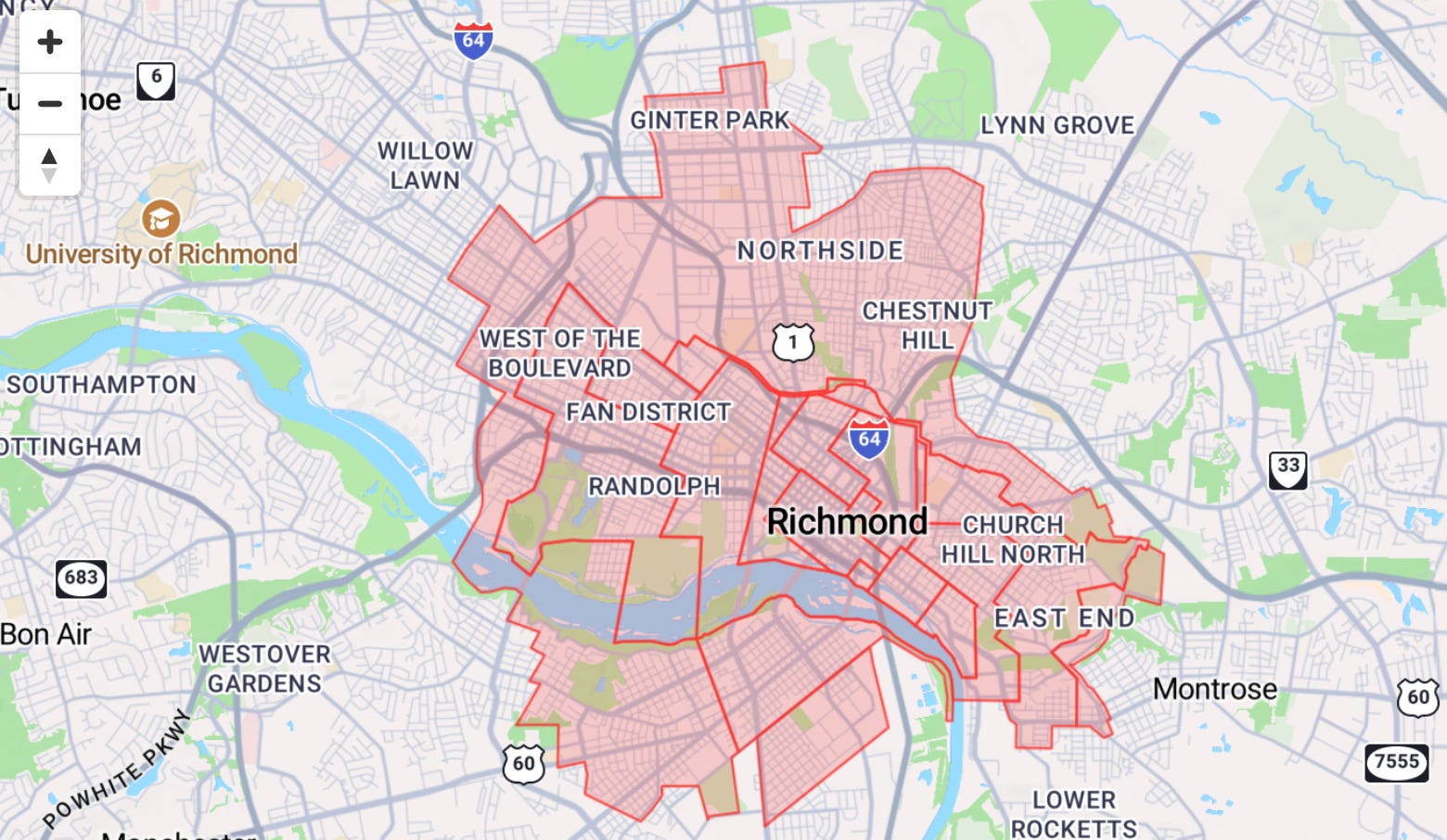
Richmond after 1914 annexation. Source: The Richmonder
The population (based on guesstimates looking at the numbers from the 1920 and 1930 Census) of Richmond was about 178,000 by 1926. Henrico had about 24,000 residents and Chesterfield had about 31,000 residents. Henrico had a population of just over 30,000 in 1900 but the loss of land to the city affected the population count. $100 in 1926 would be the equivalent of about $1,893 today. Only about 4% of workers earned enough to file a federal income tax return.
Perhaps one of the biggest (and lasting) moments in Richmond from 1926 occurred on the first day of January when Maymont opened as a public park. Richmond’s Gilded Age jewel was gifted to the city by the Dooley’s on the condition it remain a public park and open to all, and to this day remains a free city park and is one of the most visited spots in the city for locals and tourists alike, and for good reason. The 100 acres of green space, gardens, wildlife, and history are a marvel to young and old alike and serve as a respite for recreation, education, meditation, jubilation, and celebration. It remains a truly tremendous gift to have such a large, historical green space within our city.
In 1926, successful Richmond businessman T.C. Williams Jr., with his wife Elizabeth shipped the 400 year old Tudor Estate known as Agecroft Hall from England to Richmond and began reconstructing it in the newly created Windsor Farms neighborhood (then in Henrico County). They moved in the following year and it was officially completed in 1928.
The “Roaring Twenties” in Richmond also included the founding of the Junior League of Richmond in 1926 as well as other volunteer and non-profit organizations. Construction began on the Carillon World War I Memorial that would be finished in 1932. The city had one of the nation’s best streetcar networks and a growing number of automobiles were being added to the streets and railroads and rail yards were ever present across the city. The city’s first radio station (WRVA) had just launched a few months earlier in late 1925 and people were still talking about the Church Hill Tunnel collapse that occurred in October 1925.
The mass production of cigarettes and tobacco had driven the local economy since the late 1800’s, and in 1926 The Reynolds Metals Company began production of aluminum foil for cigarette packaging in Richmond and later moved its headquarters here in 1938 and produced an array of aluminum products. Jackson Ward was thriving in 1926 and known as the “Harlem of the South” and “Black Wall Street” with its concentration of black-owned businesses, banks, fraternal orders, social institutions, and entertainment venues. Construction also began on The Mosque in 1926 and that was the start of several major entertainment venues in the city (construction started the following year on the Byrd Theatre and Lowe’s Theater, aka, The Carpenter Theater).
In the Richmond Times-Dispatch in early 1926, a visiting Harvard professor, Dr. William Z. Ripley noted that he considered Richmond rather than Atlanta as the real metropolis of the South. The city had pulled itself out of the depression caused by Reconstruction and thanks to commerce, particularly the expansion of its tobacco industry, the city was having unparalleled prosperity.
The Mosque (now The Altria Theater) was a marvel for its time. It was built by the ACCA Temple Shriners as a fraternal gathering place and entertainment venue and not a place of worship. It got its name from the design in a lavish Moorish Revival style with twin,minarets, imported ornamental tiles from Spain, Italy, and Tunis, more than 75,000 square feet of gold leaf in the the dome. It included a 4,600-seat theater, four lounges, six lobbies, 18 dressing rooms, 42 hotel rooms, offices, a restaurant, a gymnasium, locker rooms, a swimming pool, and a three-lane bowling alley. The Shriners lost The Mosque during the Great Depression to foreclosure and the city purchased it in 1940.
In June 1926, the Arents Free Library located in Oregon Hill was bequeathed to the city with an endowment of $100,000. It had been founded in 1899 by Grace Arents, niece of local tycoon Lewis Ginter, with the stipulation that it be used as a branch library and led to the establishment of the first branch in the Richmond Public Library system. According to the RVA Libraries web site:
The library established the Schools Division of the juvenile department, and began the practice of deposit book stations, usually in public school libraries at a distance from the public library. The stations would then be open to adults in those school neighborhoods to check out books. This practice grew into deposit collections of about 25 books each in school classrooms. Staff from the Schools Division visited schools three or four times a year to shift the classroom deposit collections. Starting with four schools in its first year of operation, it served 40 schools at its peak.
The library also began the work of supplying public hospitals with books. The hospitals librarian visited each of these hospitals weekly, taking books to patients and making notes of their requests for books to bring on her next visit.
Schools made news in 1926 across the growing region and the Rosenwold program had a hand in two in particular. In Henrico, Fair Oaks Elementary School was founded as a four-room schoolhouse constructed for black children through the Rosenwald program. According to the Virginia Museum of History and Culture, “The Rosenwald Program was a rural school building program that helped educate black children during a time of deep racial inequalities in public schools. Seed money was provided to help build the schools, while local governments and black communities, despite facing significant hardships, came together to contribute money, land, building materials and labor to provide educational opportunities for their children.”
The Henrico County Historical Society website notes the original four-room schoolhouse was replaced with today’s brick building, in 1951 and full racial integration occurred in the fall of 1970. In March 2026, the Virginia House of Delegates honored the school with a resolution (HR465) commending Fair Oaks Elementary School and its service to the community.
In Chesterfield, Midlothian Elementary School was built in 1925-26 with Rosenwold program funds to replace the original school opened for black children in 1866 by the First African Baptist Church of Coalfield near the village of Midlothian. The school was replaced in 1948 with a brick structure that remained open until 1969 when Chesterfield County desegregated its schools.
The Richmond Normal School opened on Patterson Avenue in 1926 as a combination teacher training school and elementary school. According to the Museum District Association website, the school became “famous, and visitors came from as far away as China and India to learn about the operation. In the early 1930s, state colleges begin educating teachers, and in 1933, the school becomes Albert H. Hill Elementary School, eliminating student teaching. In 1934, it becomes a combined elementary-junior high, and since 1956 operates as a public middle school for the City of Richmond.”
Also in 1926, Virginia was one of the first states to launch Historical Highway Marker Program to commemorate traditional sites, prominent figures, and events across the Commonwealth. According to Encyclopedia Virginia, it originally focused on military events, colonial home sites, and prominent Virginians from early America, but today has expanded to include authors and musicians, architecture, transportation, and industry, and significant people, places, and events from all segments of Virginia history and society. There are more than 2,000 markers today (and 20-40 new ones per year) chosen through an application process with the Department of Historic Resources. You can search the state’s marker database here.
In 1926, Prohibition was in full swing in Richmond but had taken effect in Virginia in 1914, well before the passage of the 18th Amendment in 1919. A 2024 article by Em Holter in the Times-Dispatch looked back through the archives of stories and found that Richmond was at the forefront of the temperance movement.
“In the crowded Lyric Theater along Richmond’s Broad Street, temperance leader Mary Harris Armor, known to most as the “Georgia Cyclone” and to some as the “modern Joan of Arc,” gave an impassioned speech to a crowd of Richmonders about the evils of alcohol. Her spirited declarations and the cheers in agreement bubbled over into the street as a rallying call for change.
Armor’s presence in the former capital of the Confederacy was a feat of its own. Decades prior, when New York temperance leader Frances Willard arrived in Richmond on her 50-day speaking tour of the country, no church in the city would have her.
For most, temperance was synonymous with the abolitionist movement. After the state’s ratification of prohibition, those few in opposition often came from Richmonders who likened it to Gen. William Tecumseh Sherman’s sweeping destruction of Southern cities.”
Looking back after the repeal of prohibition in 1933, Times-Dispatch columnist Alan Burton Clarke wrote: “Virginia’s uniqueness lies in the administration of her own prohibition laws, in the circumstances under which they were adopted and in the great change of sentiment which swept them away. If ever any American Commonwealth saw prohibition at its best, Virginia was that state.”
Politically, 1926 began with the inauguration of Harry Byrd as Governor and what would become the Byrd Machine, which would control state politics for the next 40 years. One of the laws passed in the 1926 General Assembly was the “Separation of Races” law (aka the Public Assemblages Act) which required “the separation of white and colored persons at public halls, theaters, opera houses, motion picture shows and places of public entertainment and public assemblages.” Governor Byrd privately said the legislation was “extremely regrettable” but he did not publicly oppose it. The bill was opposed by the Norfolk Virginian-Pilot as well as the Richmond News Leader and the Richmond Chamber of Commerce. Gov. Byrd did not sign the bill but it became law (per the state constitution) and was the second of three so-called racial integrity laws passed by the legislature between 1924 and 1930.
Richmond had the O.G. “strong mayor” form of government at the time and was housed in what is now Old City Hall, a spectacular 1894 High Victorian Gothic architectural masterpiece at 10th & Broad Streets. You know it was a Richmond government building because a plan that was rejected as being too expensive to build in 1885 was then selected a few years later and the total cost overrun to build it was 400%. The building is now part of the General Assembly complex and was almost razed in the 1970’s to become a parking garage before being saved by the state and the Historic Richmond Foundation.
In 1924 the city elected John Fulmer Bright as mayor, a post he would serve in for 16 years. Bright beat out sitting mayor George Ainslie, who spent his three full terms as mayor using city funds to pave streets, install lights, enhance distribution for water, sewer and gas, advocated for parks, playgrounds and a public library, built new schools and hired additional firefighters and police officers. Labor leaders who somehow thought Ainslie didn’t do enough for the working class despite his focus on city services, supported Bright in 1924 under the guise that he would do more.
In his article entitled “Richmond’s Most Obstinate Man,” Harry Kollatz noted: “Bright oversaw few improvements to anything anywhere. Exceptions included the Robert E. Lee Bridge and the Carillon. Bright eschewed city planning. He preferred the guidance of businesses and developers to grow the city. Newspapers that once endorsed him turned critical, though he was elected four times, apparently a beneficiary of weaker opponents and voter tendency to support the status quo.”
Amazing how things change so much after 100 years, isn’t it? But I digress. Many say Bright’s long and unaccomplished tenure as Mayor led to the overhaul of city government and city charter change in 1948 to the council-city manager form of government and reduced city council form a two chamber 32 member body to nine members.
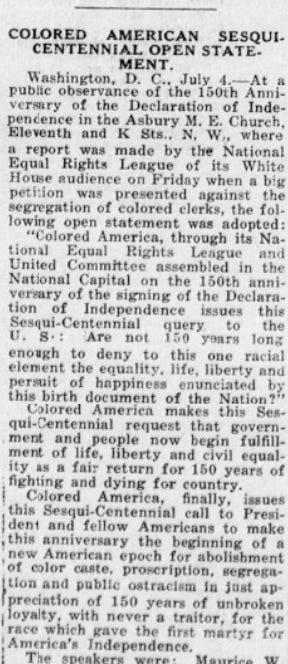
The Richmond Planet, the newspaper published by businessman, civil rights advocate and politician John Mitchell, had a different perspective on celebrating July 4th. In their July 10th edition, the Planet published an statement issued by the National Equal Rights League after their conference with President Coolidge at the White House. They protested the federal government’s segregationist employment policies put in place by President Woodrow Wilson a decade earlier. The NERL adopted the following statement which appeared in The Planet and other papers across the country:
Washington, D.C., July 4 — In a public observance of the 150th anniversary of the Declaration of Independence, in the Asbury M.E. Church…where a report was made by the National Equal Rights League of its White House audience on Friday when a big petition was presented against the segregation of colored clerks, the following open statement was adopted:
“Colored America through its National Equal Rights League and United Committee assembled in the National Capitol on 150th anniversary of the signing of the Declaration of Independence issues this Sesquicentennial query to the U.S.: “Are not 150 years long enough to deny to this one racial element the equality, life, liberty, and pursuit of happiness enunciated by the birth document of the nation?”
Colored America makes this Sesquecentennial request that government and people now begin fulfillment of life, liberty, and civil equality as a fair return for 150 years of fighting and dying for country. Colored America finally issues this sequencecentennial call to President and fellow Americans to make this anniversary, the beginning of a new American epoch for abolishment of color caste, proscription, segregation, and public ostracism in just appreciation of 150 years of unbroken loyalty, with never a traitor, for the race which gave the first martyr for America’s independence.”
We will look back at July 4th in Richmond in the 1876 and 1826 in the days ahead.
If you enjoy his work and want more in-depth coverage of Richmond politics and history, consider subscribing to RVA 5×5 on Substack
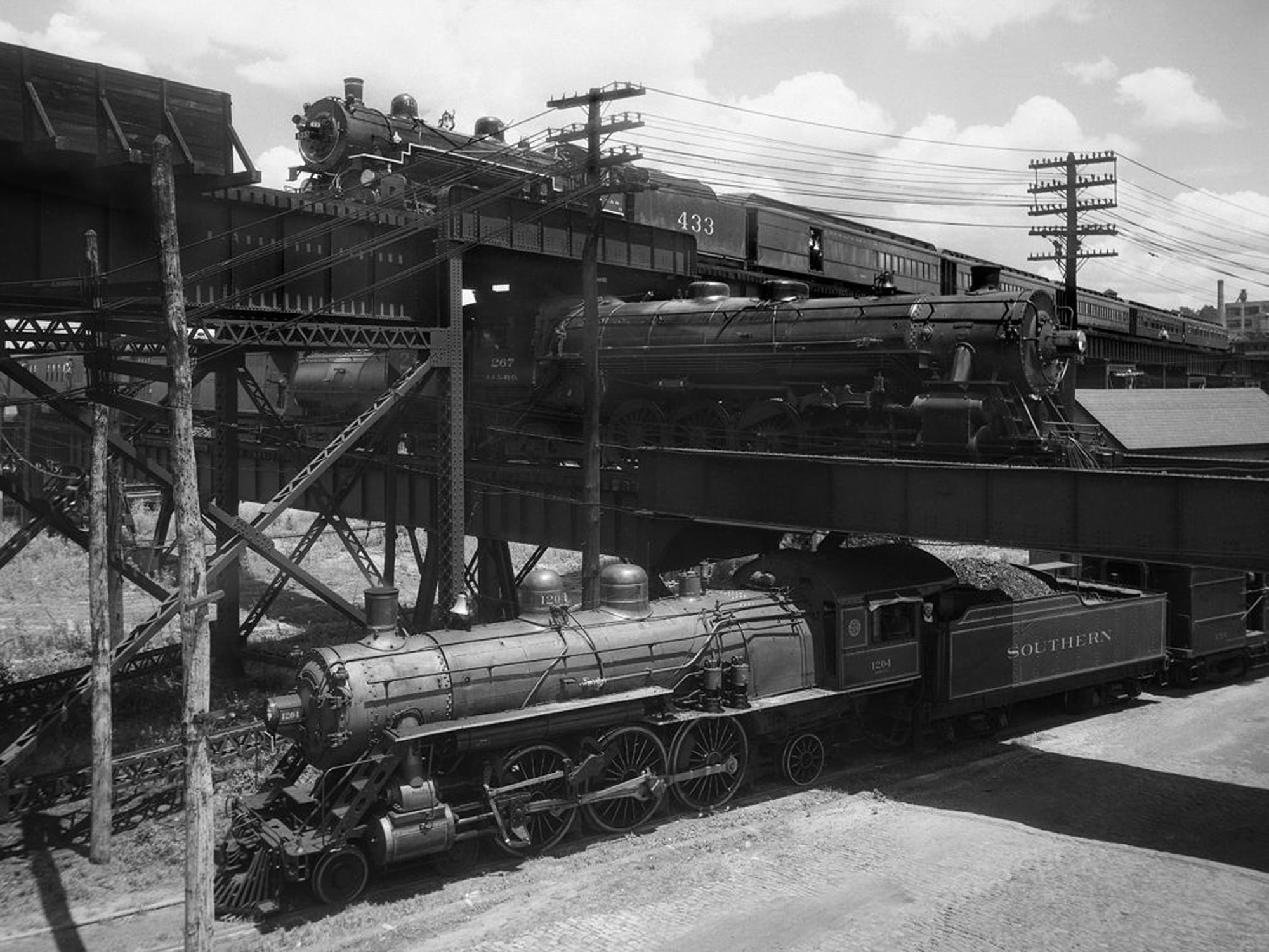
Main image: Richmond’s Triple Crossing in Shockoe Bottom, 1926. Photograph by Dementi Studio. Used under license. © Dementi Studio
Support RVA Magazine. Support Independent Media in Richmond.
At a time when media ownership is increasingly concentrated among corporations and the wealthy, RVA Magazine has remained one of Richmond’s few independent voices. Since 2005, the magazine has provided grassroots coverage of the city’s artists, musicians, and communities, documenting the culture that defines Richmond beyond the headlines.
But we can’t do this without you. A small donation, even as little as $2, one-time or recurring, helps us continue to produce honest, local coverage free from outside interference. Every dollar makes a difference. Your support keeps us going and keeps RVA’s creative spirit alive. Thank you for standing with independent media. DONATE HERE.
Subscribe to the RVA Mag Weekly Newsletter HERE
We’ve got merch HERE
Subscribe to the Substack HERE
And Reddit HERE
And YouTube HERE