
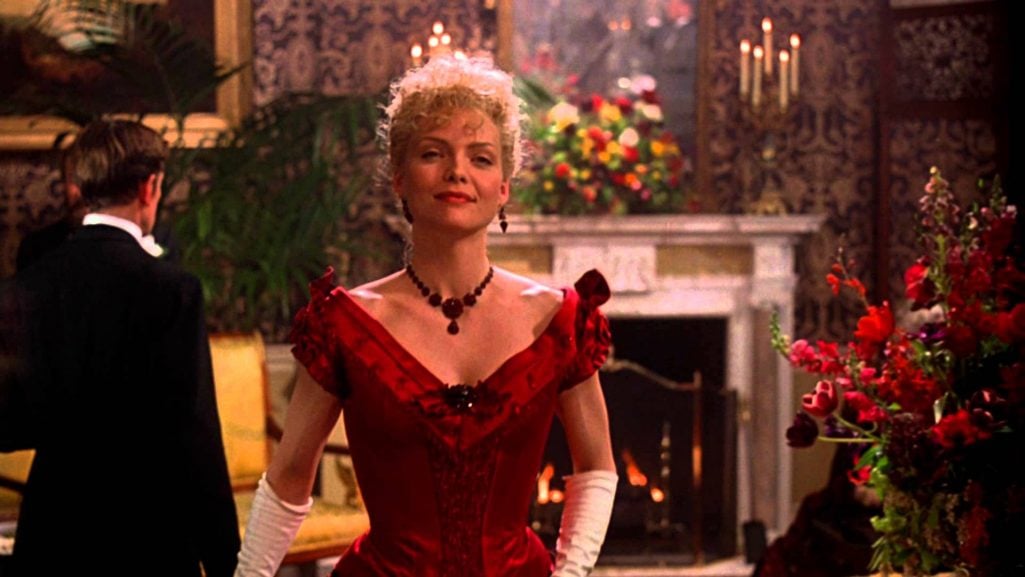
Martin Scorsese once described his own adaptation of Edith Wharton’s classic 1920 novel, “The Age of Innocence” as the “…most violent film I’ve ever made”, and it is hard to counter this claim given the emotional stakes and the explored world around that.
While this is still a tall declaration for anybody who is familiar with his previous work, such as “Raging Bull”, “Taxi-Driver”, or “Goodfellas” just to name a few, but perhaps appropriate enough given the devastating sentiment on display and the harsh realities that are upheld within. The same reoccurring themes that Scorsese often explores resurface in this nostalgic exploration of class, milieu, societal codes, sacrifice, and rituals in the bourgeois of 1870’s New York upper elite. These undercurrents are also by in large not only how the film defines itself but also how this supposed violence is played out in proper ritual and strict codes of conduct. So while violence is in the eye of the beholder in this sense, it is all the more impressive given not one ounce of blood is shed or one single death occurs onscreen.
Wharton’s story is a rather simple one told in a world of delicate circumstance. Our protagonist, Newland Archer (Daniel Day-Lewis), is engaged to May Welland (Winona Ryder), the ingénue, blank slate of a girl that his New York society wants him to marry. Problems do arise when Archer reconnects with her worldly cousin, Countess Ellen Olenska (Michelle Pfeiffer), whom he previously had feelings for long ago and attempts to circumvent those repressed feelings by doubling down and accelerating his engagement.
This reconciliation is of the time of scandal for Ellen (and thus May’s family), who is on the brink of leaving her missing and abusive husband for his infidelity and gallivanting ways, and thus ripe for gossip and social petulance along with it. May and Newland’s marriage would provide a more than helpful distraction but Newland cannot quite shake his attraction to Ellen as he openly supports her divorce by becoming her legal representation and advisor. Things become tricky as Ellen slowly becomes irresistible to Newland and the feelings are quite mutual but still repressed. Newland dreads his upcoming nuptials and longs to break free of them and run off with Ellen, seemingly his one absolute true love.
“The Age of Innocence” is a partially ironic title in that the characters constantly feign naiveté to pursue their ultimate goals and ulterior motives. They consistently simulate innocence to try to get what they want, and to covet their actual desires. Each character seemingly knows of the other’s intentions despite their best efforts to come off as innocent and thus pure.
The casting is supremely strong and dynamic in their performances. Lewis and Pfeiffer, in particular, are perfect in their ability to subtly create tension and repressed romantic infatuation. In the heart of the story is Ryder’s May, a deceptively calculating young woman who sees more than she puts on. She is too a robust supporting character in that has many shades of cunning despite her seemingly innocent nature.
Scorsese’s “The Age of Innocence” is usually relegated as a tasteful, yet conventional costume drama, much in the same vein as Merchant Ivory films, Jane Austin adaptations, or your run-of-the-mill BBC dramas. In reality, it is one of the more faithful and stimulating adaptations through the vigorous cinema language it employs while still retaining a healthy unwavering devotion to the source material. Scorsese walks a tightrope of never striking out into outlandish flights of fancy while still keeping a progressive sense of style in his crafting of visuals. Often focusing on key objects, paintings, colors, food, he uses profuse camera movements to display and coat the story through his visual spectacle. The film is also narrated by an ominous voice (Joanne Woodward) that surrogates Wharton’s own luminous prose and dissection of the opulence at hand, with every gaudy and lavish scenes of dinners, garden parties, dances, and snowy old New York that are carefully built and bursting with color permeating the screen and actual fantasy.
“The Age of Innocence” is often overlooked in the Scorsese realm and it’s a shame considering how well it holds up and is such a faithful representation and creative expression of high society at a cost. There is plenty to consume in the over two-hour running time within the well-built world that rewards multiple viewings. The film shows a wide array of influence from Kubrick (“Barry Lyndon”) to Visconti (“The Leopard”) and crafts a boisterous mise-en-scène in a film largely about restraint and masked intention.
“The Age of Innocence” comes to the Criterion Collection for the first time in a new, director-approved, 4K digital transfer with a 5.1 surround DTS-HD master audio soundtrack. Scorsese is perhaps the greatest director living today and is no stranger when it comes to the Criterion, as he’s released two box sets of his World Cinema Project and his controversial but revered “The Last Temptation of Christ”.
The supplemental material includes a new interview with Scorsese conducted by the Criterion Collection along with co-screenwriter Jay Cocks, production designer Dante Ferretti, and costume designer Gabriella Pescucci. The interviews are well done and enlightening but one still longs for a Scorsese commentary as the man can rattle off influences left and right. Also included is “Innocence and Experience”, a 1993 documentary on the making of the film, the film’s trailer, and an essay by film critic Geoffrey O’Brien.
For fans of Scorsese or romance period-pieces, this is a must-have release and a fine transfer that brings out the vibrant, almost jubilation of indulgence. It is a very complex film in terms of how the story is told and how information is delivered through positing indirect dialogue, and social discourse that goes beyond a simple love story. Its tragedy is under-stated but fully felt, examined, and masterfully explored.
The Age of Innocence
Martin Scorsese
United States
Spine #913
Available on Blu-Ray & DVD