
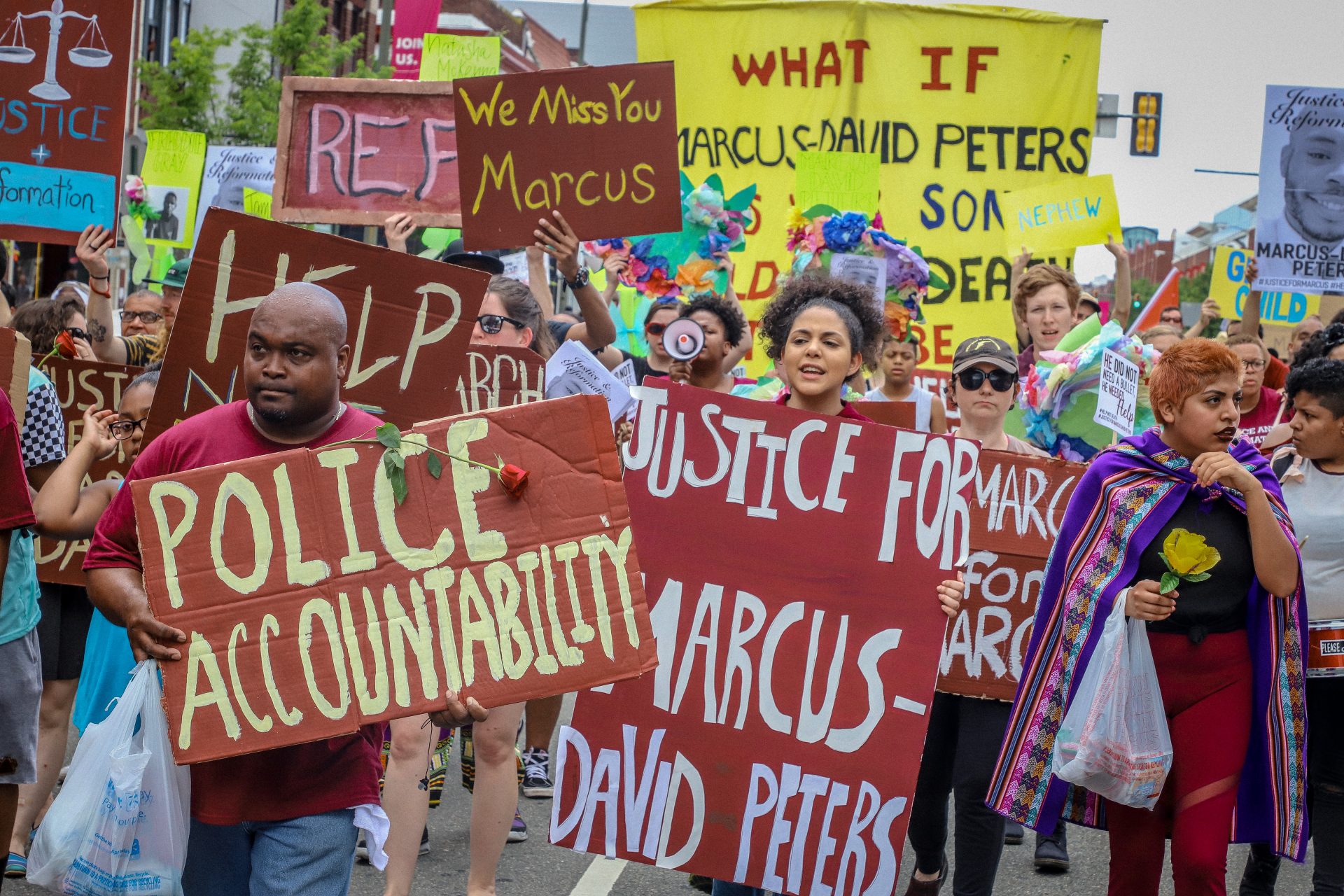
In the wake of the shooting of Marcus-David Peters, who was shot and killed by a Richmond Police Officer on I-95 after appearing unstable, demands from community organizers and local citizens have introduced the notion of using restorative justice within law enforcement reformation.
These demands have forced RPD (Richmond Police Department) and Richmonders alike to ask what type of reformation do we need, and how would restorative justice help ease complicated situations between law enforcement, victims, and even criminals. Princess Blanding, Peters’ sister, said she is calling for reformation within the Richmond Police Department after the death of her brother.
“The Richmond Police Department needs to take accountability and ownership in regards to what happens and acknowledge that things went wrong, so we can move forward in preventing this from happening again,” Blanding said.

Protest for Justice for Marcus-David Peters
Blanding and other activists hosted a community meeting at Second Baptist Church on June 30 to discuss these reformations. They had publicly and personally invited Chief Alfred Durham and Mayor Levar Stoney to the meeting, but neither appeared.
Blanding said Stoney contacted the family on the day of the meeting to say he would not be able to attend, but is keeping the Peters family in his thoughts and prayers. Stoney’s press office said in an email that the mayor would consider engaging with the family at the appropriate time, but he is not able to talk about the investigation until it is completed.
Blanding said she received no response from Durham; however, Durham said he would hold a community meeting about the investigation, once the case is handed over to the Commonwealth Attorney. Blanding said the invitation requested both Durham and Stoney to attend the meeting in order to listen to community concerns, but were never asked to speak.
Daniel Foxvog, executive director of The Virginia Center for Restorative Justice (VCRJ), said it is critical that the victims’ needs are recognized in any instance of harm.
Restorative justice is a term that has appeared more often in Richmond, but is a relatively unknown practice within the criminal justice system. Since its creation in the 1970’s, the field has been an alternative approach to the court system, but has only recently been pushed into the widespread narrative of criminal reform. VCRJ has worked to provide this alternative approach for juveniles, especially.
Judy Clarke, founder and immediate past executive director of the Virginia Center for Restorative Justice, said the center focuses on training volunteers to become restorative justice facilitators. The volunteers work to receive statewide security clearance through the Virginia Department of Corrections and Virginia Department of Juvenile Justice.
The center also organizes ‘circle processes’ and restorative justice conferences. The ‘circles’ and conferences are where the major rehabilitation happens–they are conversations between offenders, victims and their communities about the impact the offender’s crime had on all parties involved.
Foxvog said there are two key principles to understanding the most effective form of restorative justice: addressing harm and the need and obligations following that harm. Foxvog said that crime, and other types of violence, creates harm that victims and offenders should be discussing to address the harm’s impact.
“When someone is burglarized or hurt there are needs that result in that, needs of the victim, the direct victim, the person who has lost property or suffered physical damage,” Foxvog said. “There’s also the needs for the community, for safety, for well-being, for trust, for being able to have senses of wholeness.”

Chief Durham
The offender has needs as well, Foxvog said, that could have contributed to the crime committed. Restorative justice works with each party to reconcile conflict and built a new sense of healing, trust, and penitence. The ideal outcome of restorative justice is that the offender never commits crime again.
Clarke said the center is in four Virginia State Prisons: three female adult prisons and one male prison. The center also has a diversion program for juvenile offenders, which helps juvenile offenders create solutions for their actions rather than go to jail by offering counseling resources.
VCRJ connects with cases on a referral basis. Referrals usually come from an intake or probation officer, either before or after a decision has been made in court. The center first sends a letter to the victim and the offender, then meets with victims who respond to the letter and listen to their needs and priorities. Next, they meet with the offender to gather their version of events, what led them to commit the crime, and the impact the crime had on them. Oftentimes, the offender has already admitted guilt. One of the last steps is to join both parties.
While the center has been recognized in juvenile courts, they are not recognized in civil or district courts, meaning alternatives to jail provided for juveniles through the center are not currently available to adults. Clarke has requested that Foxvog, who became executive director on July 1, pursue getting recognized in those courts with Mike Herring, Richmond Commonwealth’s Attorney. They hope that in future, methods like restorative justice can be used to remedy some of the pain and confusion both for offenders and victims, like those in the Marcus-David Peters case.
“I would also say that for police departments and law enforcement agencies being able to have a relationship of trust with the communities is very critical,” Foxvog said. “It’s critical for them to be able to function and it’s critical for the communities themselves to be able to trust the police departments, and officers, and for everyone to be able to be treated with respect.”
Foxvog and Clarke rely on volunteers to make the center work. The center offers training and opportunities for volunteers to participate in conferences and jail programs in individual areas.