

She decided to finally leave.
Maybe it was after years of abuse, or after one violent night too many. Maybe it was the first time she truly believed that if she stayed, she might not survive. Whatever brought her to that moment, making the call took courage.
On the other end of the hotline is someone trained to listen, help create a safety plan, and find shelter. They want to help, but there isn’t a shelter bed available, the counseling program has a waiting list, and the organization has reached its limits.
What happens now?
For some survivors, advocates say, there is nowhere else to go. They return to the person they were trying to escape, not because they want to, but because the safety net they were counting on isn’t there.
It’s a reality Mary Maupai, executive director of Safe Harbor, says her staff confronts every day in the Richmond region. “Our shelters are full,” Maupai said. Safe Harbor operates two emergency shelters and two transitional homes, two serving survivors of domestic and sexual violence and two dedicated to survivors of human trafficking. All four are at capacity.
When someone calls the hotline needing emergency shelter, Safe Harbor first tries to place them in a local hotel while waiting for space to open but that’s only a temporary solution. “We can’t put people up in a hotel forever and ever,” Maupai said. “We assist them as long as we can, but if there’s no room in the shelter, it’s kind of like there’s no room in the inn.”
The strain doesn’t end there. Safe Harbor’s counseling program currently has a waiting list of between 75 and 100 people, and Maupai said the organization needs at least two additional counselors but doesn’t have the funding to hire them.
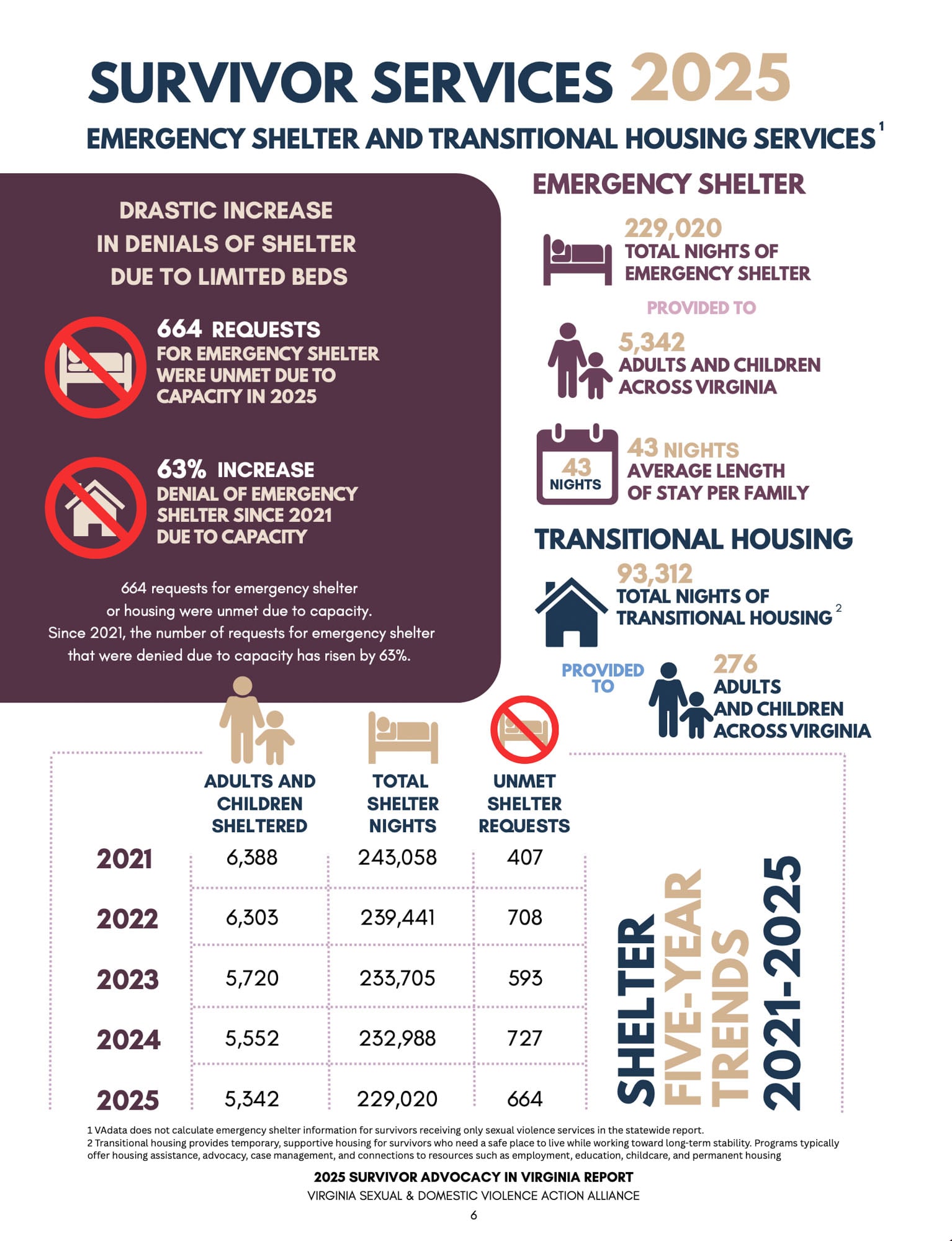
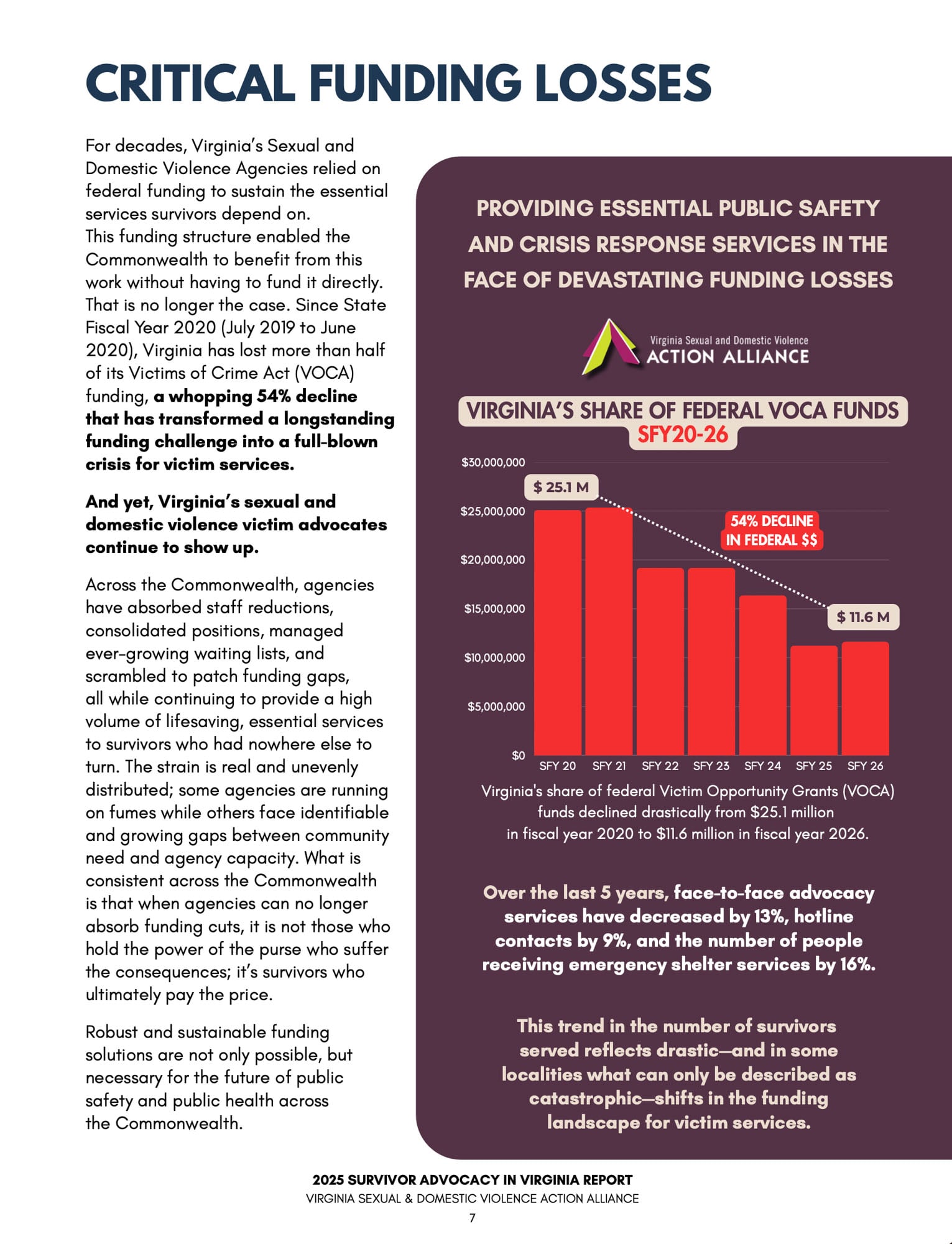
A new report from the Virginia Sexual & Domestic Violence Action Alliance, a statewide nonprofit that supports Virginia’s network of victim service agencies, suggests Safe Harbor’s experience is part of a much broader trend. Since 2020, federal funding for victim services has fallen by more than half, while organizations across Virginia continue to face staffing shortages, full shelters, and growing demand for services. The report found fewer survivors are being served today than five years ago, not because fewer people need help, advocates say, but because many organizations have reached the limits of what they can provide.
Read the report HERE
Impossible Decisions
For Maupai, the funding crisis isn’t measured in budgets. It’s measured in impossible decisions.
She said the consequences extend far beyond waiting lists and staffing shortages. “If they don’t have shelter and they want to leave, they oftentimes will have to go back to their abuser,” Maupai said. “It means people who are looking to heal and move on and hopefully thrive at some point in their life… their recovery, their journey of healing, is being delayed or stunted.”
The pressure has been building for years. Maupai said Safe Harbor has lost roughly $200,000 a year in government funding over the past five years. The organization hasn’t been able to hire the counselors it needs, while its hotel budget has repeatedly gone over budget because so many survivors require emergency housing when the shelters are full.
Even so, the organization continues trying to fill critical positions when funding allows. A day before this story was published, Safe Harbor posted an opening for a full-time human trafficking case manager.
Those realities weigh heavily on the people answering the hotline. “The direct service people, their whole heart, their whole mission is to help people. That’s what drives them,” she said. “When they see a waiting list of 50 people, or they constantly have to turn down people for shelter or for services, it eats at their soul.”
As executive director, she said she feels that weight as well. “It’s really hard,” Maupai said. “I’m supposed to tell them, ‘I need you to do more,’ while also telling them to take care of themselves and make sure they don’t burn out.”
Jonathan Yglesias, director of mission advancement for the Virginia Sexual & Domestic Violence Action Alliance, said the statewide numbers can be misleading if viewed without context.
Demand for services has remained consistently high since the pandemic and, in some cases, continues to grow, he said. What has changed is the capacity of organizations to respond. As staffing has declined, fewer advocates are available to answer calls, provide counseling and accompany survivors through the legal system.
At the same time, he said, advocates are spending significantly more time with each survivor because the needs have become more complex. “Five or six years ago, your typical sexual assault counselor or domestic violence counselor might have spent five to eight hours per client,” he said. “Now it’s looking more like 10 to 15. In some places, it’s doubled or tripled.”
“Survivors are showing up with more complex needs,” he said. “People are staying in shelter longer. People are needing child advocacy services or sexual assault crisis response. That’s just more complicated, and there are fewer services in the community to meet that need.”
A Public Safety System Out Of Balance
Maupai believes Virginia’s funding priorities have unintentionally left one part of the public safety system behind. Over the past several years, the state has invested heavily in training law enforcement, medical providers and multidisciplinary teams to better identify victims of human trafficking and domestic violence.
“The awareness and identification of victims has been fabulous,” she said. “The problem is that there has been less direct funding for direct services.”
She compares the system to a three-legged stool. “You’ve got three legs to that stool. Two of those legs are very sturdy. The other one is most definitely wobbly, and that’s the direct service piece.”
Yglesias agreed, arguing that public safety depends on both systems being adequately funded. “I think both of them need to be well resourced,” he said. Community-based advocacy organizations provide confidential, voluntary services that don’t require survivors to file a police report or enter the criminal justice system.
“That’s what our agencies do,” Yglesias said. “They’re one of those resources that is completely voluntary and that is confidential and that is free to the public.”
Both advocates described direct services as the bridge between crisis and recovery. Law enforcement may be the first point of contact, but without shelter, counseling and long-term advocacy, survivors can find themselves back in the same dangerous situations that prompted the initial intervention. In that sense, they argue, direct services don’t replace law enforcement. They help prevent repeated crises that require law enforcement to respond again.
“When someone is ready to leave, they’ve taken a huge risk,” Maupai said. “Law enforcement picks up the phone, tries to get services for them, and finds out the shelters are full or there’s a waiting list. They now have to go back and tell that person, ‘I’m sorry, but I can’t help you.'”
For both advocates, the issue isn’t choosing between policing and victim services. It’s recognizing that they depend on one another.
Maupai said Richmond’s location at the intersection of Interstates 95 and 64 has long made the region vulnerable to human trafficking, but she believes many people still misunderstand who is affected. “People think it’s something that happens somewhere else,” she said. “What we have seen in our program since we formalized our work with these individuals in 2016 is it’s happening right here in our own backyard. It’s happening to Americans, and it’s happening to people in our own community.”
She said trafficking isn’t limited to the stereotypes often portrayed in movies or television. “It’s not necessarily the woman who’s walking down Jefferson Davis Highway in stiletto heels and a miniskirt,” Maupai said. “It’s happening to school kids who go to school and then come home to an environment where they are trafficked.”
Maupai said those fears have become more pronounced among some immigrant survivors. She has seen people hesitate to report abuse or seek protective orders because they worry about encounters with immigration authorities, creating yet another barrier to getting help. “This isn’t a red or blue issue,” she said. “This is a human rights issue. Nobody should experience violence or trauma in their interpersonal relationships and within their home.”
At the same time, she said, immigrants are only one part of the story. “We have individuals that have come to our programs who have been human trafficked by their own families,” Maupai said. “They’ve been human trafficked by local churches. They’ve been trafficked by aunts, uncle. It’s more pervasive than people think.”
That’s why, she said, direct services matter so much. Survivors often take enormous risks to leave, trusting that someone will be there to help them. “You have a very finite amount of time to work with that individual and to build that trust,” Maupai said. “Once you build it, and if it gets broken, it is extremely hard to build it again.”
What’s Next?
Looking ahead, Maupai said uncertainty has become almost as difficult as the funding cuts themselves. Safe Harbor continues to build support through individual donors, foundations and corporate partners, but replacing large government grants takes years.
“We’ve been doing a good job,” she said. “The problem is, it takes time.”
Even after the organization’s fiscal year began, she was still waiting to learn whether roughly $400,000 in expected state funding would arrive. Safe Harbor has the reserves to withstand that uncertainty for now, she said. Many smaller organizations in rural communities do not. That means a funding cut hundreds of miles away doesn’t stay there. It shifts survivors toward larger regional organizations already struggling to meet demand.
“When those organizations close down,” she said, “it puts more stress on those of us that are remaining.”
When rural providers disappear, survivors don’t disappear with them. They begin turning to larger regional organizations like Safe Harbor, placing even greater strain on an already overburdened system.
Asked what he would tell Virginia lawmakers before the next budget cycle, Yglesias said he hopes they understand that victim advocates are just as essential to their communities as any other emergency responder. “The people doing this helping work and the people who are these kind of essential crisis responders in their community are just like law enforcement,” he said. “They’re overburdened and underpaid, and required to respond to things that are beyond our control in the community.”
“We are one element of a victim response ecosystem that is strained,” Yglesias said. “If we disappear, then I think there are other dominoes that fall as well.”
As the interview came to a close, Maupai reflected on why these conversations matter.
“I sometimes feel like these issues don’t really hit home until they become personal and show up on our own doorstep,” she said. “When they do, you want to make sure that individual that you love and care for can get the help that they need immediately when they need it.”
If you would like to help or donate to Safe Harbor, more information HERE.
Need Help? Local Resources
If you or someone you know needs help, support is available through organizations across the Richmond region, including:
Safe Harbor
24-Hour Helpline: (Call or Text): (804) 500-2755
YWCA Richmond
24-Hour Helpline: (Call or Text): (804) 612-6126
Latinos in Virginia Empowerment Center
24-Hour Helpline: (Call or Text): (888) 969-1825
Virginia Statewide Sexual & Domestic Violence Hotline
Available 24 hours a day, 365 days a year.
Call: 800-838-8238 (interpretation available in 200+ languages)
Text: 804-793-9999
Chat: Available online through the Virginia Statewide Sexual & Domestic Violence Hotline website.
Main photo by Diego San
Support RVA Magazine. Support Independent Media in Richmond.
At a time when media ownership is increasingly concentrated among corporations and the wealthy, RVA Magazine has remained one of Richmond’s few independent voices. Since 2005, the magazine has provided grassroots coverage of the city’s artists, musicians, and communities, documenting the culture that defines Richmond beyond the headlines.
But we can’t do this without you. A small donation, even as little as $2, one-time or recurring, helps us continue to produce honest, local coverage free from outside interference. Every dollar makes a difference. Your support keeps us going and keeps RVA’s creative spirit alive. Thank you for standing with independent media. SUPPORT HERE.
Subscribe to the RVA Mag Weekly Newsletter HERE
We’ve got merch HERE
Subscribe to the Substack HERE
And Reddit HERE
And YouTube HERE